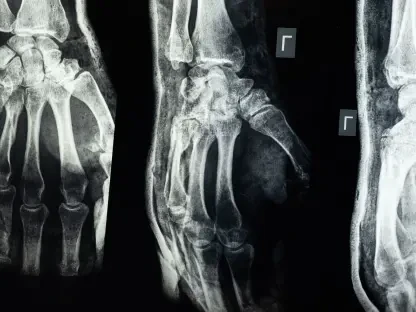

The global medical community currently faces an unprecedented shortage of radiologists, with some regions reporting delays of several weeks for routine chest X-ray interpretations, leading to critical bottlenecks in patient care. Amidst this pressure, DeepSeek AI has emerged as a stabilizing force, providing a level of consistency that mitigates the risks associated with clinician burnout and the inherent subjectivity of human visual assessment. While the human eye is remarkably adept at pattern recognition, it remains susceptible to fatigue-induced errors and cognitive biases, particularly during grueling twelve-hour shifts where subtle findings might be overlooked. DeepSeek addresses these vulnerabilities by offering an objective, high-precision diagnostic layer that integrates directly into the digital infrastructure of modern hospitals. This technology functions as a tireless second set of eyes, ensuring that every radiograph, from a standard pre-employment screening to an emergency department trauma scan, receives the same rigorous and standardized scrutiny without the variance typically associated with human observation.
Advancing Diagnostic Precision and Trust
One of the most persistent hurdles in the adoption of clinical artificial intelligence has been the “black box” phenomenon, where physicians are often reluctant to act on a machine’s verdict without a clear understanding of its underlying logic. DeepSeek addresses this head-on by utilizing sophisticated attention mechanisms that generate heatmaps, effectively highlighting the specific anatomical regions that the AI identifies as suspicious or pathological. This visual explainability transforms the system from a cryptic oracle into a transparent partner, allowing radiologists to confirm the presence of opacities, nodules, or pleural effusions with localized evidence. By bridging the gap between raw data output and clinical reasoning, the platform fosters a collaborative diagnostic environment where the final decision remains in human hands but is bolstered by evidence-based machine insights. This transparency is particularly crucial in high-stakes environments where an incorrect diagnosis could lead to unnecessary invasive procedures or the dangerous omission of treatment for life-threatening conditions.
The sheer robustness of DeepSeek’s diagnostic engine is a direct result of its training on an expansive repository of millions of annotated radiographs sourced from diverse global healthcare networks. This heterogeneous dataset ensures that the neural network is exposed to a wide range of anatomical variations across different ethnicities, ages, and comorbidities, which prevents the algorithmic bias often found in localized AI tools. Consequently, the system is capable of recognizing rare manifestations of respiratory diseases and cardiac anomalies that a single practitioner might only encounter a few times throughout an entire career. This breadth of exposure allows the AI to maintain a high sensitivity for early-stage pathologies, such as small pulmonary nodules or faint interstitial patterns indicative of burgeoning infections. By democratizing this level of expertise, the technology ensures that the standard of care in a community clinic is indistinguishable from that of a top-tier academic medical center, leveling the playing field for patients regardless of their geographic location.
Optimizing Clinical Workflows and Accessibility
Beyond the technicalities of image recognition, DeepSeek is designed to resolve the significant logistical challenges inherent in high-volume medical environments through seamless integration with Electronic Health Records and Picture Archiving and Communication Systems. This architectural alignment allows the AI to automatically flag urgent findings and prioritize them in the radiologist’s reading queue, effectively triaging cases so that life-critical anomalies are reviewed within minutes of image acquisition. Furthermore, by automating the generation of preliminary reports for routine or “normal” scans, the software relieves specialists of the repetitive burden of documenting unremarkable findings. This shift in operational dynamics enables clinicians to dedicate their cognitive resources to more complex and nuanced cases that require deep human intuition, such as multi-system trauma or rare congenital heart defects. The resulting increase in throughput does not merely save time; it fundamentally enhances the quality of care by reducing the average turnaround time for diagnostic results across entire hospital systems.
The potential for this technology to address healthcare disparities is most evident in its ability to be deployed via cloud-based infrastructure to remote and underserved regions where specialist expertise is often non-existent. In many parts of the world, general practitioners are forced to interpret complex chest X-rays without the support of a trained radiologist, a practice that can lead to missed diagnoses of infectious diseases like tuberculosis or pneumonia. DeepSeek provides these clinics with an immediate, expert-level diagnostic resource, acting as a virtual consultant that can be accessed from any location with basic internet connectivity. This global reach is transformative for public health initiatives, particularly in the management of community-acquired infections where early detection is the primary factor in preventing widespread transmission. By providing a scalable and affordable diagnostic tool, the platform empowers local healthcare workers to initiate treatment protocols earlier, thereby improving patient outcomes and significantly reducing the long-term economic burden of untreated chronic illnesses.
Ensuring Technical Robustness and Future Growth
Real-world clinical settings are rarely as pristine as controlled laboratory environments, often presenting challenges such as suboptimal patient positioning, variations in exposure settings, or the use of legacy X-ray hardware. DeepSeek overcomes these technical inconsistencies through rigorous data augmentation and normalization protocols that ensure the AI’s diagnostic accuracy remains stable across a wide spectrum of image qualities. This resilience is essential for ensuring that the tool is not only useful in modern facilities but also in older hospitals where equipment may not be state-of-the-art. Additionally, the system’s architecture supports continuous learning, which allows the model to assimilate new clinical data and adjust to evolving medical standards without requiring a complete system overhaul. This adaptability is particularly vital for responding to emerging public health threats, as the AI can be rapidly updated to recognize the radiographic signatures of new viral strains or environmental health conditions, ensuring it remains a relevant and reliable tool for the long term.
As the field of medical imaging evolves, DeepSeek is also being utilized as a sophisticated pedagogical tool, providing medical residents and students with instant, high-quality feedback on their radiographic interpretations. By offering detailed annotations and comparative analysis, the platform helps trainees refine their diagnostic skills and develop a more nuanced understanding of complex pathological signatures in a supervised, low-risk environment. This educational application ensures that the next generation of physicians views artificial intelligence as a complementary asset rather than a replacement, fostering a culture of technology-assisted precision medicine. Looking forward, there are plans to expand this modular architecture to encompass more complex imaging modalities, such as computed tomography and magnetic resonance imaging, while integrating longitudinal patient data from laboratory results and clinical notes. This holistic approach will eventually allow for a personalized diagnostic experience, where the AI synthesizes a patient’s entire medical history to provide tailored insights that reflect the unique biological profile.
The implementation of DeepSeek AI across various clinical environments proved to be a transformative milestone that moved the medical community toward a more efficient and reliable diagnostic paradigm. Healthcare administrators and lead radiologists who prioritized the integration of these AI-driven tools saw a measurable decline in diagnostic errors and a significant improvement in staff morale due to the reduction in administrative workloads. To maintain this momentum, institutions focused on establishing robust data governance frameworks and providing continuous training for staff to ensure the effective use of these automated systems. The success of the platform demonstrated that the future of radiology depended not on the isolation of human expertise, but on the seamless synergy between clinical intuition and algorithmic precision. Moving forward, the industry was encouraged to explore multimodal data integration, ensuring that diagnostic insights were grounded in a comprehensive understanding of the patient’s overall health journey. By embracing this evolution, the medical field successfully laid the groundwork for a more equitable and proactive approach to respiratory and cardiac healthcare globally.