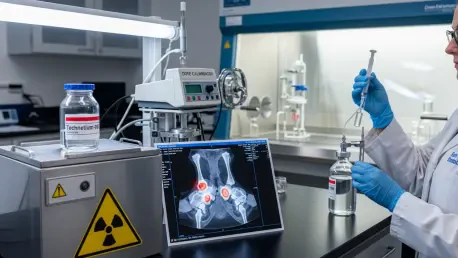

Surging oncology and cardiology caseloads have turned nuclear medicine from a niche toolkit into a frontline engine for precise diagnosis and targeted therapy across health systems worldwide, and that shift is showing up in the numbers. The global radiopharmaceuticals market was projected to expand from USD 8.28 billion in 2026 to USD 15.21 billion by 2035, reflecting a 7.31% CAGR as PET and SPECT adoption widened and clinical pathways emphasized earlier, more accurate detection. Momentum had been visible even before this year: from 2023 to 2025, technetium‑99m climbed from USD 2.50 billion to 3.15 billion, while fluorine‑18 rose from USD 1.54 billion to 1.93 billion, signaling healthy demand across tracer families. Clinically, oncology dominated revenue at about USD 3.95 billion in 2025, with cardiology next at roughly USD 2.16 billion, mirroring how precision imaging and targeted radiotherapeutics were embedded in standard care.
Where Growth Concentrated: Regions, Products, and Isotopes
Building on this foundation, regional dynamics created distinct lanes for capacity build‑out and commercial strategy. North America led with a 43.95% market share in 2025, supported by dense PET/CT and SPECT/CT footprints, aggressive prostate and neuroendocrine theranostics uptake, and robust reimbursement. In contrast, Asia‑Pacific was poised to post the fastest expansion through 2035 as cyclotron networks matured and generator logistics improved, especially in China, India, and Southeast Asia. Product mix shifts reinforced the pivot from imaging alone to intervention: therapeutic radiopharmaceuticals outpaced diagnostics in 2025 at USD 4.46 billion versus USD 3.05 billion, underscoring demand for targeted agents paired with imaging biomarkers. Isotope use told a similar story. Tc‑99m retained a broad SPECT base, but Ga‑68—aligned with PET‑based PSMA and somatostatin receptor imaging—was set for the quickest climb from 2026 to 2035, while iodine and F‑18 posted steady gains.
The Adoption Playbook: End Users, Operations, and Next Moves
This approach naturally led to an end‑user profile dominated by integrated providers. Hospitals and clinics were the largest revenue contributors in 2025 at USD 4.08 billion, followed by medical imaging centers at USD 1.96 billion and others at USD 1.48 billion, reflecting hospital‑centric procurement, multidisciplinary tumor boards, and on‑site radiopharmacy capabilities. To translate forecasts into capacity, stakeholders should have prioritized reliable generator supply for Tc‑99m, expanded Ga‑68 and F‑18 production routes, and GMP‑compliant cold‑chain workflows. Health systems could have advanced by training nuclear medicine technologists for theranostics, streamlining PSMA referral pathways, and aligning coverage with outcomes. Suppliers should have diversified isotope sources and automated synthesis modules to de‑risk shortages. Policymakers, in turn, might have cleared backlog in licensing and harmonized quality standards, ensuring PET/SPECT growth converted into timely access from 2026 to 2035.