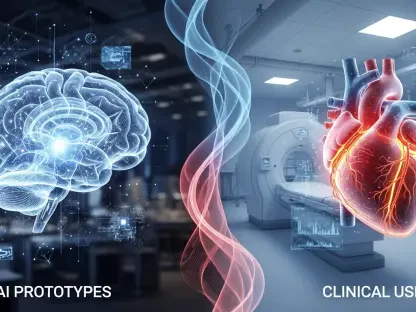

The rapid integration of sophisticated algorithms into South Korean hospitals has effectively dismantled traditional diagnostic limitations, ushering in an era where software often matches or exceeds human precision in specific screening tasks. This dramatic shift is evidenced by the sheer volume of official approvals for artificial intelligence-based software medical devices, which have surged 2.5-fold over the past three years. According to the latest figures from the Ministry of Food and Drug Safety, the industry has transitioned from a mere four approvals in 2018 to a staggering 157 in 2025. This acceleration represents a move beyond a nascent industry once dominated by a few adventurous pioneers like Lunit and Vuno. Today, the landscape is a robust ecosystem where dozens of domestic firms are successfully commercializing deep research into practical, bedside applications. The maturation of this sector reflects a broader national strategy to lead the global digital health market through high-accuracy diagnostic tools.
The Evolution of Diagnostic Intelligence
Shifting from Detection to Generative Reporting
The primary technological trend defining the current landscape is the transition from simple lesion detection to sophisticated generative analysis that provides comprehensive clinical context. Historically, medical artificial intelligence was primarily utilized as a highlighting tool, restricted to identifying the location of a potential tumor or indicating the severity of a specific disease. However, the recent approval of Soombit AI’s “AI-Read CXR” marked a definitive turning point as the nation’s first generative AI-based digital medical device. Instead of merely placing markers on an image, this technology synthesizes complex visual data to produce text-based preliminary reports that mirror the structure and tone of a human radiologist. This advancement reduces the cognitive load on physicians, allowing them to verify AI-generated summaries rather than starting every report from a blank template, which fundamentally alters the daily workflow in high-volume imaging centers.
Building on this foundation, other major players are refining how generative models interpret multi-layered clinical data to provide more nuanced diagnostic support. DeepNoid’s “M4CXR” provides a prime example of this sophistication, as it is designed to interpret 42 distinct types of thoracic conditions simultaneously. Having received an Innovative Medical Device designation, this system is currently undergoing final authorization procedures to integrate fully into the national healthcare framework. This move toward broad-spectrum analysis suggests that the era of “single-task” AI is coming to an end. Modern medical professionals now expect integrated platforms that can scan for a vast array of pathologies in a single pass. By moving toward generative text and multi-condition screening, these companies are ensuring that artificial intelligence acts not just as a secondary observer, but as a proactive assistant that synthesizes information into actionable intelligence.
Commercial Viability and Market Specialization
The financial performance of South Korean medical AI firms underscores the genuine commercial viability of these technological advancements within a competitive global market. Lunit recently reported record-breaking revenues of 83.1 billion won, a feat largely attributed to the widespread adoption of its 3D breast cancer diagnostic solution across international hospital networks. This success demonstrates that high-quality diagnostic software is no longer a research luxury but a critical component of institutional revenue and patient care strategies. Similarly, Vuno achieved an all-time high of 34.8 billion won in revenue through its specialized electrocardiogram-based kidney function screening software. These figures provide the necessary capital for these firms to reinvest in research and development, ensuring that the cycle of innovation remains sustainable and that the initial wave of growth was not merely a temporary trend.
Furthermore, the domestic market is diversifying rapidly as newer entrants target specialized medical niches that were previously underserved by standard diagnostic algorithms. Companies like 3billion and Noul are carving out unique positions by focusing on rare disease diagnostics and AI-driven blood analysis, respectively. This specialization is crucial because it addresses the “long tail” of medical needs where human expertise is often scarce or geographically concentrated. By automating the analysis of rare genetic markers or complex blood cell morphologies, these firms are extending high-level diagnostic capabilities to smaller regional clinics and specialized research labs. This shift from general-purpose tools to highly specific diagnostic instruments indicates a maturing industry where companies no longer compete for the same broad categories, but instead seek to dominate specialized vertical markets through superior data and refined algorithms.
Regulatory Frameworks and Implementation Strategies
Adapting to the Digital Medical Products Act
A significant factor contributing to the current pace of innovation is the strategic overhaul of the regulatory environment, which has become increasingly data-centric. While the number of official device approvals has risen, the number of formal clinical trial plan approvals has paradoxically decreased, reflecting a shift in how these tools are validated. Under the Digital Medical Products Act implemented in early 2024, data-based clinical trials—the primary method for refining and testing artificial intelligence software—are now exempt from requiring traditional ministerial approval for every iteration. This regulatory flexibility allows developers to iterate on their models using existing retrospective data sets without the administrative delays associated with traditional prospective human trials. Consequently, the industry has moved toward a more streamlined development model that facilitates faster innovation while maintaining rigorous safety standards.
This transition from traditional bureaucratic oversight to a data-driven validation model has allowed South Korean firms to maintain a significant competitive edge in the global market. By reducing the time required for clinical validation, the Ministry of Food and Drug Safety has effectively enabled a culture of continuous improvement within the software development lifecycle. Developers are now able to react more quickly to new clinical findings or emerging variants of diseases by updating their algorithms and validating them against massive, approved databases in real time. This approach has not only maintained high diagnostic accuracy but has also encouraged more cautious investors to enter the space, as the path to market has become clearer and more predictable. The focus has shifted from navigating red tape to ensuring the integrity of the data used for training, making the regulatory process a partner in innovation rather than a hurdle.
Strategic Integration for Clinical Success
The long-term success of medical artificial intelligence depends on how seamlessly these tools are integrated into existing clinical infrastructures and professional workflows. It was observed that the most successful implementations occurred when hospitals prioritized interoperability between AI software and electronic health record systems. Health systems that invested in training their staff to interpret AI suggestions as part of a collaborative decision-making process reported higher levels of diagnostic confidence and reduced rates of clinician burnout. Moving forward, providers sought to establish standardized protocols for when an AI’s preliminary report should be escalated for an immediate second human opinion. These strategies ensured that the technology remained a supportive tool that enhanced human expertise rather than a black-box system that replaced professional judgment, thereby maintaining the trust of both medical staff and the patients they served.
In the final assessment, the medical community established that the expansion of generative analysis was a necessary evolution for managing the increasing complexity of modern patient data. Institutions that adopted these generative tools early benefited from significant reductions in documentation time and improvements in the consistency of diagnostic reporting across various departments. Leaders in the sector advocated for the creation of shared data repositories to further refine these models, ensuring that the algorithms remained representative of diverse patient populations. By focusing on the integration of 3D imaging, generative text, and specialized diagnostics, stakeholders successfully shifted the focus from the novelty of the technology to its practical utility. These efforts solidified the role of artificial intelligence as a permanent fixture in the healthcare system, providing a clear roadmap for future developments in digital medicine.