
The landscape of medical diagnostics is currently undergoing a radical transformation as companies previously known for creative software begin to leverage their computational expertise to solve complex biological challenges. Midjourney, once a dominant force in generative artistry, has pivoted into the high-stakes world of medical hardware with the unveiling of a revolutionary underwater body scanner. This system aims to produce a comprehensive three-dimensional map of the human anatomy in less than sixty seconds, effectively challenging the status quo of clinical imaging. By moving from the digital canvas to the physical realm, the organization seeks to democratize healthcare through high-speed, accessible diagnostic tools. The shift represents a fundamental change in how health monitoring might be integrated into daily life, transitioning from occasional hospital visits to a more seamless, data-driven experience that prioritizes early detection and holistic wellness tracking. This ambition marks a new era for AI-driven health.
Engineering the Ultrasonic Submersion Process
System Architecture: The Mechanics of Underwater Data Capture
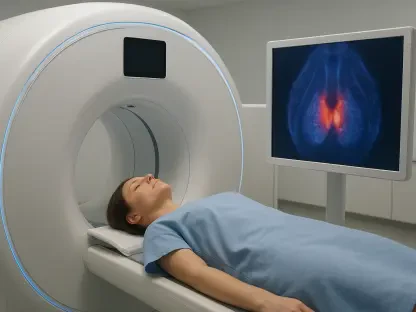
The engineering behind this scanning system is centered on a specialized immersion process that utilizes the physical properties of water to enhance acoustic transmission. The procedure begins when a user stands on a circular platform which gently lowers the individual into a shallow, temperature-controlled pool. Surrounding this tank is a massive, high-tech ring embedded with roughly 500,000 microscopic sensors designed to both emit and receive high-frequency ultrasonic waves. Unlike traditional imaging that requires direct skin contact or restrictive enclosures, this approach uses water as a highly efficient medium to conduct sound waves into the body. As the person is submerged, the sensor array captures a continuous stream of raw acoustic data from every possible angle. This methodology allows for a rapid capture of the body’s internal geometry without the need for the prolonged, static positioning required by traditional diagnostic methods. The result is a frictionless experience.
Digital Twins: The Role of AI in Biological Reconstruction
Once the raw ultrasonic data is gathered, advanced artificial intelligence models take over to synthesize the information into a high-fidelity digital twin of the user’s internal structure. These algorithms are tasked with interpreting the subtle variations in sound wave reflection to reconstruct detailed images of muscles, nerves, and soft tissues. By utilizing high-speed parallel computation, the system can process the vast amounts of feedback almost instantaneously, creating a holistic view of the body rather than focusing on a single isolated organ. This capability represents a significant departure from standard clinical practices, where imaging is typically reactive and localized to a specific area of concern. The goal is to provide a comprehensive physiological map that can be analyzed for anomalies or used as a baseline for future comparisons. This integration of hardware and software promises to turn raw acoustic feedback into a precise, navigable map of human biology for better care.
Challenging the Dominance of Traditional MRIs
Clinical Efficiency: Improvements in Speed and Accessibility
A primary motivation behind this technological shift is the urgent need to address the logistical and financial bottlenecks associated with traditional Magnetic Resonance Imaging. Standard MRI procedures are often lengthy, frequently lasting up to ninety minutes, and they require patients to remain perfectly still within a noisy, confined space. In contrast, the underwater scanner is engineered to complete a full-body diagnostic assessment in approximately one minute. This dramatic reduction in time could significantly increase the throughput of health facilities and reduce the wait times that currently plague medical systems. Furthermore, the speed of the device opens the door for frequent health check-ups that would otherwise be impossible due to cost and scheduling constraints. By making the process as quick as a routine hygiene task, the technology encourages a more proactive approach to health management, allowing for the tracking of subtle changes over time. Speed is the key here.
Patient Safety: Eliminating Magnetic Risks and High Costs
Beyond the advantages of speed, the ultrasound-based system offers a safer and more versatile alternative to the powerful magnetic fields used in traditional scanners. Magnetic Resonance Imaging requires a strictly metal-free environment because the intense magnetic pull can cause dangerous interference with implants or metallic objects. The new scanner relies entirely on sound waves, which are inherently safe for individuals with pacemakers, cochlear implants, or surgical pins. This inclusivity ensures that a wider demographic can benefit from advanced internal imaging without the risks or contraindications typically associated with MRI suites. Additionally, the operational costs of an ultrasound system are projected to be significantly lower than those of magnetic imaging, which necessitates specialized rooms and expensive cooling systems. Lowering these financial barriers is a key component of the strategy to move diagnostic power away from centralized hospitals and into community settings.
Scientific Roadblocks and Technical Risks
Physics Constraints: Managing Acoustic Impedance Mismatch
Despite the promising outlook, the development of an underwater scanner faces formidable obstacles rooted in the fundamental laws of physics. One of the most significant challenges is acoustic impedance mismatch, a phenomenon where sound waves are reflected or distorted when moving between different materials. While water is an excellent conductor for sound into soft tissue, dense materials like bone and pockets of air within the lungs create significant barriers that ultrasound cannot easily penetrate. This limitation means that the scanner may struggle to provide clear imagery of the brain, which is encased in the skull, or the internal structures of the respiratory system. Traditional MRI still holds a clear advantage in these areas because magnetic fields are not obstructed by bone in the same way sound waves are. Overcoming these physical hurdles requires sophisticated wave-shaping techniques and perhaps a realization that the scanner may supplement rather than replace existing MRIs.
Data Reliability: Mitigating AI Hallucinations in Diagnostics
Another critical concern involves the reliability of the AI models used to interpret the collected sensor data, particularly regarding the risk of hallucinations. Because the reconstruction process relies on predictive algorithms to fill in gaps where signal quality is poor, there is a distinct possibility that the AI could generate images of internal structures that do not exist. In a medical context, these statistical fabrications could lead to false negatives or the oversight of early-stage pathologies that require absolute accuracy for effective treatment. Relying on synthesized data rather than direct observation poses a significant safety risk if the system prioritizes visual clarity over clinical truth. Ensuring that the software remains grounded in empirical data is essential for maintaining the trust of the medical community and the safety of the patients. The challenge lies in balancing the speed of AI-driven reconstruction with the rigorous precision required for dependable diagnostics.
Strategic Roadmap for Global Implementation
Market Entry: From Wellness Spas to Clinical Use
The strategic roadmap for this technology begins with an unconventional entry point into the market through high-end wellness and recovery environments. Rather than seeking immediate hospital integration, the plan involves launching a flagship facility in San Francisco in 2027 that combines the scanner with traditional spa amenities. This environment is designed to serve as a living laboratory where the first generation of the hardware can be tested by a health-conscious demographic. By placing the device alongside saunas and cold plunges, the company aims to gather extensive real-world data while providing users with a low-stress experience. This feedback loop is vital for refining the sensor technology and the AI algorithms before attempting to move into more formal clinical settings. Starting in the wellness sector allows for iterative improvements in hardware design while building public familiarity with the concept of regular, elective body scanning as part of a lifestyle.
Scalable Healthcare: Building a Global Monitoring Network
Looking toward the horizon of 2031, the vision expanded into a massive global network comprising 50,000 scanning units positioned in accessible hubs. This scale was intended to provide monthly health assessments for up to one billion people, fundamentally shifting the paradigm of preventative care. To achieve this, several actionable steps were identified, including the standardization of ultrasonic data formats and the establishment of strict AI transparency protocols. Stakeholders focused on developing robust privacy frameworks to protect the sensitive physiological data generated by such a massive user base. Previous pilot programs suggested that the integration of this technology into municipal health centers could reduce the burden on acute care facilities by identifying issues long before they became emergencies. Consequently, the transition to widespread adoption required a dual focus on refining the physics of ultrasound and ensuring that the AI remained an objective tool for health.