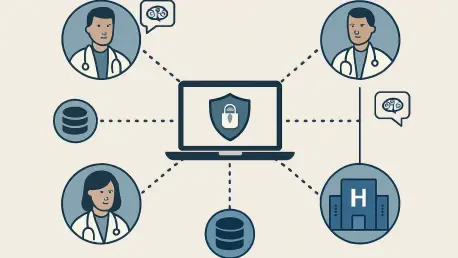

The dynamic weighted K-asynchronous federated learning protocol allows local medical devices to train security models without sharing raw, sensitive health information with a central server. This breakthrough is particularly significant for Wireless Body Area Networks (WBANs), which have transitioned from specialized clinical tools into pervasive life-support systems integrated into the daily routines of millions. These networks consist of wearable sensors and implantable devices, such as pacemakers and neurostimulators, that continuously monitor critical physiological markers. While this connectivity enables real-time healthcare, it also exposes patients to unprecedented digital risks. A breach in such a network is fundamentally different from a standard data leak; it represents a direct physical threat where an adversary could theoretically manipulate heart rates or trigger lethal insulin dosages. By decentralizing the learning process, this new framework ensures that security intelligence is built directly at the edge, effectively shielding the most sensitive patient metrics from the vulnerabilities inherent in centralized cloud repositories. This approach addresses the dual challenge of providing robust protection while respecting the rigid privacy constraints that define modern medical ethics and law in the current technological era.
Decentralized Intelligence: Securing the Medical Edge
The core of the Dynamic Weighted K-Asynchronous Federated Learning (DW-KAFL) architecture lies in its ability to operate efficiently across a heterogeneous landscape of low-power medical hardware. Traditional machine learning models require a massive aggregation of data in a central location, a process that is often prohibited by the strict data sovereignty rules governing healthcare. Federated learning circumvents this by distributing the training load to individual devices like smartwatches or infusion pumps. These devices compute local updates based on their specific data streams and then transmit only the mathematical parameters of the model to a central coordinator. This coordinator aggregates the contributions to refine a global security model, which is then sent back to the devices. This cycle allows the entire network to learn from the experiences of individual nodes without ever exposing the raw biological signals that characterize a patient’s health profile. By keeping the data local, the framework significantly reduces the risk of interception and lowers the energy costs associated with high-bandwidth data transmissions, which is a vital consideration for battery-dependent implants that are expected to function for years without replacement.
One of the primary technical hurdles in deploying federated learning within a clinical setting is the presence of “straggler” nodes—devices that are slow to respond or lose connectivity due to a patient’s movement or physical environment. Standard synchronous updates require the central server to wait for every participant to submit their local model, which can lead to significant delays and system-wide freezes if even one sensor fails to check in. The DW-KAFL system introduces a K-asynchronous protocol that solves this bottleneck by allowing the global model to update as soon as a predefined threshold of responsive nodes provides their data. This means the security infrastructure remains highly available and reactive, even when patients move through areas with poor wireless coverage or when their wearable devices enter low-power modes. By prioritizing availability without sacrificing the integrity of the learning process, the framework ensures that the defensive posture of the network evolves in real time. This flexibility is essential in a medical context where delays in threat detection could lead to missed anomalies, potentially leaving a patient unprotected during a critical physiological event or a coordinated cyberattack that targets network timing.
Adaptive Optimization: Balancing Energy and Accuracy
Managing the diversity of hardware and the physiological uniqueness of different patients requires a more nuanced approach than a one-size-fits-all security model. To address this, the framework utilizes an adaptive clustering mechanism that groups sensors based on their specific profiles, including battery status, mobility patterns, and the quality of data they produce. By categorizing nodes with similar operational characteristics, the system can tailor the learning process to the strengths and limitations of each group. For instance, high-energy wearable devices might contribute more frequently to complex model refinements, while low-power implants are preserved for critical verification tasks. This clustering reduces the statistical noise that often plagues decentralized learning, allowing the model to reach high levels of accuracy much faster than non-adaptive systems. It also allows the network to adapt to the changing state of the hardware, such as when a device’s battery begins to fail or when a patient transitions from a sedentary state to vigorous physical activity, ensuring the security model remains optimized for the current physical and technical context at any given moment.
Beyond simple grouping, the DW-KAFL framework employs a sophisticated dynamic trust-aware weighting system to evaluate the quality of contributions from each node. In a decentralized network, not all data updates are equally valuable or trustworthy; a compromised device or a malfunctioning sensor could inadvertently introduce errors that degrade the global security model. The framework assigns weights to local updates based on a multi-factored assessment that includes local classification accuracy and bio-similarity scores. If a device’s reported updates deviate significantly from the expected physiological norms or historical performance, its weight in the global aggregation is automatically reduced. Furthermore, a temporal decay function is applied to older updates, ensuring that the global model is always skewed toward the most recent and relevant data. This approach creates a self-healing security ecosystem that naturally marginalizes low-quality or malicious inputs. By continuously reassessing the reliability of every participating node, the system builds a resilient defense that can distinguish between a genuine physiological emergency and a coordinated attempt to poison the underlying detection algorithm through adversarial machine learning.
Detection Engine: Integrating Cyber and Physical Data
The detection engine within the framework is designed to handle the complexity of both digital network traffic and biological signals through a hybrid architecture. This system leverages the strengths of Convolutional Neural Networks (CNNs) and Long Short-Term Memory (LSTM) networks to provide a holistic view of the patient’s security status. The CNN branch is specialized in identifying spatial-temporal patterns within the network traffic itself, looking for signs of unauthorized access, packet flooding, or unusual communication intervals between sensors. Simultaneously, the LSTM branch focuses on the temporal dependencies of the biological data, such as the rhythmic nature of a heartbeat or the gradual fluctuations in blood oxygen levels. By processing these two distinct streams of information in parallel, the framework can detect subtle anomalies that might be missed by systems that focus only on the digital or the physical domain. This dual-layered analysis ensures that even highly sophisticated attacks, which may attempt to hide their presence within normal network behavior, are flagged because they result in impossible or inconsistent physiological readings that do not match the clinical reality.
At the apex of this detection strategy is a Variational Autoencoder (VAE) that serves as a bio-anomaly fusion center, acting as the final arbiter of network integrity. This component is particularly effective at identifying “silent” attacks, where an adversary successfully masks their network signature but must still manipulate the reported biological data to achieve their objective. The VAE learns the underlying distribution of a patient’s healthy physiological state and compares the incoming fused data against this learned baseline. If the network reports that a patient is in a state of deep sleep while the heart rate sensors indicate a sudden, inexplicable surge in activity, the VAE identifies this as a critical inconsistency. This fusion of cyber and physical metrics creates a “ground truth” verification layer that is exceptionally difficult for an attacker to bypass. To deceive the system, a malicious actor would need to perfectly synchronize a network-level intrusion with a simulated physiological profile that matches the patient’s specific history and current context. This level of complexity significantly raises the barrier to entry for attackers, making WBANs a much less attractive target for cybercriminals and state-sponsored actors alike.
Privacy Compliance: Meeting Regulatory Standards
Privacy is not merely a feature of the DW-KAFL framework but is its primary design constraint, especially given the increasingly stringent global regulations surrounding personal health information. To ensure that individual patient data remains unrecoverable from the shared model updates, the system integrates advanced differential privacy techniques. This involves injecting precisely calibrated noise into the local model parameters before they are transmitted to the central coordinator. By applying these mathematical protections, the framework ensures that even if an adversary were to intercept the model updates, they would be unable to reverse-engineer the original biological signals or identify the specific patient associated with the data. The system also utilizes update clipping to prevent any single node from having an outsized influence on the global model, which further protects against data leakage. These measures allow medical facilities to maintain compliance with rigorous standards such as HIPAA, providing a secure pathway for the adoption of artificial intelligence in sensitive clinical environments without compromising the fundamental rights or safety of the patients.
A critical aspect of the framework’s privacy model is its use of sophisticated accounting methods to monitor and manage the total privacy loss over time. Every training round contributes a small amount to a cumulative privacy budget, and the DW-KAFL system is engineered to minimize this accumulation by selecting only a fraction of the available nodes for each update cycle. This selective participation ensures that the system can remain operational and secure for thousands of iterations without exceeding the established privacy thresholds. Researchers have demonstrated that this method provides a significantly higher level of protection than standard federated learning models, which often suffer from privacy degradation over long-term deployments. By ensuring that the defensive capabilities of the network do not come at the cost of long-term data exposure, the framework establishes a sustainable model for medical security. This balance is crucial for the continuous monitoring required for chronic conditions, where devices must remain connected and active for years. The ability to provide robust, long-term privacy makes this architecture particularly attractive for healthcare providers looking to implement next-generation monitoring solutions.
Clinical Reliability: Performance and Alert Accuracy
The empirical results of the DW-KAFL framework highlight a substantial leap forward in the practical application of intrusion detection within medical networks. During extensive testing, the system achieved a detection accuracy of 97.5%, outperforming many traditional centralized and decentralized security models currently used in the field. Perhaps more importantly for the healthcare sector, this high level of protection was achieved with a 35% reduction in energy consumption per node. In the context of wearable and implantable technology, energy efficiency is often as important as security, as it directly impacts the operational lifespan of the device and the frequency of invasive battery replacement procedures. By extending the battery life of sensors by more than 50% in some cases, the framework significantly improves the quality of life for patients and reduces the long-term costs for healthcare systems. Furthermore, the system’s latency remains remarkably low, ensuring that critical cardiac alerts are processed in real time, providing the immediate response capabilities necessary for life-saving interventions in hospital and home settings.
Reliability in a clinical setting is also measured by the system’s ability to minimize false alarms, a phenomenon known as alert fatigue that can lead medical staff to ignore genuine emergencies. The DW-KAFL framework addressed this issue by reducing the false positive rate to just 4.7%, a significant improvement over previous-generation intrusion detection systems. This precision was achieved through the integration of the trust-aware weighting and the bio-anomaly fusion layers, which worked together to filter out non-threatening variations in sensor data. When an alarm is triggered, clinicians can be confident that it represents a legitimate threat to the patient’s health or the network’s integrity. This increased trust allowed for more streamlined medical workflows, as staff focused their attention on the most critical alerts without being overwhelmed by digital noise. By improving the signal-to-noise ratio in medical monitoring, the framework not only secured the network but also enhanced the overall efficacy of the care delivery process, ensuring that the technology served as a reliable partner to the medical professionals on the front lines of patient care.
Strategic Resilience: Future Security Considerations
The successful implementation of the DW-KAFL framework in localized clinical settings established a foundation for broader cross-institutional security standards. As healthcare providers looked to integrate these decentralized protocols into larger regional and national health networks from 2026 to 2028, the focus shifted toward ensuring interoperability between diverse hardware manufacturers and software platforms. Future developments in this space prioritized refining the differential privacy noise injection to provide even higher levels of utility without sacrificing data protection. Furthermore, the adoption of such frameworks was accompanied by rigorous staff training and the development of clear protocols for responding to the highly accurate alerts generated by these systems. By focusing on both technical excellence and practical clinical utility, the healthcare industry ensured that the rapid expansion of medical IoT remained a benefit to patient health rather than a liability. The transition toward these intelligent, privacy-preserving architectures represented a critical step in building a more resilient and trustworthy global healthcare infrastructure.
Looking toward the next phase of evolution, the focus moved toward creating an ecosystem where medical devices were not just passive observers but active participants in their own defense. Engineers began to explore how these federated models could be shared across different medical specialties to identify emerging threat patterns before they reached a critical mass. The integration of multi-modal data fusion became a standard requirement for any device operating within a WBAN, as the combination of cyber and physical data provided the only viable defense against increasingly complex threats. This proactive approach allowed the healthcare sector to stay ahead of adversaries, turning the massive influx of medical data into a strategic advantage for patient safety. As the technology matured, the emphasis remained on maintaining the delicate balance between high-performance security and the uncompromising privacy demands of the medical field. Ultimately, the lessons learned from the deployment of these frameworks provided a roadmap for other sectors dealing with sensitive IoT data, setting a new benchmark for secure, decentralized computing.