
The fusion of security and diagnostics into a single localized pipeline allows healthcare providers to protect patient data and physical well-being simultaneously. In the high-stakes environment of the intensive care unit, where every heartbeat is tracked by a sophisticated web of connected devices, the margin for error is nonexistent. While the Internet of Medical Things has revolutionized patient monitoring, it has also introduced a terrifying vector for cyberattacks that could theoretically alter patient dosages or mask critical alarms. Traditional security models often fail because they treat network protection and clinical diagnostics as separate silos, frequently relying on distant cloud servers that introduce dangerous latency. By localizing these functions at the network edge, a new architectural paradigm is emerging that treats security as a prerequisite for clinical data integrity. This approach ensures that the digital pulse of the hospital remains accurate and untouchable by malicious actors.
Addressing the Vulnerabilities of Modern Clinical Networks
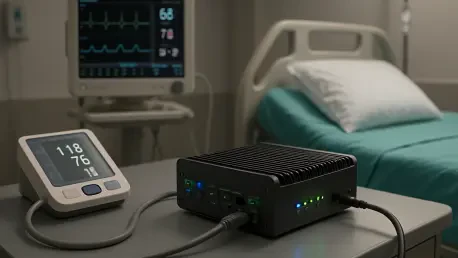
Standard healthcare IT infrastructures from 2026 to 2028 are increasingly moving away from centralized cloud processing due to inherent structural weaknesses. In a clinical setting, relying on a remote server located hundreds of miles away creates a latency gap that can be fatal during a cardiac arrest or sudden respiratory failure. Furthermore, the constant back-and-forth transmission of sensitive physiological data across public internet backbones provides multiple interception points for sophisticated ransomware or man-in-the-middle attacks. Even a brief loss of connectivity can render expensive diagnostic tools useless, leaving staff in the dark during critical moments. To mitigate these risks, researchers are championing the move toward localized edge nodes—dedicated hardware situated directly within the hospital ward. These nodes process information on-site, eliminating reliance on the external web while keeping the most sensitive patient information within the physical walls of the institution.
The Critical Need: Zero-Trust Edge Intelligence
Integrating a Zero-Trust architecture within these edge nodes represents a fundamental shift in how medical networks operate on a day-to-day basis. In the past, internal networks were often considered safe zones, but modern threat landscapes require a more cynical view where every packet of data is treated as potentially hostile. This philosophy dictates that no device, whether it is an infusion pump or a ventilator, is trusted by default simply because it is plugged into the hospital Ethernet. Every signal must be verified and authenticated in real time before its data is accepted into the clinical record. By implementing this at the edge, the system creates a sterile digital environment that parallels the physical sterility of an operating room. This continuous verification process serves as the first line of defense, preventing unauthorized commands from reaching life-critical machinery while ensuring that the data used for medical decisions has not been subtly tampered with by external adversaries.
Part 1: Establishing a Localized Security Perimeter
By shifting the intelligence from the cloud to the local network edge, this framework addresses the urgent need for a secure, localized infrastructure that can handle the high-stakes environment of an ICU. This localized perimeter functions as an autonomous security bubble, capable of maintaining operations even if the hospital’s primary internet connection is severed. This is particularly vital for real-time monitoring devices that generate high-frequency telemetry, as any delay in analyzing these signals could result in missed clinical events. The edge-based model allows for immediate intervention, where security protocols can isolate a compromised device without shutting down the entire network. This granular control ensures that the clinical workflow remains uninterrupted while a potential threat is neutralized. Furthermore, this approach significantly reduces the data footprint on the external web, naturally enhancing patient privacy by minimizing the volume of sensitive information that must travel beyond the ward level.
Designing the Sequential AI Framework
The first layer of this specialized intelligence framework utilizes a security module powered by a soft-voting ensemble algorithm to act as a digital sentry. Unlike traditional firewalls that may struggle with the high-velocity data streams of an ICU, this AI-driven approach analyzes the nuances of network traffic patterns to identify anomalies that signal a breach. By combining multiple specialized detection models, the soft-voting mechanism achieves a level of granularity that allows it to distinguish between a legitimate surge in telemetry and a malicious flood of data. This layer effectively scrubs the incoming data stream, ensuring that only verified, benign information moves deeper into the system. It is designed to operate with minimal overhead, ensuring that the inspection process does not become a bottleneck that hinders the delivery of time-sensitive patient metrics. This gatekeeping function is the essential foundation upon which the clinical safety model is built, providing a secure substrate for medical analysis.
The Security Layer: Soft-Voting Ensemble Analysis
Once the security module has certified the data as untampered, it passes into the second layer: the Healthcare AI Module, which employs Histogram Gradient Boosting for real-time diagnostics. This tier is specifically tuned to recognize the subtle physiological indicators of patient deterioration, such as oxygen saturation drops or irregular heart rhythms, long before they become catastrophic. Because it operates on data that has already been cleared by the security layer, the risk of false positive medical alerts—often triggered by malicious data injection—is virtually eliminated. This sequential logic is vital; it ensures that when a nurse or physician receives a critical alert, they can trust its clinical accuracy without hesitation. The integration of advanced gradient boosting techniques allows the system to handle the complex, non-linear data sets generated by multiple ICU monitors simultaneously. This creates a robust and reliable diagnostic engine that supports human clinicians by providing an accurate second pair of eyes.
The Diagnostic Layer: High-Precision Clinical Monitoring
Empirical validation of this dual-layer framework has yielded results that suggest a new benchmark for medical IoT performance. In rigorous testing using industry-standard datasets like CICIDS-2017 and MIMIC-IV, the security ensemble demonstrated a 99.4% accuracy rate in neutralizing diverse cyber threats. More importantly for patient safety, the diagnostic module achieved nearly 99% accuracy with complete recall, ensuring that not a single instance of clinical deterioration was overlooked during the observation period. The most striking achievement, however, was the system’s end-to-end latency, which averaged only 28.8 milliseconds. This speed is well within the thresholds required for real-time responsiveness in acute care, proving that adding a sophisticated layer of AI security does not necessarily slow down the clinical workflow. These metrics indicate that edge-based intelligence is not just a theoretical improvement but a practical, high-performance solution ready for deployment in hospitals facing digital hostility.
Measuring Performance and Future Directions
The development of the dual-layer edge architecture established a definitive blueprint for the future of secure clinical monitoring. It demonstrated that the historical trade-off between network security and diagnostic speed was a false dilemma that could be solved through localized processing. Healthcare administrators and IT architects recognized the necessity of moving toward permissioned blockchain systems to further enhance the immutability of device logs and patient records. Practical steps were taken to integrate these AI modules into existing ward-level hardware, reducing the reliance on external cloud providers. By prioritizing a sequential validation process, the industry moved closer to a decentralized model where every ICU bed functioned as an autonomous, secure data center. This shift not only protected individual patient privacy but also fortified the resilience of the entire hospital infrastructure against large-scale digital disruptions. Ultimately, the successful implementation of this framework provided a scalable strategy for health systems.
Empirical Findings: Accuracy and Latency Metrics
Validation efforts confirmed that the sequential processing of data did not adversely affect the responsiveness of clinical alerts. By measuring the time from the moment a sensor captured a vital sign to the moment a diagnostic alert was generated, researchers found that the 28.8-millisecond delay was virtually imperceptible to human staff. This performance was achieved by optimizing the soft-voting ensemble to run on low-power edge hardware, ensuring that even smaller regional hospitals could implement these advanced protections without massive investments in high-end servers. The high recall rate of the diagnostic module proved especially critical, as it meant that the system was as reliable as a human expert in identifying respiratory distress or cardiac instability. These findings solidified the argument that the next generation of medical devices must be built with integrated security and diagnostics, rather than treating these two functions as optional add-ons that can be managed by separate departments or third-party vendors.
Strategic Implications: Decentralization and Data Integrity
The successful transition to edge-based intelligence provided actionable insights for hospitals looking to modernize their cybersecurity posture. IT leaders moved to deploy localized nodes that acted as the primary processing units for ICU telemetry, effectively air-gapping the most critical diagnostic functions from the broader internet. This strategy included the adoption of rigorous data-scrubbing protocols that prevented malicious traffic from ever reaching the medical analysis tier. By focusing on low-latency, high-accuracy models, clinical teams were empowered with alerts they could trust, reducing the dangerous phenomenon of alarm fatigue. The project concluded by illustrating that data integrity was the most important asset in a modern clinical environment. Future efforts then focused on ensuring that these edge models could be updated through secure, federated learning pathways to stay ahead of evolving threats. This proactive stance toward technological integration ensured that the healthcare sector remained resilient against both biological and digital challenges in an interconnected world.