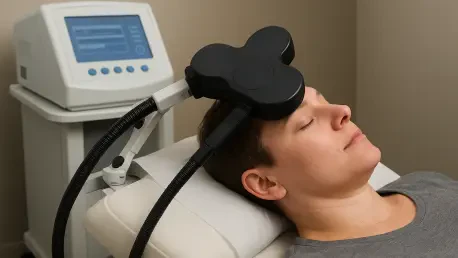

A staggering 6,000% increase in employer interest in neuromodulation suggests that interventional psychiatry is rapidly moving from a niche last resort to a mainstream healthcare demand. This dramatic shift highlights a broader transformation within behavioral health, where Transcranial Magnetic Stimulation (TMS) has transitioned from a specialized intervention for treatment-resistant depression into a versatile tool for addressing various conditions, including obsessive-compulsive disorder and nicotine addiction. As the demand for these sophisticated therapies grows, the industry is moving away from the massive, immobile hardware that defined previous decades and toward a more agile generation of portable and personalized devices. This evolution requires clinical providers to fundamentally rethink their delivery models to maintain rigorous medical standards while increasing accessibility. The integration of advanced diagnostics and remote monitoring capabilities is setting a new benchmark for what constitutes effective psychiatric care in a modern clinical setting.
Bridging the Gap: The Transition to Scalable Care Models
The historical dominance of large-scale clinical units created a significant economic barrier for independent practices and rural healthcare centers. Traditional TMS machines often require a capital investment exceeding six figures, coupled with the need for specialized rooms shielded from electromagnetic interference, which many clinics find physically or financially impossible to accommodate. This infrastructure bottleneck has historically limited patient access, concentrating life-changing treatments within affluent urban areas or well-funded academic hospitals. However, the current trend toward smaller-scale, modular devices is effectively lowering these entry barriers, allowing a broader spectrum of providers to offer neuromodulation. By reducing the physical footprint and the initial cost of equipment, manufacturers are democratizing brain-stimulation therapy. This shift ensures that smaller psychiatric practices can finally compete with larger institutions by providing cutting-edge neurological interventions without the traditional overhead.
Rather than entirely replacing the high-intensity systems utilized in specialized psychiatric hospitals, these emerging portable tools are serving as essential clinical adjuncts that expand the reach of behavioral health services. This diversification allows for a hybrid approach where patients receive intensive, physician-supervised treatment during the acute phase and then transition to portable maintenance devices to sustain their neural progress. Such a model is particularly vital for populations in underserved regions where frequent travel to a central clinic is logistically unfeasible. By providing a continuity of care that extends beyond the four walls of the clinic, these newer technologies facilitate long-term remission and reduce the likelihood of relapse. This functional expansion represents a pivot from episodic care toward a continuous management strategy, ensuring that the benefits of neuromodulation are not lost once the initial treatment cycle concludes. The goal is to create a seamless journey for every patient.
Precision Diagnostics: The Integration of EEG and Personalized Protocols
The next frontier in clinical neuromodulation involves a departure from the “one-size-fits-all” approach to magnetic pulse delivery, favoring instead real-time personalization through Electroencephalography (EEG) guidance. By integrating sensors that monitor a patient’s specific cortical rhythms, newer devices can dynamically adjust stimulation parameters to match the unique electrical signature of the individual brain. This move toward personalized therapeutics offers a degree of precision that was previously impossible in standard outpatient settings, where stimulation locations were often determined using generalized anatomical landmarks. The ability to visualize brain activity before and during treatment allows clinicians to target specific neural circuits with unprecedented accuracy, potentially increasing efficacy while minimizing side effects. This data-driven precision is transforming TMS from a blind intervention into a targeted surgical-like procedure, where every pulse is calibrated to the biological needs of the patient at that exact moment in time.
Technological advancements like Magnetic EEG-guided Resonance Therapy (MeRT) have already demonstrated significant clinical utility, particularly when treating complex conditions such as Post-Traumatic Stress Disorder (PTSD) and traumatic brain injuries. These systems utilize short, non-invasive EEG scans to identify areas of neural dyssynchrony, allowing providers to build a customized treatment plan that focuses on restoring functional connectivity. In various clinical trials conducted from 2026 to 2028, this methodology has consistently shown symptom reduction rates that exceed traditional benchmarks, establishing a new standard for psychiatric intervention. The focus is shifting toward a diagnostic-heavy model where the evaluation of neural health is just as critical as the stimulation itself. As these tools become more integrated into the standard workflow, the reliance on subjective patient reporting is being supplemented by objective physiological data, providing a more reliable metric for assessing progress and adjusting treatment protocols over time.
Economic Shifts: Insurance Evolution and Employer-Led Adoption
The financial viability of neuromodulation is being reshaped by a growing recognition of its long-term cost-effectiveness among insurance payers and corporate health sponsors. As clinical outcomes become more predictable through the use of EEG-guided protocols and portable adjuncts, insurance companies are increasingly willing to expand coverage and streamline reimbursement processes. The introduction of new CPT codes specifically designed for personalized stimulation therapies reflects a broader shift in the regulatory landscape, making it easier for providers to justify the costs of advanced technology. Furthermore, large employers are actively seeking out interventional psychiatry programs as part of their comprehensive mental health benefits, viewing it as a way to reduce disability claims and improve workplace productivity. This influx of capital and professional interest is driving a competitive market where technological innovation is directly tied to economic accessibility, ensuring that high-quality care is no longer restricted to those who can pay out-of-pocket.
Behavioral health practices are now finding themselves at a crossroads where they must diversify their service offerings to remain competitive in a rapidly evolving marketplace. By incorporating both clinical-grade TMS systems and portable neural assessment tools, clinics can develop multi-tiered revenue streams that cater to different patient needs and financial profiles. For example, offering comprehensive brain-mapping sessions as a standalone diagnostic service allows for early detection of mental health trends, which can then lead to targeted intervention protocols. This transition from a single-service model to a holistic neurological health platform provides a more stable financial foundation for practices while simultaneously improving patient outcomes. As the technology becomes more pervasive, neural function assessments may eventually become as common as standard blood work or metabolic panels in primary care. This democratization of data empowers patients to take a proactive role in their mental health while providing clinicians with the tools necessary for precision medicine.
Clinical Integrity: Maintaining Efficacy in a Distributed Hardware Market
Despite the clear benefits of increased portability and personalization, the rapid influx of new devices into the psychiatric market has sparked a necessary debate regarding clinical rigor. Established medical professionals emphasize that the gold standard of TMS was built on decades of peer-reviewed research and longitudinal data involving high-intensity magnetic coils. There is a concern that some newer, smaller entrants may prioritize convenience over the biological efficacy required to achieve deep cortical stimulation. Anatomical precision is paramount in neuromodulation, and any hardware that sacrifices focus or power for the sake of portability must be scrutinized to ensure it still meets therapeutic thresholds. This skepticism serves as a critical check on the industry, preventing the dilution of treatment quality in the pursuit of market expansion. Leading mental health organizations continue to advocate for a rigorous validation process that requires new technologies to prove their performance against existing clinical benchmarks before they are widely adopted.
The central challenge for modern practitioners involves finding a balance between adopting innovative tools and adhering to the evidence-based practices that have defined the field for years. Critics of the rapid decentralization of TMS argue that maintaining the necessary magnetic intensity is a significant engineering hurdle for smaller, battery-powered devices. Without the cooling systems and massive power supplies found in traditional units, there is a risk that these tools may only be suitable for mild cases or maintenance therapy rather than primary intervention for severe pathology. This ongoing tension ensures that as the market diversifies, it remains grounded in clinical reality rather than marketing hype. By maintaining a high bar for regulatory clearance and efficacy data, the industry can protect patient safety while still embracing the technological shifts that make care more accessible. This balanced approach is essential for maintaining public trust in interventional psychiatry as it moves further into the medical mainstream.
The Strategic Shift: Implementing Future-Ready Care Protocols
The future of neuromodulation will likely be defined by a collaborative hybrid model that leverages the specific strengths of both legacy infrastructure and emerging technologies. In this framework, high-power, in-clinic TMS remains the primary choice for acute treatment phases, where maximum physician supervision and pulse intensity are required to break through severe symptoms. Meanwhile, the newer generation of portable devices serves a crucial role in the post-acute phase, providing patients with a reliable way to sustain their recovery in a home or community setting. This tiered approach optimizes the utilization of clinical resources, reserving expensive hospital equipment for those who need it most while offering a scalable solution for long-term maintenance. By integrating these different levels of care into a unified treatment plan, providers can offer a more flexible and comprehensive patient experience. This synergy between tradition and innovation represents the most viable path forward for the industry as it continues to expand.
Clinicians who successfully navigated this technological transition focused on diversifying their treatment portfolios through the integration of EEG diagnostics and modular hardware. They prioritized the development of clear clinical pathways that utilized high-intensity TMS for initial stabilization followed by portable stimulation for relapse prevention. This strategy effectively addressed the dual challenges of patient access and long-term efficacy, setting a new standard for behavioral health excellence. Operators who invested in data-driven personalization saw higher rates of patient satisfaction and improved reimbursement outcomes from insurance payers. Moving forward, the industry was expected to continue its shift toward decentralized neurological restoration, making neural health monitoring a fundamental component of preventative medicine. By embracing these changes, medical practices transformed themselves into modern centers for brain health, ensuring that advanced psychiatric care was both precise and universally accessible. This proactive approach solidified the role of neuromodulation as a cornerstone of modern healthcare.