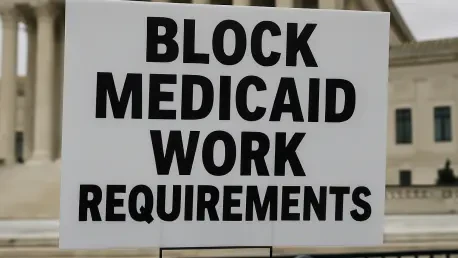

As the landscape of American healthcare undergoes one of its most significant shifts in decades, the tension between federal mandates and state-level administration has reached a boiling point. The recent judicial refusal to halt the implementation of Medicaid work requirements marks a pivotal moment for millions of citizens and the agencies tasked with their care. To help navigate the complexities of this ruling, we are joined by a seasoned authority on healthcare policy who has spent years analyzing the delicate balance between legislative intent and operational reality. This discussion explores the friction created by the “Big Beautiful Bill,” the narrow definitions of medical exemptions, and the looming administrative hurdles that states must clear before the new year.
The conversation centers on the legal and logistical fallout of a federal judge’s decision to allow Medicaid work requirements to move forward despite a lawsuit from twenty-five states and Washington, D.C. We delve into the specific challenges of the 80-hour monthly obligation, the nuances of the “medically frail” designation, and the financial debates surrounding the 90% federal reimbursement for eligibility systems.
How do you interpret the court’s decision to allow these Medicaid work requirements to proceed, especially given the intense administrative anxiety expressed by nearly half the states in the country?
The ruling by District Judge Richard Stearns reflects a strict adherence to the letter of the law rather than the operational anxieties of state governors. By rejecting the bid from twenty-five states and D.C., the court essentially signaled that administrative stress does not equate to “irreparable harm” in the eyes of the law, especially when federal funds are on the table. It is striking to see the court lean on the fact that the federal government is offering to reimburse 90% of the costs associated with developing these new eligibility systems. While states feel the crushing weight of a January 1st deadline, the judiciary sees a subsidized transition that, while difficult, is legally permissible. You can almost feel the collective shudder across state capitals as officials realize that the 90% financial carrot doesn’t actually solve the problem of building complex software and hiring staff in a matter of months.
The definition of “medically frail” has become a major flashpoint in this litigation; what are the practical implications for state agencies trying to distinguish who is truly exempt?
This is where the theoretical policy meets the harsh reality of the clinic waiting room. The states argue that the CMS finalized a rule with a much narrower definition of “medically frail” than what Congress originally envisioned, which creates a terrifying bottleneck for eligibility officers. When the definition is tightened, it forces states to implement more rigorous, and often more invasive, screening processes to determine who is healthy enough to work 80 hours a month and who is truly too sick to participate. We are looking at a scenario where enrollees with chronic but manageable conditions might find themselves caught in a bureaucratic gray area, risking their entire safety-net insurance. For a state like California or New York, the sheer volume of beneficiaries means that even a slight narrowing of this definition could result in thousands of people being erroneously pushed into work requirements they cannot physically sustain.
With a looming January deadline, the judge pointed out that the tight timeline was a product of congressional action rather than agency overreach—how does this shift the burden of responsibility?
The judge’s focus on the origins of the timeline is a masterful stroke of legal buck-passing that leaves states in a very difficult position. By clarifying that the “tight timeline” was dictated by “The Big Beautiful Bill” passed last summer and not by a rogue regulatory agency, the court has effectively told the states that their grievance is with Congress, not the CMS. This creates a functional nightmare for state administrators who are now sprinting toward a January 1st goalpost that they feel was planted in shifting sand. It removes the legal grounds for an injunction because the CMS is seen as merely a messenger delivering a mandate from the people’s representatives. The emotional toll on state health departments is palpable; they are being told that the speed of the rollout is a feature of the law, not a flaw of the regulation, leaving them no choice but to comply or risk losing their federal standing.
What does the 80-hour monthly requirement actually look like for a beneficiary on the ground, and why are states so concerned about the disruption to care?
For the average beneficiary, the 80-hour requirement represents a fundamental shift in how they interact with the government. They must now document and prove every month that they have spent at least 80 hours working, volunteering, or attending school, which is a massive reporting burden for someone who may not have stable internet or a predictable work schedule. States are deeply concerned that this “administrative churn” will cause people to lose coverage not because they are ineligible, but because they couldn’t navigate the paperwork in time. The fear is that we will see a repeat of previous experiments where thousands of people fell off the rolls simply because the reporting systems were too clunky or the notices never reached their mailboxes. It’s a high-stakes gamble with the health of the expansion population, and the states are rightfully worried about the sensory overload this will cause for their already strained social services departments.
What is your forecast for Medicaid policy?
The horizon for Medicaid looks increasingly litigious and fragmented as we move toward the end of the year. While this specific request for a pause was rejected “without prejudice,” the door remains open for a full briefing on the merits of the case, meaning we could see a last-minute reversal if states can prove the CMS rule contradicts the actual legislation. If the briefing stretches past December, I expect to see a secondary wave of frantic legal maneuvers as states attempt to block the January 1st launch once more. Ultimately, we are moving toward a tiered system where a person’s access to healthcare depends heavily on their state’s ability to build a functional 80-hour tracking machine. My expectation is that the first two quarters of the coming year will be defined by massive fluctuations in enrollment numbers and a series of “course correction” regulations as the reality of the implementation hits the ground.