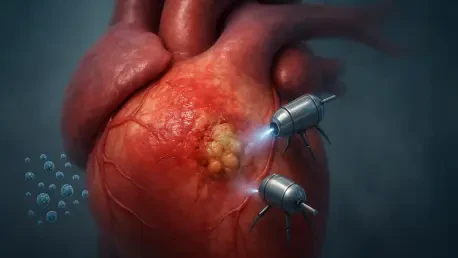

Engineers are leveraging the precision of electromagnetic steering to move medical devices through the heart without the need for internal power supplies. This breakthrough by the team at Johns Hopkins University introduces a pair of rice-sized robotic modules designed to address infective endocarditis, a life-threatening inflammation of the heart’s valves. Traditionally, patients suffering from this condition face grueling weeks of intravenous antibiotics or traumatic open-heart surgeries to remove infected tissue. By utilizing external magnetic fields for navigation, these tiny devices bypass the need for bulky batteries or complex internal motors, allowing them to traverse the delicate and high-pressure environment of the cardiovascular system. The primary objective is to deliver concentrated medicine directly to the site of infection, minimizing systemic side effects. This methodology represents a significant shift from broad-spectrum systemic treatments to hyper-localized intervention, changing how clinicians manage infections.
Dual-Module Engineering: Anchoring and Precision Delivery
The robotic system functions through the coordination of two specialized modules that operate in a sequential and collaborative manner. The first component is a needle module, which is engineered with microscopic barbs that facilitate a secure grip on the endocardial tissue. These barbs are critical because they allow the device to anchor itself firmly against the constant motion of the heart while reducing the force required for tissue penetration by approximately 66.7 percent compared to standard needles. Once the anchor is established, the second component—a drug-delivery module—is deployed to meet it. This modularity ensures that the sensitive delivery mechanism remains protected until it is time for the therapeutic phase. By separating the anchoring and delivery functions, the researchers have allowed for a higher degree of stability, ensuring the device does not drift away during the critical moments of medication release, even within the turbulent flow of blood within the heart chambers.
After the needle module has successfully secured its position, the drug-delivery module utilizes magnetic force to dock precisely with the stationary anchor. This docking sequence is fundamental to the system’s success, as it creates a stable bridge for the transfer of liquid medication into the targeted tissue. During controlled experiments, the device successfully delivered a precise dose of approximately 22 microliters of medicine over a sustained period of 180 minutes. This slow-release capability is designed to maintain high local concentrations of antibiotics or other therapies, which is far more effective than systemic administration for eradicating stubborn biofilms associated with heart infections. Once the delivery cycle is complete, the drug module can detach for retrieval or potential reloading, leaving the needle module in place if subsequent doses are required. This flexibility allows for a customizable treatment regimen tailored to the specific severity of the patient’s infection.
Clinical Integration: Navigation and Future Testing
A defining characteristic of these micro-robots is their completely untethered nature, which is made possible through the application of external electromagnetic fields. Unlike traditional catheters that require physical wires to provide power and direction, these robots respond to magnetic gradients generated by equipment positioned outside the patient’s body. Precision navigation is further enhanced by an AI-assisted visual guidance system that provides real-time feedback during the steering process. In laboratory environments, this advanced software allowed researchers to track the robots with exceptional accuracy, maintaining tracking errors at less than one-third of the total length of the robotic body. The implementation of these systems in clinical trials planned from 2026 to 2029 aims to validate these findings in more complex living systems. The AI guidance ensures that the magnetic pulses are calibrated perfectly to account for the resistance of blood flow and the proximity of delicate structures.
The development of these magnetic micro-robots established a new framework for treating localized cardiac infections with minimal physical trauma. The project demonstrated that untethered devices could successfully navigate and perform complex mechanical tasks within simulated biological environments. Moving forward, the focus shifted toward optimizing the biocompatibility of the materials used in the robots to prevent immune responses during long-term exposure. Engineers worked on refining the retrieval process to ensure that all components could be safely extracted after the infection subsided. Medical professionals recognized that the integration of such technology required a standardized protocol for electromagnetic steering in clinical settings to ensure consistency. These advancements paved the way for a shift in cardiology where precision robotics complemented traditional pharmaceutical approaches. The successful validation of these micro-devices suggested that future cardiac therapies would rely heavily on autonomous navigation to improve survival.