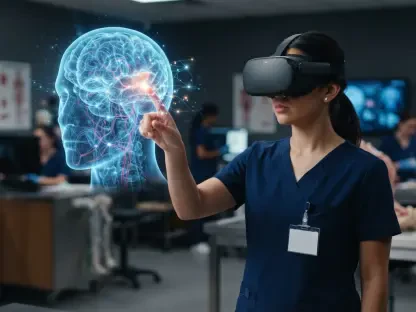

Differential privacy offers a technical trade-off where a privacy budget of five can stabilize accuracy while suppressing certain types of update-level leakage. This finding has sent ripples through the neurotechnology sector as the boundaries between clinical monitoring and consumer-grade wearable devices continue to blur in 2026. While the rapid adoption of Brain-Computer Interfaces (BCI) has enabled unprecedented control over assistive technology and immersive digital environments, it has simultaneously opened a Pandora’s box of privacy concerns. Electroencephalogram (EEG) signals are no longer viewed merely as clinical data for diagnosing epilepsy or sleep disorders; they are recognized as rich, quasi-biometric repositories of a person’s inner life. These millisecond-scale electrical recordings from the scalp can inadvertently reveal a user’s cognitive fatigue, emotional states, and even specific neurological predispositions. As the industry scales, the urgency to protect this highly personalized “neural footprint” has never been greater, especially as research indicates that traditional decentralized security models are failing to provide the robust anonymity users expect in increasingly interconnected ecosystems.
Investigating Vulnerabilities in Decentralized Neural Networks
Part 1: Experimental Design and Neural Architectures
To systematically evaluate how neural data might be exposed in a distributed network, researchers constructed a rigorous testing environment focused on motor imagery classification. This specific BCI task involves a user imagining the movement of their hands or feet, which generates distinct neural patterns that a computer can translate into commands. The study leveraged two comprehensive datasets to ensure the results were not limited to a small sample size: the BCI Competition IV Dataset 2a, which included nine subjects, and the more expansive PhysioNet Motor Movement dataset, featuring 109 individual subjects. By treating each subject as an independent “client” within a federated network, the experimental framework was able to mimic the architecture of modern healthcare clouds and consumer wearable platforms. This setup allowed the team to observe how individual brain signatures interact with a global model that is being updated by a diverse group of users.
The complexity of the underlying machine learning models played a pivotal role in determining the extent of the security risks. The research team employed two different neural network architectures to compare their performance and vulnerability. SimpleNet, a lightweight and fully connected network, was used to establish a baseline for how basic models handle sensitive updates. In contrast, EEGNet—a specialized convolutional neural network designed specifically for brain signals—was utilized to extract complex spatial and temporal features from the raw data. Despite the sophisticated design of EEGNet, which is highly efficient at interpreting brain activity, the study found that its ability to accurately identify patterns also made it more susceptible to leaking the very identity of the user. This suggests that the more effective a model becomes at recognizing neural signals, the more likely it is to retain the specific biometric characteristics that define the individual.
Part 2: Integrating Noise for Privacy Protection
In an effort to mitigate these significant risks, the researchers integrated Differential Privacy (DP) into the federated learning pipeline. This technique involves injecting controlled statistical noise—specifically Laplace noise—into the mathematical updates before they are transmitted from a user’s device to the central aggregator. The goal is to obscure the contribution of any single individual so that an attacker cannot determine whether a specific person’s data was used to train the model. The study measured the effectiveness of this defense using a “privacy budget” represented by the Greek letter epsilon ($\epsilon$). A lower budget indicates a higher level of noise and, theoretically, stronger privacy protection. By testing different values, the team sought to identify a “sweet spot” where the system could maintain high classification accuracy for motor imagery tasks without leaving the user’s identity exposed to digital eavesdroppers.
The implementation of Differential Privacy highlighted a fundamental tension between the utility of the technology and the security of the user. While adding noise successfully obscured some of the direct links between model updates and individual participants, it often came at the cost of the system’s overall performance. If too much noise was added, the motor imagery classifier struggled to distinguish between the intended commands, rendering the BCI device less responsive or even unusable. However, when the noise was reduced to improve accuracy, the “leakage” of personal information became more pronounced. This trade-off is particularly challenging in the context of neural data, because EEG signals are inherently noisy and highly variable. The research demonstrated that simply layering privacy protocols onto existing systems is not a panacea; rather, it requires a meticulous calibration that the industry has yet to standardize across different types of neural applications.
Evaluating Multi-Level Membership Inference Attacks
Part 3: The Threat Model and Attack Strategies
The study’s most critical contribution was the deployment of a sophisticated threat model known as the “honest-but-curious” server. In this scenario, the central computer responsible for aggregating data updates follows all the official protocols but simultaneously attempts to use the received information to infer private details about the users. This is a common concern in modern cloud computing where service providers might be tempted to monetize user insights or where a compromised server could expose sensitive data. To probe the defenses of the federated system, the researchers launched four distinct types of Membership Inference Attacks (MIAs). These included record-level inference, which checks if a specific EEG segment was used in training; feature-level inference, which targets the model’s internal representations; and gradient-level inference, which examines the raw updates sent to the server. Finally, client-identity inference was used to see if an update could be linked back to a specific person.
Each of these attack vectors revealed a different layer of vulnerability in the way federated networks handle brain data. Record-level attacks demonstrated that even when the data remains local, the way a model responds to “familiar” data can be a dead giveaway to an adversary. Feature-level attacks were particularly concerning because they showed that the internal “thought process” of the neural network retains a recognizable version of the user’s original neural patterns. By analyzing the intermediate activations of the model, an attacker could potentially reconstruct aspects of the user’s cognitive state that were never intended to be shared. These findings underscore that the privacy problem in BCI is not just about the raw data itself, but about the statistical echoes that the data leaves behind in every layer of the artificial intelligence system.
Part 4: Adversarial Models and Identification Methods
To ensure the attacks were as realistic as possible, the researchers used two different types of adversarial models to interpret the leaked datlogistic regression and random forests. These tools acted as the “attacker’s brain,” scanning the model updates for any discernible patterns that could link a signal to a specific user. Logistic regression provided a linear approach to identifying vulnerabilities, while random forests utilized a more complex, non-linear ensemble strategy to crack the privacy protocols. This dual-adversarial approach confirmed that even relatively simple statistical tools could bypass standard federated learning defenses. The results showed that the risk was not dependent on the attacker having access to supercomputing power; rather, the fundamental structure of how we currently share model updates is flawed.
The high success rates of these identification methods proved that the current standards for decentralized training are insufficient for neural applications. When the random forest model was applied to vanilla federated learning updates, it was able to identify the correct user with near-perfect precision. This level of accuracy suggests that model updates act as a highly descriptive signature, much like a digital fingerprint, that is nearly impossible to hide without extreme measures. The study found that even when users were part of a large group, their unique neural signatures stood out clearly against the aggregate. This suggests that the “anonymity in numbers” often promised by big data platforms is an illusion when dealing with data as deeply personal and physiologically unique as an electroencephalogram, requiring a complete rethink of how identity is handled in neural networks.
The Reality of Privacy Leakage in Federated Systems
Part 5: Identifying the Illusion of Data Locality
One of the most persistent myths in the tech industry is that keeping raw data on a local device is enough to guarantee privacy. The research by Khanam et al. effectively debunked this notion by showing that standard federated learning configurations are almost entirely transparent to a motivated attacker. Without the addition of differential privacy, the success rates for gradient-level and client-identity attacks reached a staggering 99.2%. This means that the central server—or anyone who compromises it—can pinpoint exactly which individual provided a specific update. The “privacy-by-design” label often attached to federated learning is shown to be misleading in this context; while the raw EEG files never leave the user’s smartphone or headset, the mathematical summaries sent to the cloud are just as revealing as the original signals.
This revelation has profound implications for the legal and ethical frameworks governing neurotechnology in 2026. If the “local data” promise is technically insufficient, then current consent forms and privacy policies may be providing users with a false sense of security. The study highlights that the problem is structural: the gradients computed during training are mathematically derived from the private data, and therefore they carry the statistical DNA of that data. In the case of EEG signals, which are high-dimensional and rich in personal identifiers, these gradients are far more descriptive than those generated by more generic data types like text or images. The illusion of locality fails because it ignores the fact that the model’s learning process is, by definition, an extraction of information from the source, and that information remains embedded in the update.
Part 6: Persistent Patterns in Neural Data
Even after the researchers applied differential privacy to the system, a troubling amount of information remained accessible. While the noise successfully suppressed the direct identification of clients, the record-level and feature-level leakages proved much harder to eliminate. The internal feature spaces of the EEGNet and SimpleNet models remained distinguishable even when the privacy budget was set to a strict level. This suggests that the way the human brain organizes signals during tasks like motor imagery is so distinct and consistent that it creates a residual signal that statistical noise cannot easily mask. The very features that allow a BCI to be accurate—the specific frequencies and spatial distributions of brain waves—are the same features that an attacker can use to identify a “member” of a training set.
This persistence of neural signatures points to a fundamental challenge in “neuro-privacy.” Unlike a password or a credit card number, you cannot change your brain’s electrical patterns if they are compromised. The study revealed that these signatures are deeply ingrained in the models trained on them. Even when the mathematical noise made the updates look like random data to a casual observer, the underlying neural structure remained intact enough for sophisticated algorithms to detect. This suggests that the industry must move beyond simple noise-injection techniques. To truly protect a user’s cognitive privacy, we may need to explore methods that fundamentally alter the representation of neural data before it ever enters a machine learning model, ensuring that the features used for control are decoupled from the features that define individual identity.
Correlation Between Model Performance and Risk
Part 7: Generalization and Intrinsic Signal Risks
A common belief in the field of artificial intelligence is that privacy leaks are primarily caused by overfitting, a phenomenon where a model memorizes its training data rather than learning general patterns. If a model is overfitted, it becomes highly vulnerable because it effectively contains a “copy” of the training samples. However, the researchers found that for EEG data, the relationship between performance and risk is much more complex. While overfitting did contribute to higher vulnerability in the smaller MI1 dataset, the larger MI2 dataset showed a different trend. In the larger group of 109 subjects, the models generalized well to new data but still exhibited high levels of privacy leakage. This implies that privacy risk is an intrinsic property of the EEG signal itself, not just a symptom of poor training.
This finding suggests that a perfectly functioning BCI system is, by its very nature, a privacy risk. Because the goal of these systems is to respond precisely to an individual’s unique neural commands, the system must learn to recognize that individual’s specific brain patterns. In 2026, as we move toward more personalized medicine and “always-on” neural wearables, this creates a paradox: the more helpful and accurate a device is, the more dangerous it becomes from a privacy perspective. The research indicates that even if a model is trained perfectly and avoids all traditional signs of overfitting, the “leakage” of the user’s identity is built into the output. This shifts the responsibility from the data scientists to the architects of the entire privacy ecosystem, requiring a defense that assumes the model will always contain sensitive information.
Part 8: Implications for Ethical Neurotechnology Design
The results of this study demand a transition toward a multi-layered defense strategy for all future brain-computer interface designs. Relying solely on federated learning or basic differential privacy is no longer a defensible position for companies handling neural data. Instead, engineers must consider a “defense-in-depth” approach that combines multiple cryptographic and statistical protections. For instance, secure multi-party computation could be used to aggregate model updates in an encrypted state, ensuring that even the central server never sees the individual contributions. Additionally, homomorphic encryption could allow the server to perform the necessary math on the updates without ever “unlocking” the sensitive information contained within them.
Beyond the technical requirements, the study highlights the need for context-specific privacy standards. A BCI used for a high-stakes medical diagnosis might require a different privacy budget than a consumer device used for gaming. Furthermore, the research noted that real-world data is often imbalanced—for example, in seizure detection systems where the “event” data is rare. In these cases, the minority class is even more vulnerable to being singled out, as their unique neural patterns stand out sharply against the “normal” background. Moving forward, the neurotech community must adopt a more nuanced understanding of risk that accounts for these imbalances and the highly personalized nature of brain activity, ensuring that the most vulnerable users are not the ones most at risk of a privacy breach.
Future Directions for Secure Neurotechnology
Part 9: Addressing Cumulative Loss and Active Adversaries
The study highlighted several vital areas for the next phase of neuro-security research, particularly the issue of cumulative privacy loss. In most current evaluations, the privacy budget is calculated per training round. However, a model might go through hundreds or even thousands of rounds over its lifecycle. In the context of 2026, where devices are constantly learning and adapting to a user’s changing neural patterns, the “total” amount of leaked information can add up over time, eventually rendering even the best defenses ineffective. Future systems must implement rigorous “privacy accounting” to track this cumulative risk and alert users or administrators when the total privacy loss exceeds a safe threshold. This would prevent the gradual erosion of anonymity that occurs in long-term federated learning deployments.
Researchers also emphasized the need to prepare for “active” or malicious adversaries. The current study focused on a passive, “curious” server, but the next generation of threats could involve attackers who intentionally inject poisoned data into the federated network. These malicious updates could be designed to “trick” the global model into revealing more information about the other participants or to create backdoors that make identity inference even easier. Safeguarding against these active threats will require new validation protocols to ensure that every update sent to the central server is not only private but also legitimate and non-malicious. The transition toward a more hostile cyber landscape necessitates that neurotechnology moves from a “trust-but-verify” model to a “zero-trust” architecture.
Part 10: Building Resilient and Respectful Systems
The findings presented by Khanam and colleagues served as a pivotal moment for the neurotechnology industry. It was demonstrated that the mere locality of data was not a sufficient shield against modern adversarial techniques. To move forward, the community began prioritizing the development of systems that treated cognitive privacy as a fundamental human right rather than a technical afterthought. This included expanding privacy evaluations to a wider range of EEG applications, from emotion recognition to sleep tracking, ensuring that every type of neural interaction was protected by the same rigorous standards. The goal shifted toward creating a universal security framework that could adapt to the diverse ways humans interact with brain-sensing technology.
Ultimately, the study concluded that privacy in the age of neural AI was not a static feature but a dynamic process that required constant vigilance. The researchers recommended that stakeholders in the BCI space adopt transparent auditing processes and standardized privacy metrics to provide users with clear evidence of their data’s safety. By integrating advanced cryptographic methods with refined differential privacy budgets, the industry worked toward a future where neural interfaces were both powerful and fundamentally respectful of the individual. The legacy of this research was the realization that while the brain may be the final frontier of data privacy, the tools to protect it are within reach if designed with a deep understanding of the unique signals that define us.