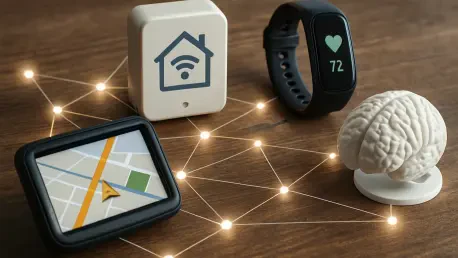

Modern life is increasingly defined by an invisible web of sensors that have migrated from the vast stretches of city infrastructure into the intimate corners of the private home. While the early days of the Internet of Things were dominated by the logistical management of public assets and the precision of satellite-based tracking, the current landscape has shifted toward a more profound objective: the preservation of human psychological well-being. This transition represents a significant leap from monitoring where a person is to understanding how a person feels. As the industry moves away from the macro scale of urban efficiency, a new focus on micro behavioral data is emerging, driven by the realization that our daily interactions with common objects can reveal more about our internal states than any questionnaire ever could. By leveraging sophisticated algorithms and domestic connectivity, researchers are now capable of identifying the subtle onset of mental health challenges long before a crisis manifests in a clinical setting.
The Evolution of Connectivity: From City Streets to Smart Homes
The initial success of IoT technology was largely built on the back of massive urban mobility projects that revolutionized how people navigate metropolitan environments. In cities like Seoul, the Ttareungi bicycle service serves as a prime example of how GPS-enabled networks can manage thousands of individual units across a sprawling geography. These systems rely on a complex interplay between satellite receivers and centralized software to track location, speed, and usage duration in real time. This capability has not only optimized fleet management and billing accuracy but has also fundamentally changed the public’s perception of shared resources. By ensuring that every bicycle is accounted for and every trip is logged, the technology provides a level of transparency and reliability that was previously impossible. This phase of development proved that IoT could handle high-density data and maintain operational integrity under constant pressure, setting the stage for more personal applications.
To address the shortcomings of traditional tracking, the focus has shifted toward ambient sensing, a concept where technology is woven into the very fabric of the home. Instead of requiring a person to wear a sensor, the sensors are embedded directly into common household appliances like refrigerators, microwaves, and dishwashers. This approach allows for passive, continuous data collection that occurs naturally as an individual goes about their daily life without any conscious effort. By monitoring how often a refrigerator door is opened or how long a television remains on, these systems can build a comprehensive profile of a user’s habits. This invisible technology removes the psychological burden of being monitored, leading to more authentic data that reflects true behavioral patterns. As the home environment itself becomes a diagnostic tool, the potential for identifying subtle shifts in a person’s mental state increases, providing a level of insight that is both objective and non-intrusive.
Behavioral Intelligence: Predictive Care and the Future of Wellness
Recent research from institutions like KAIST has demonstrated that the way we interact with domestic objects is a direct reflection of our internal psychological state. By analyzing data from sensors attached to kitchen appliances, researchers have been able to categorize various behavioral types that correspond with specific mental health conditions. For instance, an irregular frequency of using the microwave late at night often correlates with stress-induced eating habits, while a sudden decrease in using the stove might suggest a loss of interest in self-care. These interactions, when aggregated over time, create a digital signature of a person’s routine. This methodology allows for a sophisticated analysis of human behavior that moves far beyond the simple movement tracking seen in the early days of IoT. By providing a clear picture of daily life, these smart systems enable clinicians to tailor their treatments based on the actual needs of the individual rather than generic symptoms or biased self-reports.
The final evolution of this technology focused on establishing a unique behavioral baseline for each individual, creating an AI-driven system that acted as a preventative shield. The regularity of an individual’s routine became the most accurate predictor of health, where sudden deviations—such as altered sleep times or neglected chores—served as reliable red flags for a mental health crisis. When these patterns were detected, smart speakers provided proactive support or connected the user to professional help in real time. This journey from urban GPS to mental health care successfully bridged the gap between digital data and human emotion. The shift toward personalized medicine transformed the home into a laboratory for wellness, where technology served as a constant, silent guardian of the mind. By prioritizing the human experience over mechanical efficiency, the development of the Internet of Things proved that the most valuable data was that which helped people understand and protect themselves.