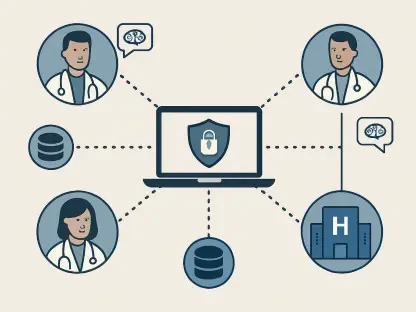

Modern healthcare institutions are currently grappling with a severe financial squeeze where the rising costs of labor and supplies far outpace the relatively stagnant reimbursement rates provided by insurance carriers and government programs. To navigate this treacherous economic landscape, hospital administrators are no longer treating artificial intelligence as a speculative venture or a niche experiment for early adopters but as a foundational pillar for operational survival. The shift from pilot programs to full-scale enterprise integration marks a critical turning point in how medical centers approach the documentation process, moving away from manual entry toward automated, high-precision systems. This technological evolution is primarily driven by the urgent need to close the revenue gap that has widened due to inefficient administrative workflows and the increasing complexity of modern medical coding requirements. By embedding AI directly into the clinical encounter, health systems are effectively safeguarding their financial health while simultaneously alleviating the heavy administrative burden that has historically hindered physician productivity.
Strategic Integration: Moving Toward Rapid Return on Investment
Executive leadership teams in the healthcare sector have fundamentally altered their expectations regarding the implementation of digital tools, moving away from broad qualitative goals toward strict quantitative performance metrics. While initial investments in ambient clinical intelligence were often justified by the desire to improve clinician satisfaction and reduce burnout, the current priority is a rapid and demonstrable return on investment that materializes within a single fiscal year. Financial officers now demand that technology deployments provide a clear path to profitability, typically expecting measurable gains within six to twelve months of activation. Healthcare organizations that initiated these programs are now projecting a steady increase in revenue capture from 2026 to 2028, reflecting a more sustainable fiscal trajectory. This rigorous financial scrutiny has forced a pivot toward AI solutions that integrate seamlessly with existing electronic health record systems to capture every billable detail without manual input.
The transition toward data-driven financial management is characterized by a granular focus on reducing administrative friction points that traditionally lead to revenue leakage and unpaid claims. Advanced algorithms are now employed to identify discrepancies between the services provided and the documentation submitted, ensuring that every claim is supported by robust clinical evidence before it reaches the payer. This level of scrutiny significantly lowers the probability of claim denials, which have historically cost large health systems millions of dollars in lost revenue and administrative rework each year. Furthermore, the speed at which AI can process and format clinical notes allows for a much faster billing cycle, reducing the number of days that charges remain in accounts receivable. By optimizing the documentation-to-reimbursement pipeline, healthcare organizations can stabilize their cash flow and reinvest those funds into critical patient care initiatives and facility upgrades that were previously deferred due to budgetary constraints.
Precision Coding: Strengthening the Documentation-to-Revenue Pipeline
High-fidelity clinical documentation serves as the essential infrastructure for the entire revenue cycle, and any lapse in accuracy during the initial note-taking phase can have cascading negative effects on a provider’s bottom line. Artificial intelligence serves as a sophisticated filter that analyzes the nuances of a clinical encounter to ensure that the resulting medical codes accurately reflect the severity of the patient’s condition and the intensity of the care provided. Human error, often caused by fatigue or the sheer volume of data, frequently leads to under-coding, where complex procedures are recorded as simpler, lower-reimbursed services. AI-driven platforms mitigate this risk by cross-referencing patient vitals, laboratory results, and physician observations to suggest more precise diagnostic codes that capture the true resource utilization of each visit. This level of accuracy not only maximizes legitimate reimbursement but also ensures that the healthcare provider remains compliant with federal auditing standards, thereby avoiding the costly penalties associated with incorrect billing practices.
The practical application of automated documentation yields distinct financial benefits depending on the specific clinical environment, ranging from the high-stakes emergency department to traditional outpatient settings. In the fast-paced world of emergency medicine, physicians often experience memory decay, where the specific details of multiple rapid-fire patient interactions begin to blur before the doctor has a chance to sit down and complete their charts. AI tools that capture audio or text in real-time allow these details to be preserved instantly, ensuring that critical procedures and time-based interventions are not omitted from the final billing statement. Conversely, in the ambulatory care space, the focus shifts toward capturing the full scope of chronic disease management and preventive services that are often overlooked in manual documentation. By meticulously recording every aspect of the patient journey, from initial assessment to the coordination of follow-up care, AI ensures that no billable service goes unrecorded, effectively plugging the holes in the revenue stream that have historically plagued independent practices.
Operational Excellence: Optimizing Long-Term Financial Performance
In the context of value-based care and Medicare Advantage models, the financial health of an organization is inextricably linked to the accurate documentation of a patient’s total risk profile over an extended period. Artificial intelligence has become an indispensable tool for identifying and documenting chronic conditions that might otherwise be missed during a routine consultation, ensuring that risk adjustment scores are both accurate and comprehensive. Organizations that have transitioned from using AI as a mere convenience to using it as a central component of their revenue cycle management have seen significant improvements in their financial standing. By increasing the specificity of clinical notes, these institutions have minimized the exhausting cycle of appeals and resubmissions that typically occurs when insurance payers question the necessity of a specific treatment. This move toward greater precision allows for a more collaborative relationship with payers, as the documentation provided is backed by objective, AI-verified data that is much harder to dispute during the claims review process, ultimately leading to a more predictable and sustainable revenue stream.
To secure a stable financial future, healthcare leaders prioritized the integration of automated documentation systems that focused on data integrity and revenue protection over simple convenience. These organizations adopted a phased implementation strategy that began with the deployment of ambient listening tools in high-volume departments to demonstrate immediate gains in productivity and billing accuracy. By selecting vendors that offered deep integration with existing electronic health record platforms, administrators ensured that the transition was seamless and did not require extensive retraining of the medical staff. Decision-makers also established clear key performance indicators to monitor the impact of AI on claim denial rates and the speed of the reimbursement cycle, allowing for real-time adjustments to their financial strategies. Moving forward, the focus shifted toward utilizing the vast amounts of captured data to predict future revenue trends and identify new opportunities for service expansion. This proactive approach to financial management allowed providers to maintain a high standard of clinical care while successfully navigating the complex economic challenges of the modern healthcare market.