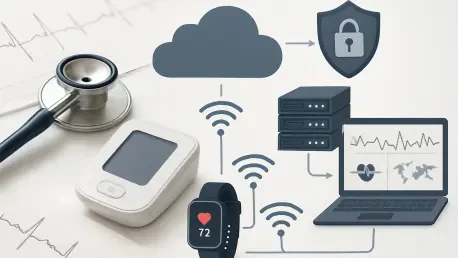

The implementation of CRYSTALS-Kyber and other post-quantum algorithms presents significant challenges for the limited computational cycles of ultra-low-power implants. As the Medical Internet of Things moves beyond simple step-counting wearables into the realm of life-critical cardiac and neuro-stimulators, the demand for sophisticated security has never been higher. This technological shift is part of a broader digital metamorphosis where decentralized healthcare systems are projected to reach a market valuation exceeding $446 billion by 2028. Driven by the expansion of telemedicine and the urgent need for continuous remote patient monitoring, the industry is navigating a transition from isolated gadgets to a unified global ecosystem. However, this massive expansion integrates telecommunications and clinical practice in ways that expose significant vulnerabilities in system interoperability. The sheer volume of connected devices necessitates high-speed pipelines that can handle sensitive data without compromising the underlying medical hardware or patient safety.
Short-Range Connectivity: Optimization of Medical Sensor Networks
The foundational layer of the current medical ecosystem rests on diverse communication protocols that are specifically tailored to balance data throughput with extreme power constraints. Bluetooth Low Energy has firmly established itself as the gold standard for consumer-facing wearables and portable diagnostic tools due to its minimal energy requirements and specialized profiles for medical data. These profiles allow devices like continuous glucose monitors and pulse oximeters to transmit periodic updates while maintaining a battery life that spans weeks or even months. Meanwhile, in institutional settings where hundreds of sensors must operate in close proximity, Zigbee provides the necessary mesh networking capabilities. This architecture allows for a high density of devices to communicate across vast hospital wards without saturating the primary network, ensuring that patient vitals are transmitted reliably from the bedside to central monitoring stations without significant interference or signal degradation.
Building on these short-range foundations, high-bandwidth applications require a more robust approach to data transmission within the clinical environment. While low-power protocols handle routine vitals, Wi-Fi remains indispensable for tasks that involve high-resolution diagnostic imaging or real-time telehealth consultations. The ability to stream 4K surgical video or transfer massive magnetic resonance imaging files requires the throughput that only advanced wireless local area networks can provide. However, this reliance on Wi-Fi introduces a higher energy cost, which is typically managed through the use of plugged-in medical carts or high-capacity rechargeable battery packs. The integration of these disparate protocols creates a multi-tiered communication architecture where the specific needs of the medical application dictate the choice of technology, ensuring that critical data is always prioritized over less urgent administrative traffic while maximizing the operational lifespan of mobile health devices.
High-Performance Communication: The 6G Medical Frontier
The horizon of medical connectivity is increasingly defined by the impending transition to 6G cellular technology, which promises to unlock clinical capabilities that were once considered theoretical. With anticipated data rates reaching one terabit per second and latency levels dropping to near-zero, 6G is positioned as the primary enabler for extreme medical applications such as long-distance telesurgery. In this scenario, a specialist can operate a robotic platform from across the globe with no perceptible delay, a feat that current 5G networks still struggle to achieve in high-stress surgical environments. Furthermore, 6G will facilitate the use of 3D holographic consultations, allowing doctors to interact with lifelike digital representations of patients in real-time. This leap in connectivity is not merely about speed but about the reliability and density of the network, enabling thousands of simultaneous high-speed connections within a single metropolitan health district without the risk of packet loss or system congestion.
This massive leap in wireless performance also allows for the creation of digital twin hospitals, where every aspect of a facility’s operations and patient responses is simulated in a virtual environment. These digital twins utilize real-time data from 6G-enabled sensors to model the spread of infectious diseases or to predict how a patient’s body might react to a specific pharmaceutical intervention. By running thousands of simulations in the virtual space before performing a procedure in the physical world, clinicians can optimize care strategies and significantly reduce the margin for error. The 6G era represents a fundamental shift from reactive medical care to a predictive and highly synchronized model, where the network itself acts as a vital component of the diagnostic process. This transition necessitates a complete overhaul of existing infrastructure, as hospitals must upgrade their internal hardware to support the extreme frequencies and sub-millimeter wave technologies that define this new communication standard.
Decentralized Processing: Edge Computing in Clinical Workflows
To manage the massive influx of data generated by advanced networks and millions of medical sensors, the architectural focus has shifted toward the implementation of edge computing. Traditionally, medical data was funneled to centralized cloud servers for processing, a method that often introduced dangerous delays in emergency situations and increased the vulnerability of sensitive information during transit. By moving computational power to the edge—directly onto the wearable device or within the local hospital network—AI-driven systems can now provide instantaneous diagnostic alerts and crisis responses. This localized approach ensures that a patient experiencing a sudden cardiac event receives an immediate intervention from an automated system rather than waiting for data to travel to a distant server and back. Edge computing effectively transforms the medical device from a passive collector into an active participant in the patient’s immediate healthcare management and safety.
This decentralized strategy also serves as a critical defense mechanism for maintaining patient privacy and reducing the overall strain on global bandwidth. By processing raw physiological data locally, only essential and anonymized summaries need to be transmitted to the central cloud for long-term storage or longitudinal analysis. For instance, an edge-enabled neuro-stimulator can analyze brain activity patterns internally and only send a high-level report of seizure activity to the neurologist, rather than uploading a continuous stream of raw electroencephalogram data. This selective transmission not only saves battery life but also minimizes the “attack surface” available to hackers who might attempt to intercept medical data in transit. As machine learning models become more efficient, the ability to perform complex medical diagnostics at the edge will become the standard, allowing for sophisticated health monitoring even in remote areas with limited access to high-speed internet or stable cloud infrastructure.
Advanced Cybersecurity: Moving Toward Post-Quantum Resiliency
Security is currently the most formidable challenge facing the IoMT, requiring a multifaceted defense strategy that covers data both at rest and in transit. Standard protocols such as AES-256 and TLS 1.3 have served the industry well, but the increasing complexity of medical networks demands more than just traditional encryption. A modern, secure architecture must integrate hardware-based authentication, such as Trusted Platform Modules, which provide a physical root of trust that is virtually impossible to bypass through software alone. These hardware security modules ensure that only authorized devices can join a hospital network, preventing the “man-in-the-middle” attacks that have plagued earlier iterations of connected health tech. Furthermore, rigorous organizational policies must be synchronized with technical measures to ensure total compliance with international legal standards like HIPAA and GDPR, which govern the ethical handling and storage of sensitive patient information.
The emergence of quantum computing has introduced a unique “harvest-now, decrypt-later” threat, where malicious actors steal encrypted medical records today with the intent of cracking them once quantum technology reaches maturity. Because medical histories remain sensitive for several decades, the transition to post-quantum cryptography has become an urgent priority for healthcare providers and device manufacturers alike. Algorithms like CRYSTALS-Kyber are being deployed to resist quantum-level brute-force attacks while still functioning on existing silicon architectures. However, the increased mathematical complexity of these algorithms requires more computational power, which can significantly drain the batteries of implanted medical devices. Balancing the need for high-level security with the physical limitations of a pacemaker or an insulin pump remains a primary focus for engineers who must ensure that the next generation of security does not come at the cost of device longevity or patient comfort.
Quantum Key Distribution and Blockchain Integrity
For the most sensitive segments of healthcare, such as the exchange of genomic sequences or pharmaceutical research, Quantum Key Distribution offers a theoretically unbreakable layer of protection. Unlike classical encryption, which relies on mathematical difficulty, QKD uses the laws of physics to detect any attempt at eavesdropping. If a third party tries to intercept a quantum-distributed key, the quantum state of the particles changes, immediately alerting the sender and receiver to the breach. While the high cost of the necessary fiber-optic infrastructure currently limits QKD to institutional transfers between major research centers, it represents the future of secure communication for high-value medical assets. As the technology matures and the cost of specialized photon detectors decreases, we can expect to see QKD-secured pipelines connecting national health databases, ensuring that the most intimate biological data of a population remains shielded from even the most advanced cyber-adversaries.
Complementing these physical security measures is the integration of consortium blockchain technology, which provides an immutable audit trail for patient data and consent management. While public blockchains are often too slow and energy-intensive for the high-frequency data generated by medical sensors, private or consortium-based ledgers offer the throughput necessary for large-scale hospital operations. These decentralized ledgers empower patients by giving them absolute control over who accesses their medical records, allowing them to grant temporary permissions to specialists or researchers via smart contracts. Once a record is added to the blockchain, it cannot be altered or deleted without detection, which prevents the fraudulent manipulation of medical history or pharmaceutical trial results. This transparency builds a foundation of trust between patients and providers, ensuring that data integrity is maintained throughout the entire lifecycle of a medical record, from the initial sensor reading to final clinical analysis.
Strategic Outcomes: Harmonizing Technical and Ethical Requirements
The researchers determined that the future of medical connectivity depended on the successful resolution of the trilemma involving security, energy efficiency, and interoperability. It was concluded that the industry had to move toward a more standardized framework that allowed disparate devices from different manufacturers to communicate seamlessly within a single clinical environment. The study identified that the implementation of post-quantum standards was no longer an optional upgrade but a foundational necessity to protect against long-term data exposure. By analyzing the performance of current edge computing models, the investigation found that localized intelligence significantly reduced the risks associated with data latency and transit vulnerabilities. These findings suggested that the path forward required a unified effort to integrate advanced cryptographic measures without compromising the battery life of life-sustaining implants or the speed of emergency response systems.
As the industry moved toward more advanced implementations, the integration of federated learning emerged as a critical strategy for collaborative medical research. It was established that this privacy-by-design approach allowed multiple institutions to train diagnostic models on diverse datasets without ever sharing raw patient information across borders. This methodology addressed both the legal hurdles of data privacy and the technical challenges of managing massive datasets. The final analysis indicated that the successful synthesis of 6G networks, quantum-resilient protocols, and decentralized intelligence would ultimately define the next generation of human healthcare. Practical steps were recommended to prioritize the development of more efficient power management for high-security implants. These strategic efforts paved the way for a more resilient and patient-centric ecosystem where the benefits of global connectivity were balanced against the absolute necessity of individual data sovereignty.