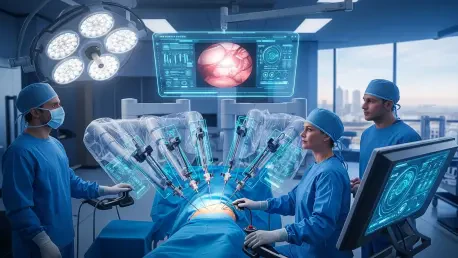

The intricate dance of a robotic arm navigating the microscopic corridors of a human artery requires more than just pre-programmed instructions; it demands a profound, intuitive understanding of the physical world. While traditional artificial intelligence has largely flourished within the boundless digital realms of text and imagery, the next frontier involves embedding this intelligence into machines that can feel, react, and predict the consequences of their physical actions. Nvidia is currently spearheading this transition by moving beyond standard digital logic to pioneer what is known as Physical AI. This strategy focuses on teaching machines to interact with their environment through embodied experience, fundamentally changing how robots are trained for high-stakes environments. In the realm of healthcare, this manifests as a sophisticated Medical Physics Simulation framework within the Isaac platform. Here, surgical robots are not merely told what to do; they are trained to understand the laws of physics, developing a physical intuition regarding force, contact, and tissue response. By mastering these variables, these systems move from being simple programmed tools to intelligent entities capable of navigating the complex, tactile environment of a human body. This shift represents a departure from static automation toward dynamic, responsive systems that can adjust to the subtle nuances of human anatomy in real time. The boundary between mechanical execution and cognitive decision-making is becoming increasingly blurred as these machines learn to interpret the physical world with a level of precision previously reserved for experienced human surgeons.
Addressing The Severe Bottleneck Of Clinical Data
Developing advanced surgical robots is notoriously difficult due to the severe lack of high-quality, diverse data from actual clinical procedures. Unlike AI chatbots that learn from vast amounts of internet text, surgical robots cannot easily practice on human patients because the operating room is a highly regulated space where safety is paramount. The slow pace of clinical trials means a robot might wait years to encounter rare anatomical variations or specific complications, such as a calcified vessel or a unique tissue reaction, making real-world learning impractical. This scarcity of data creates a significant barrier to entry for developers who need to ensure their systems can handle every possible scenario. Without a massive library of diverse surgical outcomes, the progress of autonomous medical technology remains tethered to the limited frequency of physical surgeries. This logistical constraint has historically forced manufacturers to rely on simplified models that do not fully capture the chaotic reality of a living organism. Consequently, the industry has long sought a way to accelerate the learning curve without compromising patient safety or ethical standards. The challenge lies in finding a middle ground where machines can gain experience without the inherent risks of live experimentation.
To bypass these logistical and ethical hurdles, Nvidia’s framework manufactures these critical experiences computationally. By generating thousands of complex physical interactions on demand, developers can expose robotic systems to corner cases that they would rarely see in a physical hospital setting. This ability to synthesize data allows for the creation of smarter, more responsive machines that have already seen and practiced for thousands of potential surgical scenarios before they ever touch a patient. This synthetic environment allows for the simulation of rare pathologies and unexpected surgical mishaps, providing the robot with a comprehensive education in disaster management. Moreover, the simulated nature of this training means that a robot can fail thousands of times in a virtual environment to perfect a single movement. This iterative process ensures that the final software version deployed in a hospital has been vetted against a much wider range of variables than any single surgeon would encounter in a lifetime. By digitizing the experience of surgery, the platform provides a scalable solution to the data bottleneck, ensuring that every robotic system is prepared for the most challenging anatomical anomalies. This proactive approach to training is essential for building public and professional trust in automated medical interventions.
Merging Rigid Physics With Creative Generative Systems
The technological core of this shift relies on a hybrid architecture that blends the hard rules of classical physics with the creative power of generative AI. Mechanical simulation libraries model predictable elements like the bending of a catheter or the resistance of a vessel wall, while generative components handle visual scene dynamics and unpredictable anatomical variations. This combination ensures that the robot understands not just the math of the procedure, but also the visual and physical nuances that define human surgery. By integrating these two distinct types of intelligence, the system can simulate how light reflects off moist tissue or how blood might obscure a camera lens. These visual details are crucial for training the computer vision systems that guide robotic movements, as they provide a level of realism that standard simulations often lack. Furthermore, the physics engine provides a grounding reality that prevents the generative AI from creating impossible physical interactions. This synergy creates a high-fidelity virtual world where every action has a realistic consequence, allowing the robot to develop a sophisticated sense of cause and effect. This dual-layered approach is what separates Physical AI from previous iterations of medical software, as it accounts for both the seen and the unseen forces at play during an operation.
This approach utilizes massive GPU power to run thousands of training environments at the same time, a process known as parallel simulation. Nvidia’s benchmarks show that this method can compress months of training into minutes, allowing developers to explore failure modes at an unprecedented scale. While this speed dramatically accelerates the research and development phase, it also provides a controlled environment where robots can make mistakes and learn from them without any real-world risk to patient health. The ability to run these simulations in parallel means that a robot can learn from different scenarios simultaneously, effectively crowdsourcing its own education across a virtual fleet of machines. This massive scale of computation is necessary to handle the complexity of the human body, which is far more variable than any industrial assembly line. As the hardware becomes more powerful, the fidelity of these simulations continues to improve, bringing the virtual training ground closer to the reality of the operating room. This technological leap allows for the rapid testing of new surgical techniques and instruments, significantly reducing the time it takes to move a product from the design phase to clinical implementation. This efficiency is a cornerstone of the modern medical technology development cycle, enabling faster innovation.
Industry Integration And The Drive Toward Transparency
Major industry players like Johnson & Johnson MedTech and Medtronic are already adopting this Physical AI framework to refine their robotic systems. For example, some companies use digital twins to simulate complex kidney stone procedures, while others focus on training autonomous systems to feel their way through delicate cardiovascular networks. These applications demonstrate how simulation can enhance precision in diverse fields, from urology to heart surgery, by providing robots with a sophisticated sense of touch and spatial awareness. By creating a digital twin of a specific procedure, engineers can identify potential mechanical failures before they occur in a clinical setting. This level of preparation is particularly valuable for procedures that involve navigating tight, tortuous pathways within the body where visibility is limited. The integration of Physical AI into these established platforms provides a significant competitive advantage, allowing companies to iterate on their designs with greater speed and accuracy. Furthermore, the data gathered from these simulations can be used to provide real-time guidance to human surgeons, creating a collaborative environment where man and machine work in tandem. This partnership is already showing promise in reducing the rate of complications and improving overall patient outcomes across various surgical specialties.
Despite these technological leaps, the transition to AI-driven surgery requires high levels of transparency to satisfy regulatory bodies like the FDA. Nvidia’s decision to make the framework open-source allows researchers and regulators to inspect the underlying physics and ensure that the robot’s behaviors are based on sound scientific principles. While simulation cannot yet fully replace physical testing, it serves as a vital foundation for proving safety and reliability in a field where there is zero margin for error. Providing an open-source platform encourages a community-driven approach to safety, where multiple experts can audit the simulation for biases or inaccuracies. This transparency is essential for gaining regulatory approval, as it provides a clear record of how the AI was trained and what data influenced its decision-making processes. Moreover, the ability to replicate results across different research institutions helps to standardize the benchmarks for robotic performance. As the industry moves toward more autonomous systems, the need for verifiable and explainable AI becomes even more critical. By anchoring the training process in the immutable laws of physics, developers can provide a logical justification for the robot’s actions, which is a key requirement for any medical device. This focus on accountability ensures that the technology remains a tool for healing rather than a source of unpredictable risk.
Future Implications: Establishing New Standards For Surgical Safety
The transition from static robotic tools to intelligent, physically aware partners represented a fundamental shift in how the medical community approached surgical intervention. As these systems became more integrated into the standard of care, the focus moved toward creating a seamless interface between the surgeon’s intent and the robot’s execution. This evolution was not about replacing the human element but rather about extending it, allowing surgeons to perform tasks that were previously considered beyond the limits of human dexterity. The use of Physical AI helped to bridge the gap between theoretical knowledge and practical application, providing a safety net that could intervene when a human error was detected. This period of development highlighted the importance of a multi-disciplinary approach, bringing together computer scientists, physicists, and medical professionals to solve some of the most complex challenges in modern medicine. The successful implementation of these systems demonstrated that the key to safer surgery lay in the ability to predict and adapt to the unpredictable nature of biological systems. This realization prompted a broader discussion about the ethical implications of autonomous medical devices and the necessity of maintaining human oversight in an increasingly automated world.
To maximize the benefits of these advancements, healthcare organizations had to prioritize the development of robust infrastructure that could support large-scale simulation and data analysis. The move toward digital twins and Physical AI required a commitment to continuous learning and the adoption of open standards to ensure interoperability between different robotic platforms. Stakeholders within the medical industry recognized that the path forward involved fostering an ecosystem where data was shared responsibly to improve safety for all patients. They also emphasized the need for ongoing education for medical professionals, ensuring that they were equipped to manage and supervise these sophisticated machines effectively. By focusing on the integration of physics-based intelligence and human expertise, the medical field established a new paradigm for surgical precision. This approach ensured that the technology remained focused on the ultimate goal of improving patient care and reducing the physical burden of disease. The lessons learned during this phase of technological expansion provided a blueprint for other high-stakes industries, illustrating how Physical AI could be used to enhance safety and performance in complex environments. This collaborative effort set the stage for a new era where technology and medicine worked in harmony to achieve unprecedented results.