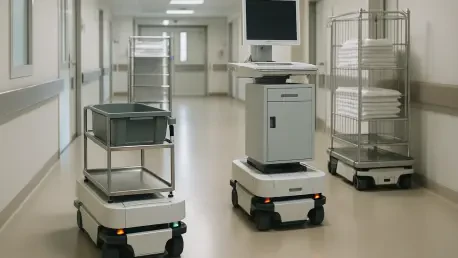

Hospital logistics robots are expected to become a $4.2 billion market by 2032 as facilities seek ways to automate the transport of supplies and medications. This projection underscores a massive shift as healthcare systems move beyond simple software demonstrations toward the tangible integration of agentic and physical artificial intelligence. While agentic AI focuses on autonomous digital systems that can plan and execute complex administrative workflows like patient scheduling, physical AI involves hardware—most notably robotics—equipped with spatial sensors to interact with the environment. This distinction is crucial for hospital boards now deciding where to allocate capital. In the current landscape of 2026, the industry is no longer content with theoretical potential; the focus has shifted to how these systems can reliably perform in high-pressure clinical settings. Successfully crossing this threshold requires a departure from isolated testing toward a comprehensive strategy that addresses technical hurdles and human adoption.
Bridging the Gap: Moving Beyond the Initial Pilot Phase
Despite widespread enthusiasm, a notable discrepancy exists between the intended use of artificial intelligence and its daily operational reality on the hospital floor. Recent survey data from the beginning of 2026 indicates that while over 80% of healthcare executives expect these technologies to deliver significant value, only about 3% have successfully deployed autonomous agents into live clinical workflows. This ‘scale gap’ reveals that many projects were initially designed for controlled demonstrations rather than the chaotic, unpredictable nature of a working medical facility. Analysts suggest that nearly 40% of ongoing agentic AI projects face cancellation by 2027 because they lack the necessary risk controls or fail to prove a clear financial return. The transition from a pilot to a production environment is notoriously difficult, as it requires the technology to withstand the rigors of 24/7 hospital demands without the constant supervision of the developers who built it.
Institutional Resilience: The Reality of Clinical Integration
The struggle to scale often originates from the inherent complexity of healthcare infrastructure, which is frequently characterized by fragmented legacy systems and inconsistent data standards. Unlike the sanitized environments of a technology lab, hospital wards are high-stakes settings where the margin for error is non-existent. When an AI tool moves from a pilot phase to real-world use, it encounters obstacles such as incomplete electronic health records and varying clinical protocols that differ even between departments. To overcome these barriers, organizations are beginning to realize that the technology must be adaptable and resilient enough to handle these irregularities. Instead of chasing the most sophisticated algorithms, successful facilities are prioritizing the integration layer that allows AI to communicate with existing software. This approach ensures that the tool supports the staff rather than creating additional technical debt or logistical friction that could jeopardize patient safety or operational continuity.
Clinical Leadership: Transforming Skepticism Into Active Adoption
Transitioning AI into permanent clinical use requires a unified strategy among the C-suite, moving the technology out of IT silos and into the broader operational framework. Clinical leaders, including Chief Medical Officers, must champion these tools as a means of providing workload relief rather than as a disruption to established patient care models. For instance, the deployment of specialized logistics robots, such as those used for delivering medications, has already demonstrated the ability to save nursing staff thousands of hours of manual labor. When healthcare professionals see that physical AI handles repetitive, time-consuming tasks like transport, their skepticism often turns into active support. This cultural shift is essential for long-term success, as the value of AI is ultimately determined by the willingness of the frontline workforce to incorporate it into their routines. Providing structured training and clear escalation paths ensures that staff feel empowered rather than replaced by new automated assistants.
Technical Foundations: Prioritizing Data Quality and Governance
On the technical and financial side, leadership must focus on building a robust data foundation and a phased investment model. Chief Information Officers are currently prioritizing data quality and governance to prevent the risks associated with AI ‘hallucinations’ or the processing of inaccurate clinical information. Without well-governed data, even the most advanced agentic AI becomes a liability rather than an asset. Meanwhile, Chief Financial Officers are shifting away from approving massive, one-time capital outlays toward a more incremental funding approach tied to specific performance milestones. By releasing funds as the technology proves its return on investment in specific workflows—such as reduced administrative overhead or optimized supply chains—hospitals can manage the financial risks of scaling. This disciplined financial oversight ensures that the expansion of AI capabilities is grounded in measurable gains, allowing the organization to build a sustainable ecosystem that can evolve alongside future technological breakthroughs.
Safety and Oversight: Implementing Human-in-the-Loop Controls
As hospitals move toward agentic and physical AI, the focus shifts from systems that merely analyze data to those that execute actions in the physical or digital world. This transition necessitates a far more rigorous governance framework than what was required for traditional diagnostic tools. Action-oriented systems, whether they are managing medication schedules or assisting in robotic surgery, require built-in guardrails and comprehensive audit trails to ensure accountability. Quality and safety leads are now tasked with establishing ‘human-in-the-loop’ protocols that allow for immediate clinician intervention if an automated system encounters an unexpected exception or a high-risk patient scenario. These safety mechanisms are not just technical requirements; they are the foundation of trust between the technology and the medical professionals who rely on it. By creating a transparent environment where every AI-driven action is logged and reviewable, hospitals can mitigate the risks of automation while maximizing its efficiency.
The Path Forward: Transforming Hospital Efficiency Through Automation
Ultimately, the goal of moving AI from the pilot phase to real-world use was to protect the human element of medicine by automating the logistical and administrative burdens that often lead to professional burnout. By the end of 2026, forward-thinking organizations recognized that the path to success was not found in replacing clinicians, but in providing them with the space to exercise their clinical judgment and empathy. The transition process taught leadership that scaling technology required a balance between technical innovation and cultural readiness. Strategic investments in data infrastructure and staff training became the hallmarks of hospitals that successfully integrated these tools. By focusing on narrow, high-impact tasks such as scheduling and supply chain management, facilities were able to demonstrate immediate value without compromising patient care. This disciplined approach transformed AI from an experimental novelty into a permanent, governed asset that significantly enhanced the operational resilience and service quality of modern healthcare environments.