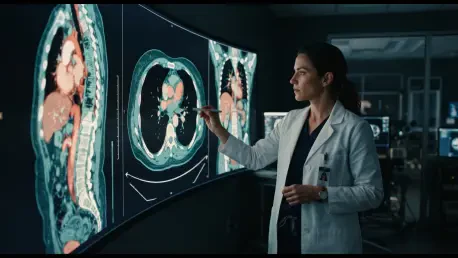

The transition from standalone software to integrated healthcare platforms is a key component of the current strategy for medical imaging technology providers. In an era where diagnostic efficiency dictates patient outcomes, Coreline Soft has solidified its leadership by securing its 13th U.S. Food and Drug Administration 510(k) clearance for the AVIEW Aorta Metrics system. This milestone reflects a pivot toward comprehensive cardiovascular analysis, moving beyond the company’s established expertise in pulmonary health. The newly cleared software is specifically designed to automate the complex process of aortic segmentation, providing radiologists with high-precision diameter measurements across various anatomical regions directly from standard chest CT scans. By streamlining these workflows, the technology addresses a critical need for reliable quantitative data in high-pressure clinical environments. This strategic expansion ensures that medical facilities can leverage AI to provide more detailed insights without adding unnecessary complexity to their existing imaging protocols.
Enhancing Diagnostic Accuracy Through Automated Analytics
Advanced Segmentation: The Core of Quantitative Assessment
The primary challenge in monitoring aortic health has historically been the variability inherent in manual measurement techniques, which can lead to inconsistent patient management. AVIEW Aorta Metrics mitigates these risks by utilizing sophisticated algorithms that offer straightened curved planar reformation and intricate 3D visualizations of the vascular structure. These tools allow for a more shadowed understanding of the aorta’s geometry, facilitating the identification of subtle changes that might be missed during a traditional review. Furthermore, the software provides automated zone classification, ensuring that every assessment is conducted with a high degree of objectivity. This level of technical sophistication is essential for longitudinal studies where tracking the growth of an aneurysm over several years requires absolute precision. By digitizing and automating these steps, the platform reduces the cognitive load on radiologists while simultaneously increasing the diagnostic reliability of every scan performed.
Consistent Monitoring: Improving Clinical Outcomes
Reliable quantitative evaluations are the cornerstone of modern preventative medicine, especially regarding life-threatening conditions like aortic dissections or expansions. The integration of Aorta Metrics into the clinical workflow allows for the establishment of a standardized baseline for every patient, which is vital for monitoring progression over time. Because the AI performs measurements in a reproducible manner, it eliminates the subjective variability that often plagues manual reporting. This consistency ensures that any change in aortic diameter is interpreted as a genuine physiological shift rather than a difference in measurement technique between technicians. As healthcare systems transition toward more data-driven models, having access to such precise biomarkers becomes indispensable. This technology not only supports immediate diagnostic needs but also enhances the long-term predictive capabilities of radiology departments, allowing for earlier interventions and personalized treatment planning for patients.
Strategic Implementation and the Future of Screening
Opportunistic Screening: Maximizing the Value of Medical Imaging
The current American healthcare landscape is increasingly focused on the concept of opportunistic screening, which seeks to extract maximum diagnostic value from every imaging procedure performed. Coreline Soft’s AVIEW platform is at the forefront of this movement, enabling clinicians to analyze multiple conditions from a single chest CT examination. Instead of looking solely for lung nodules or signs of pneumonia, the software simultaneously assesses coronary artery calcium and aortic metrics, effectively turning a standard scan into a comprehensive multi-organ health check. This holistic approach is particularly valuable in identifying asymptomatic conditions that might otherwise go undetected until they reach a critical stage. By integrating these disparate analyses into a single interface, the platform optimizes the efficiency of the radiology suite and ensures that no potential health risk is overlooked. This strategy aligns with the broader industry goal of improving population health management.
Market Integration: Bridging Detection and Application
Building on this foundation, the company deepened its footprint in the U.S. market through significant collaborations with industry leaders such as INFINITT North America and Optellum. These partnerships facilitated “zero-click” automation within existing Picture Archiving and Communication Systems, significantly lowering the barrier for clinical adoption. At the RSNA 2026 conference in Chicago, the demonstration of these integrated tools showcased how the gap between automated detection and practical clinical implementation was finally bridged. Medical institutions prioritized the adoption of such multi-layered AI platforms to enhance their diagnostic throughput and improve patient safety. The shift toward these comprehensive systems represented a move away from fragmented software solutions toward a more unified, data-driven approach to healthcare. Moving forward, providers evaluated how these automated quantitative tools could be best integrated into their specific workflows to ensure long-term sustainability.