
The tiered architecture allows high-parameter large language models to be reserved for the most complex tasks, optimizing hardware usage and increasing overall system throughput. As medical imaging becomes more sophisticated in 2026, the documentation following these procedures often struggles to keep pace, remaining trapped in a fragmented landscape of diverse stylistic preferences and narrative prose. Radiologists frequently favor idiosyncratic phrasing, which, while medically accurate, creates significant friction when attempting to integrate findings into automated clinical decision support systems or large-scale research databases. To bridge this gap, researchers at the H. Lee Moffitt Cancer Center have pioneered a multi-agent artificial intelligence framework that targets the “Wild West” of narrative radiology reporting. By focusing on a philosophy of text preservation rather than summarization, this system ensures that the original clinical nuance provided by the expert remains intact while still being reorganized into a standardized anatomical hierarchy. This shift toward local AI processing represents a critical evolution in how healthcare institutions manage sensitive data, providing a secure environment that operates behind the hospital firewall to protect patient privacy while simultaneously enhancing the utility of every diagnostic report generated across the facility.
Efficiency: The Modular AI Pipeline Structure
The first line of processing in this modular system is handled by a deterministic engine driven by a domain-specific dictionary of approximately 600 regular expression patterns. These rules were developed in meticulous collaboration with board-certified radiologists to identify common, predictable linguistic patterns that appear in the majority of diagnostic reports. This deterministic agent is computationally lightweight and designed to handle the most straightforward elements of a report—sentences that clearly belong to specific anatomical categories based on established keywords and standard medical phrasing. Because it does not require the heavy lifting of a large language model, this initial stage can process data almost instantaneously, significantly reducing the load on the institution’s primary hardware resources. In recent evaluations, this agent successfully classified over 83% of sentences, proving that much of the clinical narrative follows a structure that can be captured through precise, rule-based logic without the need for probabilistic inference.
Beyond simple keyword matching, the modular pipeline is designed to manage the complexities of medical language by escalating difficult tasks only when necessary. This hierarchical approach ensures that the system maintains a high throughput, even when faced with high-volume clinical schedules that might otherwise overwhelm a standard AI implementation. By filtering out the “low-hanging fruit” with a deterministic classifier, the system preserves its most powerful reasoning capabilities for the minority of sentences that involve ambiguous phrasing or unusual clinical observations. This architecture reflects a sophisticated understanding of hospital resource management, where the cost and latency of running high-parameter models must be balanced against the need for absolute accuracy. The result is a workflow that mirrors the triage systems used in emergency medicine, ensuring that every piece of data is handled by the most appropriate and efficient tool available within the technological stack, thereby maximizing the return on hardware investment while maintaining clinical integrity.
Reasoning: Leveraging Advanced Language Models
When a sentence fails to trigger a predefined rule in the deterministic stage, it is escalated to a secondary agent utilizing a quantized version of the Llama-3.1-8B-Instruct model. This agent is specifically tasked with contextual inference, using the surrounding linguistic cues to determine which anatomical or organ-level category a specific finding belongs to. While the first agent relies on exact patterns, the second agent possesses a broader understanding of medical vocabulary and syntax, allowing it to interpret variations in phrasing that might confuse a traditional rule-based system. For more intricate descriptions—such as those involving medical devices that span multiple anatomical domains or complex tumor involvements—the task is handed off to a third, more robust agent. This high-parameter module, powered by a DeepSeek-R1-Distill-Llama-70B model, provides the deep reasoning required to adjudicate difficult phrasing and ensure that even the most nuanced fragments of the original report are correctly categorized within the standardized schema.
The integration of these different model sizes allows the system to maintain a nuanced “understanding” of the text without the risks associated with cloud-based generative AI. Because the entire framework operates locally on a single high-performance GPU, the institution retains full control over the data and the logic used to process it. This setup is particularly effective at handling “multi-domain” sentences where a radiologist might describe findings across the chest and abdomen in a single breath. The larger 70-billion-parameter model can parse these complex relationships, identifying the primary anatomical focus while ensuring that no secondary information is lost during the restructuring process. This tiered strategy not only protects against the omission of critical data but also prevents the “hallucinations” that often plague generic language models when they are asked to summarize or rephrase technical medical content. By keeping the radiologist’s original words intact, the system acts as an intelligent filing clerk rather than a creative writer, which is essential for maintaining the medical record’s legal and clinical validity.
Quality: Automated Clinical Auditing and Assurance
The final and perhaps most transformative component of the framework is a standalone reasoning module that performs a comprehensive audit of the entire document. Unlike the previous agents that focus on individual sentences, this agent analyzes the report as a cohesive whole to identify internal contradictions and reporting discrepancies. It meticulously checks for consistency between the “Findings” section and the “Impression” summary, looking for errors that are common in high-pressure clinical environments, such as laterality reversals where a finding on the left side is inadvertently summarized as being on the right. This layer of automated quality assurance serves as a vital safety net, catching potential mistakes that could lead to surgical errors or incorrect treatment plans. By cross-referencing anatomical notes with the patient’s clinical history, the system can even detect gender-anatomy discordance, flagging reports where an assessment is biologically impossible given the patient’s profile.
In addition to catching contradictions, the audit agent is programmed to monitor for “critical findings” that require urgent communication to the referring physician. It identifies specific medical emergencies or urgent diagnoses documented in the body of the report and verifies whether they have been correctly prioritized in the final summary. If a critical finding is mentioned in the detailed notes but omitted from the impression, the AI flags the report for immediate human review. This proactive approach to patient safety addresses one of the most significant challenges in modern radiology: the potential for vital information to be buried within a dense, unstructured narrative. By providing a “second set of eyes” that never fatigues, the system helps ensure that the most important diagnostic information is always front and center, thereby reducing the risk of delayed care and improving the overall quality of communication between diagnostic imaging experts and the clinical teams responsible for patient management.
Performance: Measuring Speed and Accuracy in Practice
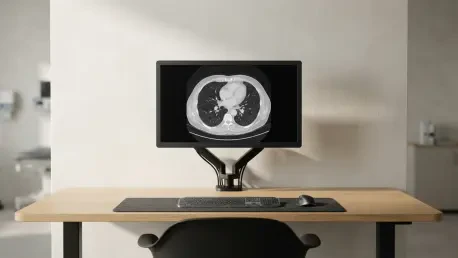
The practical utility of this multi-agent system was demonstrated in a retrospective study involving 638 computed tomography reports, where the pipeline processed more than 22,000 individual sentences with remarkable efficiency. On average, the system required less than one minute to completely restructure and audit a standard report, even when running on a single NVIDIA H100 GPU. The study highlighted how the tiered architecture successfully distributed the workload, with the lightning-fast deterministic agent handling the vast majority of the text, while the more time-intensive reasoning models were reserved for the remaining 5% of complex cases. This distribution proved that the system could scale effectively within a busy hospital environment without requiring a massive investment in additional server infrastructure. Interestingly, the researchers observed that the processing time was often influenced by the radiologist’s writing style, as more narrative and disorganized reports naturally triggered more frequent escalations to the high-parameter models.
The clinical audit results further underscored the AI’s role as a powerful tool for error detection, as the system flagged approximately 14% of the evaluated reports for suspected inconsistencies. While many of these flags were related to minor clarity issues, a significant portion involved major contradictions that could have had clinical consequences if left uncorrected. The system’s ability to detect these section mismatches—where the detailed findings did not align with the final diagnosis—provided a clear demonstration of how AI can improve the reliability of the medical record. Moreover, the 100% accuracy rate in identifying gender-anatomy discordance highlighted the system’s precision in catching specific, high-risk errors. These results suggest that the implementation of such a system could lead to a measurable reduction in diagnostic discrepancies, providing radiologists with a reliable partner in the reporting process that enhances their productivity while simultaneously safeguarding patient safety through continuous, automated monitoring.
Validation: Radiologist Feedback and Structural Integrity
To ensure that the AI’s output met the high standards required for medical practice, a team of board-certified radiologists conducted a blinded review of the restructured reports. Their evaluation confirmed that the AI introduced zero hallucinations, a critical finding that differentiates this preservation-focused framework from more common generative AI applications. The reviewers found that 69% of the reports were structured perfectly, with the remaining discrepancies often stemming from subjective disagreements over anatomical boundaries rather than objective failures of the AI logic. This high level of structural reliability is particularly beneficial for reports that were originally dictated without any internal organization, as the AI was able to transform a chaotic narrative into a clear, organ-based format that is much easier for referring clinicians to navigate. The experts rated the quality assurance logic as excellent or good in the vast majority of cases, validating the system’s ability to act as a reliable clinical auditor.
The success of the Moffitt Cancer Center study established a clear path forward for the integration of local AI agents into the clinical workflow. By treating the radiologist’s text as a fixed constraint, the researchers proved that it is possible to achieve standardization without sacrificing the unique insights and expertise of the human practitioner. This approach addresses the two primary hurdles of AI adoption in healthcare: the need for absolute data privacy and the requirement for clinical accuracy. As hospitals look toward the future of data-driven medicine, the ability to convert narrative text into structured, searchable data in real-time will become an essential component of the electronic health record. The multi-agent architecture provides a blueprint for how this can be achieved safely and efficiently, ensuring that the transition to a more digital, automated future does not come at the expense of the nuanced human observations that are the hallmark of high-quality diagnostic imaging.
Implementation: Expanding the Anatomical Framework
The development and deployment of the four-agent AI framework represented a significant shift in how medical centers approached the problem of unstructured clinical data. By combining the speed of deterministic rules with the deep reasoning of state-of-the-art open-source language models, the researchers demonstrated that standardization did not have to result in a loss of medical nuance. The system functioned as a bridge between the traditional narrative reporting style and the modern need for structured, interoperable data. As hospitals began to adopt this “local-first” AI strategy, they found that they could improve report quality while maintaining strict control over patient information, effectively bypassing the privacy concerns associated with third-party cloud services. This transition allowed for a more integrated diagnostic environment where every piece of data in a radiology report could be utilized for immediate patient care and long-term clinical research.
Looking toward the next phase of this technological evolution, the focus shifted to expanding the system’s capabilities beyond body CT protocols into more specialized fields such as neuroimaging and musculoskeletal MRI. These areas required the development of new, specialized regex dictionaries and anatomical ontologies to account for the unique linguistic patterns used by subspecialists. Additionally, developers worked on refining the feedback loops between the AI agents to further reduce the frequency of false-positive flags during the auditing process. The long-term goal remained the creation of a universal documentation assistant that could adapt to the individual stylistic preferences of any radiologist while still ensuring that every final report adhered to a rigorous national standard for clarity and accuracy. This ongoing work continued to prioritize the preservation of human expertise, ensuring that the AI remained a supportive tool that enhanced, rather than replaced, the critical thinking of the diagnostic imaging professional.