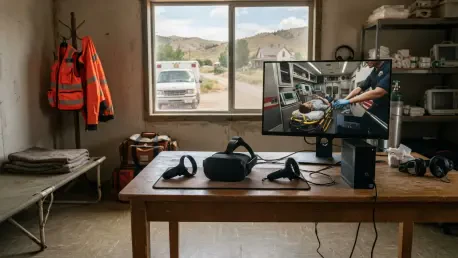

Emergency medical services in rural Minnesota are now utilizing virtual reality to practice behavioral health interventions and de-escalation for psychiatric distress. This shift marks a significant departure from traditional training methods that relied heavily on static classrooms and cumbersome physical equipment. In regions like Martin County, EMS directors are spearheading a move toward immersive digital environments that can simulate high-stakes medical emergencies with unprecedented accuracy. By transitioning to these high-tech frameworks, local agencies are solving the chronic problem of training accessibility for responders in remote townships. The move is not merely about adopting new gadgets; it is a fundamental reorganization of how medical knowledge is disseminated across the nine-county region. Leaders like Mark Griffith and Matt Lange have recognized that the old model of transporting massive amounts of gear to disparate locations is no longer sustainable in a modern, data-driven healthcare environment.
Overcoming Logistical Barriers
From Heavy Equipment to Compact Headsets
Historically, the logistics of providing high-quality EMS training in rural Minnesota were incredibly taxing. Instructors were required to haul massive trunks of physical hardware, including heavy airway mannequins, oxygen cylinders, and various diagnostic tools, to remote fire halls and community centers. This process was not only physically demanding but also financially draining, as the constant transportation and repeated use by hundreds of trainees led to the rapid deterioration of expensive medical simulators. By adopting the Meta Quest 3 system, training programs have successfully replaced these heavy equipment loads with a simple headset and a laptop. This transition has allowed the South Central Minnesota EMS Regional Board to reduce its physical footprint while simultaneously increasing its overall training capacity. The portability of VR means that a comprehensive simulation lab can now fit into a single backpack, ensuring that even the smallest volunteer departments in towns like Granada have access to the same high-caliber resources as larger urban centers.
Bridging the Imagination Gap: The Visual Advantage
Beyond the simple logistics of equipment transport, virtual reality addresses the persistent imagination gap that often hampers traditional classroom learning. In a standard simulation, students are frequently asked to imagine that a plastic mannequin is exhibiting signs of shock or respiratory distress based solely on an instructor’s verbal cues. This disconnect can limit the psychological realism of the exercise and lead to a lack of urgency during critical moments. In contrast, the VR environment provides vivid, real-time visual feedback, where a virtual patient might appear pale, diaphoretic, or struggle with visible labored breathing. Such immersive details allow responders to practice their diagnostic skills in a way that feels authentic to real-world patient encounters. By removing the burden of imagination, VR ensures that first responders are psychologically prepared for the high-pressure environments they will face in the field. This level of visual fidelity is essential for developing the split-second decision-making skills required for complex medical calls.
Collaborative Learning and Real-Time Feedback
Mastering Teamwork: The SimX Platform
A defining feature of the current training landscape is the implementation of SimX software, which facilitates multi-user collaboration within a shared virtual space. This capability is vital for emergency medical services, where effective care is the result of coordinated teamwork rather than solo effort. Currently, the platform allows up to three participants from different geographical locations—such as Truman and Fairmont—to log into the same simulation simultaneously. They can interact with the same virtual patient and each other, mirroring the real-world dynamics of an ambulance crew. With a library of eighteen distinct scenarios, the curriculum covers everything from cardiac arrests and diabetic emergencies to complicated hospital falls. This collaborative environment enables providers to practice communication protocols and resource management in a safe, controlled setting. The ability to simulate high-stress behavioral health crises through a shared digital lens has fostered a more unified approach to emergency care across the entire rural region.
Objective Assessment: Data-Driven Performance Reviews
The shift toward digital simulations has revolutionized how performance is evaluated and improved. Unlike traditional methods that rely on an instructor’s subjective observations and manual note-taking, the new VR systems incorporate automated checklists that track every action a trainee takes in real-time. This includes measuring the time it takes to administer medication and the accuracy of diagnostic assessments. The resulting empirical data provides an objective record of performance that can be used for highly focused debriefing sessions. After a scenario concludes, instructors and students review the data together to identify specific areas where errors occurred or where efficiency could be improved. This data-centric approach removes the ambiguity often found in traditional grading and allows for a more personalized training experience. By grounding professional development in hard metrics, the regional EMS board is raising the standard of care, ensuring that every responder meets a rigorous and quantifiable level of proficiency before they ever step onto a real ambulance.
Future-Proofing the Rural Workforce
Workforce Sustainability: Attracting New Recruits
Modernizing the training infrastructure is a strategic necessity for maintaining a viable workforce in rural Minnesota. As the region faces a persistent shortage of new recruits, leaders are looking to technology to make the profession more attractive to a younger, tech-savvy generation. By aligning EMS training with the digital habits of young adults, the organization is making the career path feel more relevant and accessible to those who grew up with immersive technology. Looking ahead from 2026 to 2028, the program is set to integrate advanced artificial intelligence into these simulations to further enhance realism. These AI-driven virtual patients will be capable of responding autonomously to a trainee’s voice commands and questions, allowing for more natural patient history-taking and verbal de-escalation practice. This level of interactivity will bridge the gap between simple medical procedures and the complex interpersonal skills required in the field. By positioning itself at the forefront of medical technology, the region is successfully branding EMS as a modern career choice.
A Hybrid Approach: Integrating Tactile and Digital Skills
Ultimately, the integration of virtual reality established a robust framework that balanced digital innovation with the indispensable tactile skills of traditional medicine. While the VR environment proved unparalleled for developing situational awareness and diagnostic accuracy, regional experts correctly identified that it could not yet replicate the fine motor skills required for invasive procedures. Consequently, a hybrid training model was adopted that utilized physical mannequins for hands-on tasks like starting intravenous lines while leveraging VR for complex decision-making scenarios. This comprehensive strategy ensured that rural first responders remained exceptionally well-prepared for any situation they encountered. Local leaders prioritized the continuous upgrading of hardware to avoid obsolescence, moving toward more ergonomic and high-fidelity headsets to minimize user discomfort. By proactively addressing the challenges of rural healthcare through technological investment, the South Central Minnesota EMS Regional Board provided a successful blueprint for other organizations. These initiatives fostered a more resilient medical infrastructure.