
Unlike standard sensors that typically operate at less than 100 dpi, this new device uses a 30-micrometer resolution to visualize intricate surface details during contact. Developed by a team at the National University of Singapore under the guidance of Professor Lim Chwee Teck, this groundbreaking electronic skin, known as eLuminator, represents a significant departure from traditional sensing technologies that rely heavily on external processing units. While conventional systems often suffer from latency and bulk due to the need for complex wiring and separate display screens, this new material integrates both sensing and visual feedback into a single, seamless platform. This innovation addresses a long-standing challenge in soft robotics and wearable health monitors, where the demand for high-resolution feedback often clashes with the need for thin, flexible form factors. By allowing pressure patterns to be seen immediately on the surface itself, the technology removes the digital bottleneck, providing an intuitive way to map physical interactions with unprecedented precision and speed.
Physical Integration: The Mechanics of Light-Based Sensing
At the heart of the eLuminator lies a sophisticated mechano-electroluminescent mechanism that converts mechanical stress directly into visible light. This process ensures that when any external force is applied to the surface, the device generates a glow that corresponds to the specific magnitude and shape of the contact point. Unlike pixelated displays that are limited by individual sensor grids, this system operates on a continuous, pixel-free basis, allowing it to capture the most minute details of a surface. For instance, the ridges of a human fingerprint can be clearly visualized through the light patterns produced, a feat that traditional electronic skins struggle to achieve due to their lower spatial resolution. This direct visualization method eliminates the typical lag associated with signal conversion and processing in digital systems. Consequently, the user receives near-instantaneous feedback, making the interface between the physical world and electronic sensing more transparent and reactive than any previous iteration of wearable technology.
The physical architecture of the eLuminator is designed to mimic the properties of natural skin, boasting a thickness of only 70 micrometers and a non-toxic composition. This level of thinness ensures that the material remains unobtrusive when applied to human limbs or integrated into medical instruments. Furthermore, its extreme flexibility allows it to withstand strain exceeding 100 percent, meaning it can conform to highly curved or articulating surfaces without losing functionality. Durability was a primary focus during the development phase, leading to a design that maintains consistent performance over thousands of mechanical cycles. Whether subjected to a gentle touch or a high pressure of up to 180 kilopascals, the material provides reliable optical and digital outputs. With an optical response time of just 15 milliseconds, the device operates well within the threshold of human perception, ensuring that the light-up feature feels immediate. This combination of resilience and sensitivity makes it a robust solution for environments that require both high performance and longevity.
Practical Applications: From Clinical Settings to Robotics
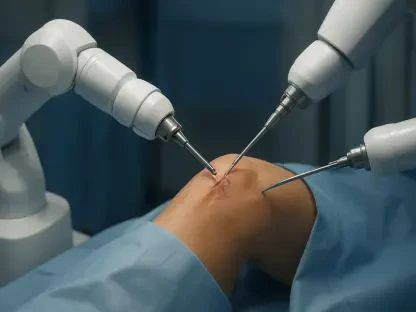
The clinical and industrial implications of the eLuminator are profound, particularly in the realm of surgery and advanced robotics. In a surgical setting, providing doctors with real-time visual feedback on the pressure applied to delicate tissues can significantly mitigate the risk of accidental trauma. Beyond the operating room, this technology offers a revolutionary approach to managing diabetic patient care by mapping pressure distribution on the foot to prevent ulceration. For individuals using prosthetic limbs, the lack of tactile feedback remains a significant barrier to achieving natural movement; however, integrating this light-emitting e-skin provides a dual benefit of digital readouts and visual cues for grip strength. In soft robotics, the ability to sense and visualize contact allows machines to handle fragile objects with a delicacy previously reserved for human hands. As these systems become more integrated into daily life between 2026 and 2028, the demand for such intuitive interfaces will continue to grow across various professional sectors.
Looking ahead, the development trajectory for the eLuminator involved refining the material to achieve higher levels of sensitivity while lowering power consumption. Stakeholders in the medical device industry were encouraged to consider how this integrated feedback loop could be adapted for existing surgical tools to enhance safety protocols. Researchers prioritized scaling the manufacturing process to make this thin-film technology more accessible for mass-market wearable applications. It became clear that the integration of mechano-electroluminescence offered a unique solution to the problem of data overload, as it allowed users to filter complex information through simple visual patterns. This shift paved the way for more responsive biomedical designs and smarter prosthetic limbs, ultimately transforming the way physical contact was monitored. Future efforts focused on collaborating with clinical partners to transition the technology from the laboratory into real-world hospital environments, ensuring the device remained at the cutting edge of human-machine interaction.