
The use of the body as a communication bus allows for medical interventions that are significantly less invasive than current surgical implantation methods. This breakthrough, known as the Smart Wireless Autonomous Networking System (SWANS), addresses the critical gap between external health wearables and internal medical devices. In the current landscape of 2026, where digital health monitoring has become a standard of care, the ability to bridge the divide between a wristwatch and a deep-tissue stimulator is paramount. Researchers at the Georgia Institute of Technology have pioneered a method that bypasses the limitations of traditional radio waves by leveraging the conductive properties of human tissue. By treating the body not as a barrier but as a biological conduit, this technology enables a seamless flow of data that was previously hindered by the physics of electromagnetic transmission. This evolution represents a departure from bulky, battery-heavy hardware toward injectable electronics.
Overcoming the Physical Barriers: The Limitations of Radio Frequency
Traditional wireless protocols, such as Bluetooth and standard radio frequency waves, encounter fundamental physical obstacles when tasked with traveling through complex biological environments. The human body is predominantly composed of water and dissolved ions, which act as a dispersive medium for electromagnetic radiation. This composition causes a phenomenon known as signal attenuation, where energy is absorbed and scattered rather than passing cleanly through to its target. Consequently, a signal intended for a deep-tissue implant often degrades significantly before reaching its destination, necessitating a higher power output to maintain a reliable connection. This requirement creates a feedback loop of engineering challenges, as higher power demands lead to increased heat generation and faster battery depletion. Engineers have historically struggled to find a balance between signal integrity and biological safety, limiting the reach of internal sensors and complicating the design of long-term medical solutions.
Because of these interference issues, conventional medical implants are frequently forced to incorporate relatively large antennas and sophisticated communication electronics to ensure they remain reachable from the outside world. These components occupy valuable internal space, which in turn necessitates larger device housings and high-capacity batteries. For a device intended to be placed within a delicate organ or threaded through narrow blood vessels, every additional millimeter of size represents a major surgical hurdle. While technologies like Near-Field Communication offer a low-power alternative, they are restricted by extremely short ranges and require nearly perfect alignment between the external reader and the internal implant. This lack of versatility has long prevented the development of a truly distributed network of sensors across the human frame. The move toward more integrated solutions requires a total rethink of how data is moved across the biological divide to enable next-generation healthcare.
Redefining Connectivity: Harnessing the Conductivity of Human Tissue
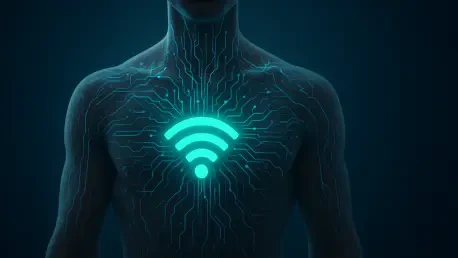
The core innovation of the SWANS architecture lies in its clever utilization of the body’s natural conductivity rather than treating it as an adversary. By recognizing that human fluids and electrolytes can effectively function as a biological wire, researchers have developed a system that uses the skin as a conduit for data transmission. A specialized wearable hub serves as the central node of this network, introducing minute electrical pulses directly into the skin’s surface. These pulses are calibrated to be far below the threshold of human perception, ensuring they cause no physiological discomfort or damage while creating a subtle voltage gradient across the entire body. When a micro-implant equipped with conductive pads and a simple transistor circuit detects these specific fluctuations in voltage, it can receive instructions or transmit data. This method fundamentally simplifies the internal hardware required for medical communication by using the medium itself to carry the signal load efficiently.
Efficiency and miniaturization are the primary benchmarks of success for this body-centric networking approach. Technical analysis indicates that the communication components utilized in SWANS are more than fifteen times as power-efficient as standard Bluetooth or NFC alternatives currently available in 2026. Furthermore, the system demonstrates over ten times the communication coverage within biological tissue compared to existing radio-based methods. This reduction in power consumption allows for the shrinking of communication electronics to a width of less than three millimeters. Such a compact form factor enables the delivery of advanced medical devices through a standard 16-gauge needle, potentially replacing complex surgeries with simple outpatient injections. The ability for an implant to operate for an entire year on a microscopic battery, specifically for periodic therapeutic actions, marks a significant milestone in the journey toward sustainable and autonomous bioelectronic medicine for the wider population.
Validation of the Concept: From Animal Models to Addressable Networks
To provide a concrete proof of concept for this body-as-a-wire network, researchers successfully implemented a closed-loop system in a rat model to synchronize disparate physiological actions. Flexible strain sensors were utilized to monitor the movement of the animal’s forelimbs, sending data to a wearable hub that immediately translated the motion into a coded electrical pulse. Deeply situated near the sciatic nerves of the hind limbs were receivers designed to react specifically to these pulses through the tissue. When the rat moved its front leg, the signal traveled across the body via biological conductivity, triggering the internal receivers to stimulate the nerve and cause a corresponding movement in the hind leg. This experiment provided clear evidence that electronic interventions can be coordinated across biological systems without the need for bulky antennas or external radio waves. It highlights the potential for creating artificial neural pathways that bridge gaps caused by traumatic injury or neurological illness.
Beyond simple one-to-one communication, the SWANS framework introduces the possibility of a sophisticated internal ecosystem often referred to as the Internet of Bodies. By modulating the duration and voltage levels of the electrical pulses, the external wearable hub can address multiple implanted devices independently. This capability ensures that a signal meant for a cardiac pacer does not inadvertently trigger an insulin pump or a gastric stimulator. The wearable hub acts as a central brain, coordinating a decentralized network where various sensors and actuators work in harmony to maintain homeostasis. For instance, a single hub could manage a set of metabolic sensors while simultaneously directing the activity of a series of targeted drug-delivery modules. This level of selective activation prevents signal cross-talk and allows for a highly personalized health management strategy where different components of the system interact only when specifically summoned by the hub to perform a designated medical task.
Integrating the Technology: Path Towards Clinical Implementation
While the transition from animal models to human application is promising, it requires addressing the substantial physiological diversity found in human populations. Unlike the uniform tissue distribution in research rats, human bodies vary significantly in their composition of fat, muscle, and bone, all of which possess different conductive properties. Muscle tissue is highly conductive due to its fluid content, whereas body fat acts as a natural insulator that can impede the flow of electrical pulses. Consequently, a universal pulse strength may not work effectively for every individual, necessitating sophisticated calibration algorithms to map a person’s unique biological conductivity. Engineers are currently focused on developing automated tuning systems that can adjust the wearable hub’s output based on real-time feedback from the implants. Ensuring consistent signal propagation across varied body types is a critical step before this technology can move from the laboratory into widespread clinical use.
The ultimate success of the SWANS initiative depended on long-term safety evaluations and the refinement of internal hardware for permanent use. Future efforts should prioritize the standardization of communication protocols to ensure cross-compatibility between different manufacturers of injectable medical devices. Stakeholders in the medical device industry were encouraged to adopt these low-power standards to facilitate a more cohesive health ecosystem. Clinical trials should focus on patients with chronic conditions who require frequent adjustments to their treatment regimens, as they stand to benefit most from autonomous internal networking. As researchers moved toward human testing, the focus remained on ensuring that constant micro-pulsing did not interfere with cellular health or natural nervous system signaling. The path forward involved creating a regulatory framework that addressed the data security of these internal networks, protecting patients from unauthorized access while maximizing the benefits of connectivity.