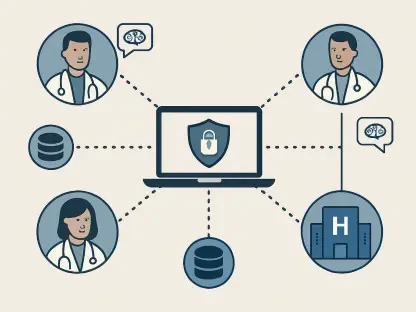

The rapid migration of patient clinical data from paper records to sophisticated cloud-based electronic health record systems has outpaced the federal government’s ability to enforce comprehensive cybersecurity protocols. While the Department of Health and Human Services has historically relied on the Health Insurance Portability and Accountability Act to safeguard patient privacy, these regulations were not originally designed to counter the aggressive, multifaceted ransomware attacks currently plaguing the medical industry. The sheer volume of sensitive information stored within these digital repositories makes them high-value targets for international cybercriminal syndicates who exploit every available vulnerability. Federal agencies find themselves in a reactive position, often penalizing organizations only after a catastrophic data breach has occurred rather than establishing a rigorous, preventative framework that mandates specific technological safeguards across all vendors. This discrepancy between the sophistication of digital threats and the rigidity of federal oversight leaves millions of patient records at risk.
Systemic Vulnerabilities: The Structural Weaknesses in Compliance Frameworks
One of the primary obstacles to effective oversight is the decentralized nature of health information technology governance, which splits responsibility across multiple agencies with differing priorities and limited resources. The Office for Civil Rights primarily focuses on privacy violations and the aftermath of security incidents, whereas the Office of the National Coordinator for Health IT is tasked with promoting interoperability and technical standards. This fragmentation results in a lack of cohesive, enforceable security requirements that EHR developers must meet before their products are deployed in clinical settings. Furthermore, the voluntary nature of many cybersecurity guidelines provided by the National Institute of Standards and Technology allows smaller healthcare providers to bypass critical updates due to financial or technical constraints. Without a unified federal mandate that requires continuous monitoring and automated threat detection, many facilities continue to operate with legacy software that contains known, unpatched vulnerabilities.
Building on this foundation of fragmented governance, the audit process itself remains fundamentally flawed because it relies heavily on self-attestation and infrequent manual reviews. Federal investigators simply do not have the manpower to conduct deep-dive technical audits of thousands of healthcare organizations and hundreds of EHR vendors on a regular basis. This reliance on the honor system creates a false sense of security, as organizations may check boxes for compliance without actually hardening their internal networks against sophisticated phishing or social engineering schemes. Additionally, the federal government has been slow to implement a certification process that explicitly ties EHR financial incentives to robust, verified cybersecurity performance. While providers received billions for adopting digital records, there was no equivalent financial pressure to ensure those systems could withstand a modern cyber assault. Consequently, the industry has prioritized data sharing and user convenience over the structural integrity of the underlying data infrastructure.
To address these persistent vulnerabilities, federal oversight bodies shifted from a compliance-based mentality to a risk-based security posture that actively anticipated emerging threats. The integration of Zero Trust Architecture within the EHR ecosystem became a necessary standard, requiring every user and device to be continuously authenticated regardless of their location on the network. Policymakers recognized that simply reacting to breaches was no longer sustainable, leading to the development of mandatory security minimums for all certified health IT products. These standards included the implementation of multi-factor authentication by default and the encryption of data both at rest and in transit across all interoperable platforms. By moving toward a model where cybersecurity was a prerequisite for market entry rather than an afterthought, the federal government finally began to close the gap between regulatory expectations and the realities of modern digital warfare. This proactive approach turned the tide against systemic data theft.