
The persistent struggle of healthcare facilities to maintain essential non-clinical services during overnight hours has reached a critical turning point with the implementation of advanced automation, marking a significant departure from traditional hospitality models. Hospitals operate on a relentless twenty-four-hour schedule that often leaves a visible gap in service quality during the quietest hours of the night when traditional kitchen staff are hardest to recruit and retain. While much of the national conversation regarding healthcare labor shortages focuses heavily on nursing and specialized medical roles, the deficit in essential support staff, particularly within food services, has created significant logistical hurdles for administrators. WellSpan Health has addressed this specific challenge by unveiling the Fresh Take Eatery at WellSpan York Hospital, an innovative autonomous kitchen designed to provide consistent, high-quality nutrition without the need for constant human supervision. This deployment serves as a direct response to shifts in the labor market, where non-clinical positions remain difficult to fill despite rising demand for around-the-clock facility operations. By embracing a fully automated culinary system, the hospital ensures that both frontline staff and visitors have access to healthy meals at any hour, effectively bridging the gap between operational needs and available manpower.
Engineering Efficiency in a Compact Footprint
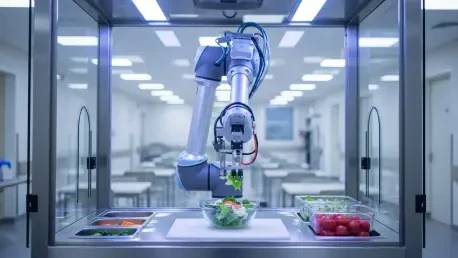
The technical foundation of this initiative rests on a strategic partnership between WellSpan Health, RoboEatz, and ABB Robotics, resulting in the first commercial application of this specific autonomous kitchen technology. Unlike traditional cafeteria renovations that often require expansive structural changes and massive square footage, this robotic system operates within a remarkably small footprint of only four hundred square feet. This postage-stamp size allows the hospital to integrate high-volume food production into existing spaces that were previously underutilized or too small for a full-scale kitchen operation. The mechanical assembly is designed for maximum versatility, featuring a sophisticated robotic arm that manages the entire lifecycle of a meal, from retrieving ingredients to the final plating process. This efficiency does not come at the expense of variety, as the system is engineered to store, cook, and serve more than eighty different meal options. The compact nature of the installation demonstrates how modern robotics can be retrofitted into aging infrastructure, providing a scalable solution for urban hospitals where physical space is at a premium and expansion is often cost-prohibitive.
Beyond the physical hardware, the system’s operational capacity significantly outpaces traditional manual setups in similar environments, producing approximately one thousand meals per day. This represents a fifty percent increase in the hospital’s retail meal volume, a surge that would typically require a substantial increase in human staffing levels that are currently unavailable in the labor market. The robotic kitchen is not merely a vending machine; it is a fully functional culinary unit that handles complex tasks including precision cooking and autonomous cleaning after every order to meet stringent health codes. By automating these repetitive and labor-intensive tasks, the hospital can redirect its existing human workforce toward more complex nutritional needs and patient-facing services. The integration of such high-output technology ensures that the food service department remains a reliable pillar of hospital operations, regardless of external fluctuations in the local job market. This shift toward mechanical reliability provides a stable baseline for nutritional delivery, allowing the administration to focus on clinical excellence while the automated system manages the logistical burden of feeding a massive, rotating population of employees and guests.
The Role of Artificial Intelligence in Culinary Logistics
The intelligence driving this robotic system is divided into a sophisticated dual-AI framework that balances mechanical precision with creative menu development. The first component, referred to as physical artificial intelligence, oversees the mechanical aspects of food safety, waste reduction, and preparation efficiency. This layer of intelligence monitors ingredient temperatures in real-time and ensures that every motion of the robotic arm is optimized for speed and safety, drastically reducing the margin for human error in food handling. In tandem, the system utilizes generative artificial intelligence to develop and optimize seasonal menus, ensuring that the food offerings remain diverse and appealing to a demographic that may use the service daily. This technology allows the hospital to analyze consumption patterns and adjust ingredient orders automatically, which minimizes food waste and lowers operational costs. The synergy between these two AI types creates a self-sustaining ecosystem that learns from every transaction, progressively refining its techniques to provide a better dining experience while maintaining the rigorous standards required within a medical environment.
To ensure the technology harmonized with existing hospital workflows, WellSpan customized the system to support local suppliers while adhering to the mechanical constraints of the robot. This required a meticulous calibration of ingredient dimensions, as the robotic components require specific sizes and shapes to function correctly during the assembly and cooking phases. This level of customization ensures that while the process is automated, the quality of the ingredients remains high and supports the regional economy. Furthermore, the digital integration allows hospital staff, such as nurses and technicians, to pre-order meals through a dedicated website. This functionality enables employees to schedule pickups that align perfectly with their designated break times, eliminating the wait times that often plague traditional cafeterias during peak hours. By streamlining the interface between the consumer and the kitchen, the technology addresses the time-poverty experienced by healthcare professionals, making it easier for them to access healthy food without disrupting their clinical duties. This thoughtful integration demonstrates that automation, when implemented with a focus on user experience, can enhance the daily lives of a workforce.
Strategic Implementation and Future Systemic Standards
The successful launch of the autonomous kitchen at York Hospital provided a clear roadmap for addressing the structural labor deficiencies that have plagued the healthcare industry since 2026. Hospital leadership recognized that the integration of robotics was not merely a temporary fix but a necessary evolution in facility management that prioritized consistent service delivery over traditional staffing models. By analyzing the data gathered during the pilot phase, the organization established new protocols for expanding automated dining services to other regional locations. This transition allowed the facility to maintain a 24/7 service window without the prohibitive costs of overtime pay or the risks associated with skeleton-crew shifts. The initiative proved that high-tech culinary solutions could survive the rigors of a high-traffic medical environment while meeting the diverse dietary needs of a large population. The past performance of the system highlighted the feasibility of using “Physical AI” to manage sanitation and safety, which effectively mitigated the risks typically associated with human-led food preparation in sensitive environments.
Moving forward, healthcare organizations should consider the adoption of compact, modular robotic units as a standard component of institutional planning to insulate themselves from future labor volatility. Facilities ought to evaluate their current non-clinical vacancies and identify repetitive service tasks that could be transitioned to autonomous systems, thereby freeing up capital for clinical recruitment and retention. Strategic partnerships with robotics firms like RoboEatz or ABB can facilitate the customization of these units to fit specific architectural constraints, making them viable for both new constructions and renovations of older buildings. Administrators must also prioritize the digital integration of these systems into employee wellness platforms to maximize the convenience factor, which has shown to improve staff satisfaction scores. As the technology continues to mature, the focus should shift toward creating a network of automated services that include janitorial and logistical robotics to further stabilize hospital operations. This proactive stance on technology adoption will ensure that hospitals remain functional and efficient centers of care, regardless of the challenges present in the broader economic and labor landscapes.