
James Maitland stands at the forefront of the surgical revolution, blending a deep mastery of robotics with a visionary approach to Internet of Things (IoT) applications in the modern operating room. With a career dedicated to the intersection of mechanical precision and digital connectivity, Maitland has become a leading voice on how automated systems can bridge the gap between high-level surgical expertise and global patient access. His insights are particularly poignant as the medical technology industry shifts toward endoluminal solutions, where the goal is no longer just to operate, but to navigate the body’s natural pathways with unprecedented accuracy. This discussion traverses the strategic evolution of gastrointestinal interventions, focusing on the transition from traditional, highly invasive surgeries to robotic-assisted endoscopic procedures. Maitland explores the critical balance between long-term innovation and immediate market distribution, the democratization of complex medical skills to solve the global shortage of specialized surgeons, and the rigorous quality transformations required to maintain trust with global health regulators.
How do you navigate the strategic tension between investing in revolutionary, long-term robotic platforms and the immediate need to provide clinical solutions through distribution partnerships?
In the fast-paced world of medtech, you cannot afford to be a one-note player; you must master the present and the future simultaneously. We look at this through a two-pronged strategy where one arm focuses on immediate market impact and the other on long-term systemic change. By forming distribution partnerships for current robotic devices, a company can immediately assist physicians who are struggling with complex therapies right now, providing tools that enhance their current workflows. Meanwhile, investing in proprietary platform innovation, like the work being done with endoluminal robots, allows us to fundamentally rethink how procedures are conducted from the ground up. This isn’t just about adding a new tool to the tray; it’s about creating a scalable ecosystem that evolves alongside our understanding of disease, ensuring that we aren’t just reacting to the market, but actively shaping its future trajectory.
With colorectal cancer claiming nearly 900,000 lives annually, how can robotics specifically address the barriers that prevent life-saving procedures like endoscopic submucosal dissection from becoming a global standard?
The statistics surrounding colorectal cancer are sobering, especially as we see the incidence rising in younger populations, yet our ability to intervene is often hamstrung by the sheer technical difficulty of the procedures. Endoscopic submucosal dissection, or ESD, is a prime example; while it’s a brilliant way to treat lesions, it is notoriously demanding, with about 200,000 cases performed yearly, largely concentrated in Asia. To reach true proficiency, a surgeon often needs to perform 200 to 300 procedures, which creates a massive bottleneck for adoption in regions like the United States. This is precisely where robotics enters the narrative as a great democratizer, because it effectively lowers that barrier to entry by smoothing out the learning curve. By making these intricate movements repeatable and less dependent on individual super-specialist skills, we can expand access to care and ensure that a patient’s outcome isn’t dictated solely by the geographic luck of their surgeon’s training.
What defines your vision for an integrated endoscopy ecosystem, and how does it differ from the more specialized robotic tools we currently see in the surgical landscape?
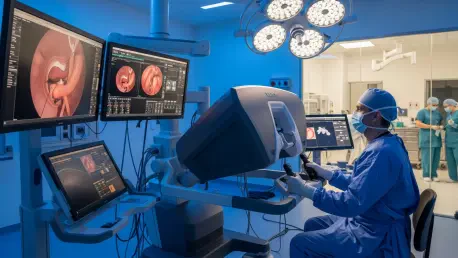
The current landscape is dotted with many point solutions—impressive machines designed to solve one very specific problem or navigate one narrow anatomical path. Our focus, however, is on building a platform that is inherently scalable and fully integrated into the existing endoscopy infrastructure rather than being a standalone island of technology. We aren’t just looking at a robot in isolation; we are looking at how that robot communicates with diagnostic imaging, how it navigates multiple indications over time, and how it fits into the physical space of the GI suite. This broader perspective means our initial focus on high-volume GI interventions is just the beginning of a roadmap that will eventually see the platform tackle a wide variety of soft tissue procedures. It’s about creating a versatile “Swiss Army Knife” for the internal body, rather than a single-purpose scalpel, allowing the system to grow in value as more clinical applications are unlocked.
In an era where we aim to detect, diagnose, and treat in a single session, how does endoluminal robotics fundamentally alter the physical experience and long-term recovery for the patient?
The shift toward a single-setting model is perhaps the most compassionate change we can bring to the patient experience, moving us away from the agonizing wait times between a diagnosis and an intervention. By using an endoscope to see, reach, and treat a lesion in one go, we are essentially eliminating the need for the “cold steel” approach of traditional laparoscopic or open surgeries. For the patient, this means fewer incisions, significantly less pain, and a recovery process that feels like a minor procedure rather than a major life event. We are looking at a future where we can treat millions of gastric and colon issues with the precision of a robot, reducing the reliance on highly invasive alternatives that often keep patients in hospital beds for days. It’s a transition from “recovering from surgery” to “recovering from the disease,” and that psychological and physical difference is immense.
Maintaining innovation while navigating regulatory challenges like FDA warning letters is a complex balancing act; how does a focus on quality transformation serve as the foundation for these technological leaps?
Technological brilliance is worthless if it isn’t anchored in a rock-solid foundation of safety and regulatory compliance. When a company faces challenges like three warning letters or import alerts, it serves as a powerful catalyst for a total quality transformation that goes beyond just checking boxes for the regulators. We are talking about strengthening every internal process, from the initial design phase to critical areas like endoscopic reprocessing, to ensure that every device that enters a hospital is beyond reproach. This transparent dialogue with agencies like the FDA isn’t just about clearing a hurdle; it’s about building a culture of consistency and trust that allows us to innovate with confidence. Without that rigorous focus on patient safety, we cannot expect physicians or patients to embrace the next generation of robotic interventions that we are so passionate about bringing to the world.
What is your forecast for the role of the traditional surgeon in a world increasingly dominated by endoluminal robotics?
The surgeon of the next decade will transition from a manual artisan to a high-level digital navigator, where their expertise is amplified rather than replaced by robotic systems. I forecast that within the next ten years, we will see a dramatic inversion in the surgical theater, where endoscopic robotic procedures become the first line of defense for the majority of GI cancers, rendering many of today’s open surgical techniques historical artifacts. We will move toward a global network of care where even a rural hospital can offer “gold standard” results because the robot provides the stability and precision that used to take decades of specialized practice to achieve. Ultimately, the robot will handle the mechanical repeatability, leaving the human surgeon to focus on the complex decision-making and empathetic care that no machine can ever truly replicate.