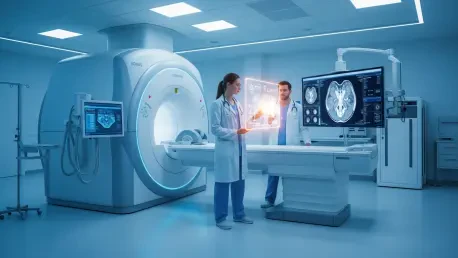

The integration of sophisticated artificial intelligence into medical imaging workflows is fundamentally altering how clinical data is synthesized, ensuring that diagnostic precision keeps pace with the increasing complexity of modern healthcare requirements. This systemic evolution represents a critical merger between advanced computational power, specifically deep learning and computer vision, and the established hardware infrastructures of radiology departments such as X-ray, CT, and MRI systems. As global healthcare systems face mounting pressure from aging populations and a rising prevalence of chronic diseases, these digital tools are no longer viewed as optional enhancements but as essential components of a high-functioning diagnostic environment. The transition toward AI-enabled imaging focuses on automating the more repetitive aspects of image interpretation, allowing clinical professionals to dedicate their expertise to complex cases where human judgment remains irreplaceable. By streamlining the identification of subtle anomalies and prioritizing urgent findings, these systems are effectively reimagining the patient journey from initial scan to finalized treatment plan, making the entire process more resilient, faster, and significantly more accurate for providers and patients alike.
Financial Dynamics: Market Valuation and Strategic Drivers
The economic trajectory for the artificial intelligence-enabled imaging sector suggests a period of sustained and robust expansion, with the market expected to reach an impressive $15.16 billion by 2035. Starting from a valuation of approximately $3.62 billion in 2025, the industry is navigating a decade of transformation characterized by a compound annual growth rate of 15.9%. This consistent financial momentum reflects a broader industry shift where experimental pilots have given way to standardized clinical implementations and commercially viable software-as-a-service models. Such growth is largely propelled by the increasing demand for high-efficiency diagnostic tools that can alleviate the financial and operational burdens currently placed on healthcare systems. Investment is pouring into this space not only from venture capital and specialized medical tech firms but also from large-scale public health initiatives that recognize the long-term cost savings associated with earlier and more accurate disease detection.
Several intersecting factors are fueling this commercial momentum, most notably the escalating global burden of chronic conditions like cardiovascular disease and various forms of cancer that require frequent and detailed imaging. Simultaneously, the global medical community is grappling with a severe and growing shortage of qualified radiologists, creating a gap between the volume of scans being produced and the capacity of experts to interpret them. AI serves as a critical force multiplier in this context, allowing diagnostic departments to manage significantly higher workloads without compromising the quality of care or contributing to professional burnout. Furthermore, the standardization of data formats and the maturation of cloud computing have made it easier for hospitals to integrate these sophisticated algorithms into their existing electronic health records. This technological readiness, combined with a clearer regulatory pathway for software-as-a-medical-device, has cleared the obstacles that previously hindered large-scale commercial adoption, setting the stage for the next decade of market dominance.
Technical Evolution: Deep Learning and Modality Innovation
Deep learning has established itself as the most influential technological architecture within the current imaging landscape, rapidly outpacing traditional rule-based algorithms. By employing neural networks that approximate the cognitive functions of the human brain, these systems can perform incredibly complex tasks such as automated organ segmentation, lesion quantification, and the identification of minute biomarkers that might be invisible to the naked eye. This advancement allows for the extraction of granular data from traditional images, essentially turning a standard scan into a rich, multi-dimensional dataset that supports more nuanced clinical decisions. The ability of deep learning models to improve through continuous exposure to diverse data sets ensures that these tools become more precise over time, adapting to various patient demographics and technical variations in imaging hardware. This architectural shift is the primary catalyst for the development of next-generation diagnostic software that maintains clarity even when using low-dose radiation protocols.
While Computed Tomography and Magnetic Resonance Imaging continue to be the primary beneficiaries of AI due to the massive, complex datasets they generate, innovation is rapidly expanding across all imaging modalities. In the realm of X-ray technology, AI is now frequently used to provide real-time triage for pulmonary conditions, identifying life-threatening issues like a pneumothorax in seconds. Ultrasound, which is traditionally highly dependent on the skill of the operator, is also seeing a surge in AI integration to help sonographers capture the correct anatomical views and provide automated measurements during live procedures. This democratization of expertise ensures that high-quality diagnostic capabilities are available even in decentralized or rural clinics where specialized staff may be less available. The continuous refinement of these algorithms across different hardware types ensures a cohesive diagnostic ecosystem where intelligence is embedded at every stage of the imaging chain, from the moment a patient enters the scanner to the generation of the final report.
Clinical Application: Specializations in Oncology and Neurology
The market for AI-enabled imaging is increasingly pivoting toward high-stakes medical specialties such as oncology, neurology, and cardiology, where precision is paramount for patient survival. In oncology, AI tools are being utilized to track the progression of tumors with a level of accuracy that was previously unattainable, allowing clinicians to measure treatment efficacy through minute changes in volume and density. These applications are vital for the growth of precision medicine, as they provide the objective data needed to tailor therapies to the specific biological profile of an individual patient’s disease. By reducing the variability inherent in human interpretation, AI ensures that longitudinal studies of a patient’s condition are consistent and reliable over several years of treatment. This level of detail is particularly crucial when dealing with complex metastatic cancers where multiple lesions must be monitored simultaneously across different parts of the body.
Neurological applications of AI imaging have also seen a significant rise in adoption, particularly in the management of acute conditions like ischemic and hemorrhagic strokes. Time is the most critical factor in treating brain injuries, and AI systems can now automatically flag potential large vessel occlusions and notify surgical teams within minutes of a scan being completed. Beyond emergency care, these tools are being applied to chronic neurodegenerative diseases such as Alzheimer’s and multiple sclerosis, where they can detect subtle patterns of cortical thinning or white matter changes long before significant clinical symptoms appear. By providing a more detailed window into the structural and functional changes of the brain, AI helps neurologists move from reactive symptom management to proactive, evidence-based intervention strategies. This trend toward specialized, high-resolution analysis is driving a deeper integration between imaging data and other clinical indicators, creating a more holistic view of patient health.
Strategic Leadership: Regional Trends and Corporate Ecosystems
Hospitals and large integrated health networks have emerged as the primary end-users and main revenue drivers in the current market, acting as the central hubs for both emergency and specialized care. These institutions are aggressively adopting AI to streamline internal workflows and optimize the use of their most expensive imaging hardware, ensuring that every minute a scanner is active provides maximum clinical value. For hospital administrators, the integration of AI is often viewed as a strategic investment to reduce the time-to-treatment for critical cases, which significantly improves patient outcomes and reduces the long-term costs associated with extended hospital stays. By utilizing AI to automate the administrative and preliminary screening portions of the radiology workload, hospitals can focus their human resources on direct patient interaction and complex diagnostic problem-solving. This shift in operational focus is fundamental to maintaining high standards of care in an increasingly competitive and resource-constrained healthcare environment.
Geographically, North America remains the dominant force in the global AI imaging market, supported by a mature healthcare infrastructure and significant public and private investment in medical research. The region’s leadership is further solidified by a favorable regulatory environment that encourages the development of digital health technologies and a strong presence of major technology hubs. However, the Asia-Pacific region is experiencing the most rapid growth as countries like China and India invest heavily in modernizing their healthcare systems to serve massive, aging populations. These nations are often leapfrogging older diagnostic models by moving directly to AI-integrated systems that can help bridge the gap in specialist availability across vast geographic areas. The competitive landscape itself is a sophisticated mix of traditional medical device giants like GE HealthCare and Siemens Healthineers, who are embedding AI into their hardware, and specialized software firms and tech leaders like NVIDIA, who provide the underlying computational infrastructure required for high-performance processing.
Future Trajectory: Predictive Analytics and Implementation Steps
The progression of the imaging market through 2035 was defined by a fundamental shift from simple detection toward sophisticated predictive analytics that anticipated disease pathways. Developers and healthcare providers recognized that the true value of artificial intelligence lay in its ability to synthesize imaging data with genomic and clinical history to forecast health risks before they manifested as physical symptoms. This era saw the establishment of rigorous data privacy standards and ethical frameworks that ensured the integrity of the algorithms while eliminating demographic biases that had previously hindered wider adoption. Organizations that successfully navigated this transition focused on creating interoperable systems that allowed for seamless data exchange between different departments and institutions. The refinement of these tools was supported by extensive clinical validation, which proved that AI-enhanced diagnostics consistently outperformed traditional methods in both speed and longitudinal accuracy.
Successful implementation of these technologies required a deliberate focus on change management and the continuous education of the medical workforce to ensure that AI was used as a collaborative tool. It became clear that the most effective diagnostic environments were those that balanced automated efficiency with human oversight, maintaining a patient-centered approach despite the high degree of technical integration. Regulatory bodies played a vital role during this period by streamlining the approval process for adaptive algorithms, allowing for faster updates in response to new clinical data. As the technology matured, the emphasis moved away from the novelty of the tools toward their practical impact on public health outcomes and institutional sustainability. The widespread adoption of AI-enabled imaging ultimately transformed radiology into a more data-driven and proactive discipline, providing a clear roadmap for other medical fields to follow in the pursuit of evidence-based, digital-first healthcare delivery.