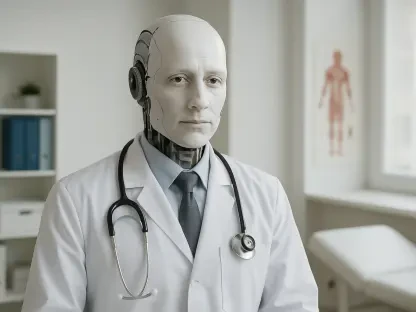

The prevailing narrative, fueled by science fiction and sensational headlines, has long painted a future where autonomous robots methodically replace the skilled hands of human surgeons in the operating room. This vision, however, fundamentally misinterprets the true trajectory of surgical innovation, which is not about removing the surgeon but rather about elevating them to the command center of an unprecedented technological evolution. The future of surgery is not autonomous; it is “Performance-Guided”—a paradigm where advanced digital tools serve to augment, not supplant, the irreplaceable judgment, skill, and intuition of the human expert. This critical distinction repositions surgeons not as obsolete technicians bracing for replacement, but as the essential and indispensable leaders of the coming AI-driven era in healthcare, tasked with harnessing technology to achieve a new frontier of patient care and surgical excellence. The revolution will not be automated; it will be human-led, with technology as the ultimate co-pilot.
A New Partnership in the Operating Room
The core of this transformation lies in the concept of Performance-Guided Surgery, a surgeon-centric model that fundamentally reframes the relationship between human and machine. Instead of technology operating independently, this approach integrates it as a collaborative partner, embedding real-time data analytics, sophisticated digital guidance systems, and intelligent insights directly into the surgical workflow. These tools function as an extension of the surgeon’s own senses and intellect, providing an additional layer of crucial information, from digitally highlighting critical anatomical structures obscured from the naked eye to offering data-backed suggestions based on thousands of prior procedures. Crucially, the final clinical judgment and the execution of the procedure remain firmly in the hands of the human expert, ensuring that technology serves to reinforce and enhance, rather than override, the surgeon’s hard-won expertise and ethical responsibility. This model creates a symbiotic loop where the surgeon’s experience guides the technology, and the technology’s insights inform the surgeon.
This powerful fusion of human expertise and digital intelligence promises to elevate the standard of care by amplifying a surgeon’s inherent abilities to new heights. The technology is designed to help surgeons see with greater clarity, think more critically under immense pressure, and perform highly complex procedures with a superior degree of confidence and consistency across the board. Every action, decision, and instrument movement can be meticulously captured and analyzed, creating a rich, objective data log of each procedure. This digital record becomes an invaluable asset for detailed post-operative review and serves as a powerful engine for continuous, data-driven performance improvement. It allows both the individual surgeon and the AI system to learn and evolve from every single case, fostering a culture of perpetual refinement and pushing the boundaries of what is surgically possible while striving for more standardized and reliable patient outcomes.
Reimagining Surgical Education for a Digital Age
This profound technological leap forward necessitates an equally revolutionary overhaul of surgical education. The traditional apprenticeship model, which has for centuries relied heavily on high case volume, sheer repetition, and direct mentor-mentee relationships, is no longer sufficient or sustainable in a modern healthcare landscape. In many institutions, hands-on training opportunities for residents are becoming increasingly scarce, yet the expectation for high performance and standardized, reproducible care has never been greater. This disconnect creates a significant “variability gap,” where the quality and depth of a surgeon’s training are often dictated by the geographic location and specific resources of their institution. This antiquated framework leaves the next generation of medical professionals ill-equipped to command a digitally integrated operating room and fully leverage the powerful tools at their disposal, threatening to slow the adoption of beneficial innovations.
To bridge this critical educational divide, a new hybrid training model is essential, one that thoughtfully blends indispensable hands-on clinical experience with scalable, democratized digital learning platforms. This modern approach leverages technology to standardize best practices and make world-class expertise accessible to all. Trainees can utilize immersive virtual reality environments to rehearse complex and rare procedures step-by-step, building muscle memory and cognitive familiarity before ever touching a patient. They can receive objective, AI-driven feedback on their technique, access vast, curated video libraries of expert surgeries, and even benefit from real-time remote mentorship from leading surgeons across the globe. This hybrid structure ensures that while a surgeon’s core instincts are honed through direct patient care, their exposure to a wide array of techniques and expert knowledge is no longer a matter of chance, creating a robust foundation for a career defined by lifelong learning and continuous skill refinement.
Redefining Mastery in Modern Surgery
The seamless integration of performance-guiding technology ultimately prompted a fundamental redefinition of what it meant to be a master surgeon in the modern era. Surgical excellence was no longer measured solely by “experience alone” but was instead judged by the more holistic metric of “experience plus insight.” In this new paradigm, the surgeon’s role evolved beyond that of a pure technical operator into that of a sophisticated clinical leader and data interpreter, adept at processing and acting upon a constant stream of complex digital information in real time. Core competencies expanded dramatically, shifting the focus from manual dexterity alone to include advanced digital literacy, a high degree of cognitive adaptability, and the crucial ability to lead a complex human-machine team effectively and ethically within the high-stakes environment of the operating room. Surgical training programs were therefore restructured to make these skills foundational elements, ensuring future surgeons were prepared not just to use new tools, but to lead with them.
Ultimately, the future of surgery that unfolded was profoundly human-centric, a testament to the idea that technology’s greatest purpose was not replacement but empowerment. The goal of integrating AI and robotics was never to create a sterile, empty, and fully automated operating theater, but rather to empower a highly skilled, digitally fluent surgeon to achieve what was previously thought impossible. The ultimate measure of surgical excellence in this advanced age became not the absence of the human touch, but the commanding and confident presence of a surgeon-leader who masterfully harnessed technology as an extension of their own will and expertise. It was these pioneering individuals who truly understood how to leverage intelligent systems to anticipate variability, refine their techniques, and consistently deliver safer, more effective, and demonstrably superior outcomes for every single patient under their care.