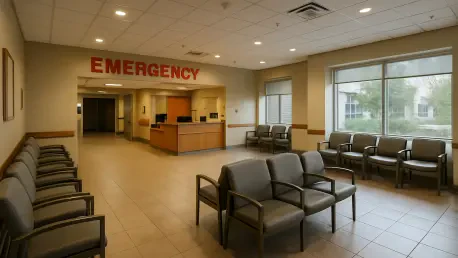

The familiar challenge of overflowing emergency departments, particularly during the demanding winter season, has long represented a critical pressure point for England’s healthcare system, often leading to stressful conditions for both patients and staff. For years, hospitals have predominantly operated in a reactive mode, scrambling to allocate resources and manage patient flow only after a surge in arrivals is already underway. This approach inevitably contributes to prolonged wait times and places immense strain on medical professionals. However, a significant technological shift is now underway across the country, aiming to replace this reactive cycle with a predictive, data-driven strategy. Hospitals are beginning to implement an advanced artificial intelligence tool designed to forecast patient demand, marking a pivotal step toward alleviating seasonal bottlenecks and fundamentally changing how emergency care is managed and delivered. This initiative is about more than just technology; it represents a strategic move to empower administrators and support frontline workers.
A Proactive Approach to Patient Care
The core of this transformation is an AI-powered demand forecasting tool, now operational in 50 National Health Service (NHS) organizations, which is engineered to move healthcare management from a state of reaction to one of proactive preparation. This system functions by synthesizing a complex and diverse array of data streams into a single, coherent predictive model. It analyzes information ranging from Met Office weather forecasts, which can influence everything from respiratory illnesses to trauma incidents, to years of historical hospital admission rates. The algorithm also incorporates seasonal health data, such as flu outbreaks, and tracks daily patient traffic patterns to identify emerging trends. By integrating these disparate sources, the AI generates highly accurate predictions of when and where emergency services will experience their most significant demand. This foresight provides hospital administrators with a crucial advance warning of potential pinch points, enabling them to make more informed and timely decisions regarding staffing levels, bed availability, and overall capacity management, ensuring resources are in place before a crisis hits.
Government Backing and Future Implications
This widespread adoption of predictive AI is a key component of the Prime Minister’s AI Exemplars program, a broader government initiative focused on modernizing public services through the integration of advanced technology. Top government officials, including the Technology Secretary and the Health Innovation Minister, have championed the project as a vital step in leveraging artificial intelligence to support the hardworking staff of the NHS and ultimately improve patient outcomes. The program is seen not merely as a technological upgrade but as a strategic investment in the resilience and efficiency of the national healthcare infrastructure, especially during the perennially challenging winter months. Early feedback from hospital managers who have implemented the system has been overwhelmingly positive, with many highlighting its immediate effectiveness in supporting better operational decisions. They report that the ability to anticipate patient surges, even a few days in advance, allows for more efficient staff allocation, smoother patient transitions, and a tangible reduction in wait times.
The Dawn of a Smarter NHS
The initial deployment of this predictive AI tool marked a significant turning point in the modernization of the NHS, demonstrating a commitment to harnessing data for tangible patient benefit. The success seen in the first 50 trusts provided a powerful proof of concept, showing that anticipating patient demand was not just a theoretical possibility but a practical strategy for improving hospital efficiency. This progress established a new baseline for operational management, where data-informed foresight replaced last-minute scrambling. The positive outcomes, such as better staff allocation and more streamlined patient journeys, created a strong foundation for future technological integration. It was understood that this was only the beginning; the principles behind the emergency department tool could be adapted for other hospital departments, from maternity wards to elective surgery scheduling, creating a more cohesive and intelligent healthcare ecosystem. The initiative underscored a broader vision where technology serves as a crucial ally to medical professionals, freeing them to focus more on patient care and less on logistical crises.