
A significant transformation is quietly taking place within the Las Vegas medical landscape, methodically reshaping the city from a place once bypassed for elite medical treatment into a premier global destination for advanced surgical procedures. This evolution is driven by a powerful confluence of revolutionary robotic technology, world-renowned surgical expertise, and a comprehensive institutional commitment to innovation and education. This synergy is not merely elevating the standard of patient care within Southern Nevada; it is actively rewriting the city’s long-standing reputation, positioning it as a hub where patients from around the world now seek unparalleled surgical solutions that are simply unavailable elsewhere. The old narrative is being inverted, with the city’s airport becoming an entry point for medical tourists in search of the future of surgery.
The Catalyst for Change
A Surgeon and His System
At the heart of this medical renaissance is the introduction of the groundbreaking Dynamis Robotic Surgical System at Southern Hills Hospital, a platform operated by the uniquely qualified orthopedic surgeon Dr. Kornelis Poelstra. In a distinction that sets him and his institution apart on a global scale, Dr. Poelstra is believed to be the only surgeon in the world currently operating this specific system for complex spinal procedures. This exclusivity has transformed Southern Hills Hospital into a powerful magnet for patients requiring intricate spinal interventions, drawing them from as far away as the East Coast, Florida, and Texas. Dr. Poelstra himself notes the inversion of an old joke that Las Vegas’s best hospital was its airport for departures; now, that same airport serves as a crucial gateway for patients arriving to receive a level of specialized care that cannot be replicated anywhere else. This influx signals a definitive shift in the city’s medical identity.
The presence of this one-of-a-kind technology has created a center of excellence that redefines what is possible in spinal surgery and fundamentally alters the patient journey. Individuals who previously would have sought treatment in traditional medical meccas are now rerouting their plans to Southern Nevada, a testament to the compelling advantage offered by the Dynamis system under Dr. Poelstra’s guidance. The development establishes Las Vegas not just as a participant in the field of advanced surgery but as a leader setting a new global standard. This shift is validated by the increasing number of patients undertaking cross-country travel, a clear indicator that the combination of pioneering technology and singular expertise at Southern Hills Hospital represents a powerful and irresistible draw for those facing some of the most challenging spinal conditions, solidifying the city’s newfound status as a destination for cutting-edge medical care.
A Revolution in Hard Tissue Surgery
To fully grasp the magnitude of this advancement, it is crucial to understand the specific technological leap that the Dynamis system represents within the broader evolution of surgical robotics. For many years, the field was dominated by platforms designed for soft tissue, with systems like the Da Vinci series revolutionizing procedures involving organs and muscles. However, the mechanics of these robots were fundamentally unsuitable for the distinct demands of orthopedic and spinal operations on bone. The development of robotic assistance for hard tissue surgery began to gain traction with earlier models, such as the single-arm Mazor X system, which represented a significant step forward. Yet, these pioneering systems consistently ran into a critical and persistent obstacle that limited their precision and widespread adoption: the problem of stabilization. This challenge remained the primary barrier to unlocking the full potential of robotics in orthopedics.
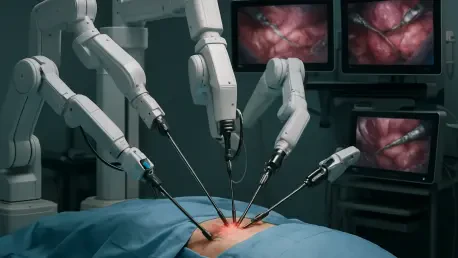
The core issue that plagued earlier hard tissue robots was their inability to ensure the surgical target remained perfectly immobile. As Dr. Poelstra explains, a surgical robot can only execute its pre-programmed, semiautonomous tasks with absolute precision if the vertebra is completely stationary. With a single-arm robot, there was no integrated mechanism to securely hold the bone steady while another part of the system performed a delicate task like drilling or placing a screw. Any microscopic movement from the patient, even the subtle motion of breathing, could compromise the procedure’s safety and accuracy. The Dynamis system, developed by the Switzerland-based firm LEM Surgical, provides the definitive solution to this long-standing challenge through its innovative multi-arm architecture. Its design integrates three distinct robotic arms into a single, mobile cart. In a paradigm-shifting approach, one arm is dedicated to securely stabilizing the spine, effectively creating a rigid and unmoving surgical field while the other arms perform the primary surgical tasks with unprecedented accuracy, guided by a third arm dedicated to optical navigation.
Building an Ecosystem of Excellence
A Deep Institutional Investment
The arrival of the Dynamis system is not an isolated technological marvel but a flagship achievement within a much broader, strategic investment by Southern Hills Hospital and its parent company, HCA Healthcare. This deep institutional commitment to leveraging innovation for better patient outcomes is evidenced by the hospital’s extensive fleet of advanced medical technology. According to Jason Desai, the hospital’s chief operating officer, the facility houses approximately 10 other medical robots that are utilized across a wide range of specialties, including pulmonary care and general orthopedics. This diverse arsenal of robotic platforms underscores a core philosophy: to fully embrace minimally invasive surgical techniques. The overarching goal, as articulated by Desai, is to reduce the physical impact of surgery on patients, which in turn leads to shorter, less complicated recovery periods and allows individuals to progress to the next stage of their care and return to their lives more quickly and with better results.
This unwavering commitment to safety and quality through technological advancement has earned significant external validation, bolstering the hospital’s reputation. The Leapfrog Group, a highly respected national nonprofit watchdog organization dedicated to healthcare transparency and patient safety, awarded both Southern Hills and its sister facility, MountainView Hospital, an “A” grade—its highest possible rating. This prestigious distinction is a direct reflection of their success in implementing and maintaining superior safety protocols and achieving excellent patient outcomes. The Leapfrog Group’s assessment attributes this top-tier performance in part to the hospitals’ investment in and proficient use of their advanced robotic capabilities, which are operated by highly skilled and extensively trained clinical teams. This recognition serves as independent confirmation that the strategic focus on innovation is not just a mission statement but a tangible reality that translates into a safer, higher-quality care environment for every patient.
Training the Next Generation
A crucial third pillar supporting this medical renaissance is a robust and forward-thinking educational framework designed to ensure that cutting-edge technology is wielded by expertly trained medical professionals. The successful implementation of systems like Dynamis is contingent upon having a steady pipeline of surgeons who are proficient in their use from the very beginning of their careers. Recognizing this, Dr. Saba Habis, a vice president with HCA Healthcare’s Graduate Medical Education (GME) division, has detailed the organization’s proactive approach to training the next generation. HCA operates an extensive network of GME programs and has invested millions of dollars in state-of-the-art simulation laboratories at its facilities, including Southern Hills, MountainView, and the Galen School of Nursing. These advanced labs form the backbone of a modern medical education, providing a critical bridge between academic knowledge and real-world surgical application.
Within these sophisticated simulation centers, the future of surgery is being forged. Medical residents and fellows immerse themselves in hands-on training using robotic consoles that perfectly mimic the equipment they will encounter in actual operations. They practice complex procedures on incredibly lifelike manikins capable of simulating a wide range of patient symptoms and physiological responses, from fluctuating vital signs to adverse reactions. This immersive training in a safe and controlled environment allows new doctors to hone their skills and build confidence without any risk to patients. This approach effectively flattens the learning curve associated with new technology and ensures that proficiency is achieved before entering the operating room, eliminating what Dr. Habis refers to as “antiquated methods of medicine.” This comprehensive educational ecosystem not only enhances HCA’s ability to recruit top-tier medical talent but also directly contributes to the overarching goals of maximizing patient safety and achieving surgical precision.
A New Standard for Medical Progress
The convergence of these distinct elements—a pioneering surgeon, a revolutionary technology, and a comprehensive institutional and educational support system—forged a cohesive and powerful narrative of medical advancement. The city successfully cultivated an ecosystem of excellence where innovation was not just adopted but was also nurtured and scaled. The Dynamis system at Southern Hills Hospital stood as the flagship achievement in this transformation, but it was the surrounding infrastructure of investment and education that ensured its success was sustainable and repeatable. This deliberate, multi-faceted approach provided a blueprint for how a concentrated focus on technology, talent, and training could fundamentally reshape a region’s medical identity, turning a perceived weakness into an undeniable global strength and establishing a new benchmark for progress in the field of robotic surgery.