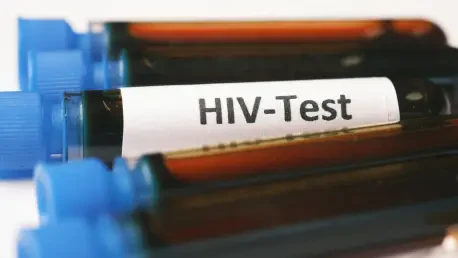

Imagine a world where a life-changing HIV diagnosis could be delivered in just five minutes, with the precision to separate active infections from the mere echoes of a vaccine—a world where misdiagnoses no longer haunt patients or skew public health data. This vision is now closer to reality thanks to a groundbreaking diagnostic tool developed by researchers at Pennsylvania State University. As HIV vaccines progress through clinical trials, a pressing challenge has emerged: standard tests often mistake vaccine-induced immune responses for active infections, leading to false positives. Known as vaccine-induced seropositivity (VISP), this issue creates barriers in personal, medical, and societal contexts, from blood donation restrictions to employment hurdles. The new rapid test, however, promises to cut through this confusion, offering clarity in mere minutes. This advancement doesn’t just refine diagnostics; it paves the way for broader vaccine adoption without the shadow of diagnostic doubt.
A Diagnostic Dilemma in the Age of HIV Vaccines
The journey to an effective HIV vaccine has been long and complex, with clinical trials showing immense promise in curbing the global epidemic. However, a significant roadblock persists in the form of VISP, where traditional antibody-based tests misinterpret vaccine responses as signs of active infection. This misstep isn’t just a technical glitch; it carries profound implications for individuals who face stigma or exclusion due to false positives in settings like military service or insurance applications. Moreover, inaccurate results can distort public health data, making it harder to track true infection rates or evaluate vaccine efficacy in large-scale studies. The need for a tool that can reliably distinguish between vaccination effects and actual HIV presence has never been more urgent, especially as vaccines move closer to widespread use. This diagnostic challenge touches on both individual lives and the broader fight against HIV, underscoring the stakes involved in getting it right with every test.
Beyond the personal toll, the ripple effects of VISP extend into the heart of global health strategies. Without precise diagnostics, researchers struggle to interpret clinical trial outcomes, while public health officials grapple with skewed incidence statistics that could mislead policy decisions. Consider the scenario of an outbreak: if vaccinated individuals are repeatedly flagged as infected, resources might be misallocated, delaying critical interventions. The frustration and psychological burden on those misdiagnosed only add to the problem, often leaving them in limbo as they seek confirmatory testing that can take weeks. Enter the urgent demand for innovation—a solution that doesn’t just detect HIV markers but decodes their context with speed and accuracy. This gap in current technology has set the stage for a transformative approach, one that could redefine how diagnostics support the rollout of preventive measures like vaccines in diverse communities worldwide.
Breakthrough Technology Offers Swift Precision
Stepping into this critical gap is a novel point-of-care testing platform, spearheaded by Dipanjan Pan, PhD, at Pennsylvania State University. Roughly the size of a smartphone and crafted through 3D printing, this device delivers results in an astonishing five minutes by analyzing multiple HIV markers simultaneously. Unlike conventional tests that rely solely on antibodies, this tool detects p24 protein, antibodies against p24, viral RNA, and a control RNA molecule, painting a comprehensive picture of a patient’s status. By integrating machine learning algorithms, it identifies active viral replication—a hallmark of true infection absent in VISP cases. Tested across 104 clinical samples from both vaccinated and unvaccinated individuals, the device boasted a sensitivity of 95% and specificity of 98%, proving its reliability in distinguishing real infections from vaccine responses. This isn’t just a technical win; it’s a lifeline for accurate diagnosis.
What makes this technology even more compelling is its practicality for real-world application. The design prioritizes scalability and affordability, ensuring it can be deployed in settings ranging from well-equipped hospitals to resource-limited clinics. Additionally, the test offers insights into infection staging by assessing levels of protein antigens and antibodies, helping clinicians determine whether a patient is in an early or late phase of HIV progression. This dual capability of rapid results and detailed analysis could transform patient care, minimizing the wait times that often heighten anxiety. Furthermore, by reducing false positives, it alleviates the societal burdens tied to misdiagnosis, such as restrictions on travel or employment. As this tool moves toward broader adoption, it stands to bridge a critical divide, ensuring that HIV vaccine programs aren’t undermined by the very tests meant to support them.
Shaping the Future of Public Health
The broader implications of this rapid test ripple through the ongoing battle against HIV, a persistent global health crisis despite advances in treatment and prevention. With millions still at risk, vaccines represent a cornerstone of long-term control, but their success hinges on diagnostics that don’t falter under the weight of VISP. This new platform not only enhances the accuracy of individual results but also strengthens the integrity of clinical trial data, enabling researchers to better gauge vaccine effectiveness. Public health systems, too, stand to benefit as clearer incidence figures guide more effective resource allocation and outbreak responses. In essence, this innovation acts as a safeguard, ensuring that the promise of vaccination isn’t clouded by diagnostic inaccuracies that could erode trust or hinder progress in high-stakes environments.
Looking ahead, the adaptability of this technology sparks optimism for its role in diverse contexts. Its cost-effective design opens doors for use in underserved regions where HIV prevalence often remains high, yet testing infrastructure lags. Meanwhile, the psychological relief it offers patients—sparing them the distress of a false positive—cannot be overstated. Health authorities and vaccine developers might now collaborate more confidently, knowing a reliable diagnostic backstop exists. As efforts to combat HIV evolve, integrating such tools into standard practice could become a priority over the coming years, potentially reshaping protocols from testing to treatment initiation. This test, in short, is more than a device; it’s a catalyst for refining how society navigates the intersection of innovation and epidemic response.
Building on a Milestone for Better Outcomes
Reflecting on this advancement, it’s evident that a significant barrier in HIV management was tackled with ingenuity and precision. The rapid test’s ability to differentiate active infections from vaccine responses addressed a long-standing diagnostic flaw, easing burdens that once weighed heavily on both patients and systems. Its high accuracy and swift turnaround reshaped expectations for point-of-care solutions, setting a benchmark for future tools. Beyond immediate results, it fortified the foundation of vaccine research, ensuring trials progressed without the fog of misinterpreted data. Moving forward, stakeholders might consider prioritizing accessibility, perhaps by accelerating production or subsidizing costs in vulnerable areas. Partnerships between tech innovators and health organizations could further refine deployment strategies, ensuring no community was left behind. This milestone, achieved with remarkable clarity, invites a renewed focus on scaling impact, turning a singular breakthrough into a global standard for care.