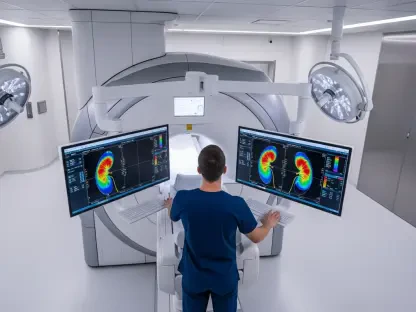

The global nuclear imaging equipment sector is experiencing a period of technologically advanced and sustained growth, with projections indicating the market will expand from its estimated size of USD 7.21 billion in 2025 to a notable USD 9.52 billion by 2034. This expansion, representing a compound annual growth rate of 3.18%, is driven by a convergence of clinical innovation, expanding diagnostic applications, and strategic infrastructure investments worldwide. At the heart of this market are sophisticated imaging systems that utilize radiotracers to provide a functional assessment of organs and tissues, offering insights that go far beyond simple anatomical structures. Core technologies include Single-Photon Emission Computed Tomography (SPECT), often integrated into hybrid SPECT/CT platforms, and Positron Emission Tomography (PET), commonly combined with CT or MRI. These systems have become indispensable across multiple clinical specialties, particularly in oncology, cardiology, and neurology, enabling clinicians to stage diseases with high precision, monitor the efficacy of treatments, and guide therapeutic pathways. The primary end-users—hospitals, specialized imaging centers, and research institutes—leverage this equipment for both routine clinical diagnostics and advanced translational research, ensuring a continuous and robust demand for high-quality nuclear medicine technology.
The Driving Forces of Market Expansion
A primary driver fueling the market’s robust growth is the expanding role of molecular imaging in monitoring therapy response, representing a significant clinical shift in patient management. Historically, anatomical imaging modalities like CT and MRI were the standard for assessing treatment effectiveness, a process that often relied on measuring physical changes in tumor size over time. However, physicians are increasingly turning to PET and SPECT scans to evaluate early biological and metabolic changes that occur in response to therapy. This functional assessment provides a much more immediate and accurate indication of treatment efficacy than anatomical changes, which can lag significantly. This trend is particularly prominent in oncology, where understanding a tumor’s metabolic activity can guide decisions to continue, alter, or cease a specific treatment regimen. The demand for quantifiable metabolic and receptor-level data is not only encouraging higher utilization rates for existing scanners but is also driving the procurement of new, technologically superior systems capable of delivering these precise insights across a diverse range of patient groups and disease states, including autoimmune and metabolic disorders.
A substantial opportunity propelling the market forward is emerging from the rapid expansion of targeted radioligand therapy (RLT) pipelines, a form of precision medicine that is revolutionizing cancer treatment. RLT involves attaching a radioactive isotope to a molecule that specifically targets and binds to cancer cells, delivering a therapeutic dose of radiation directly to the tumor while minimizing damage to surrounding healthy tissue. This approach is gaining immense traction for treating conditions such as prostate cancer and neuroendocrine tumors. As more RLT candidates advance through global clinical trials and gain regulatory approval, the demand for high-precision nuclear imaging systems has surged in tandem. These imaging systems are critical for the theranostics approach, where a diagnostic scan is first used to assess tracer biodistribution and quantify target receptor expression to determine a patient’s eligibility for the therapy. Subsequent scans can then guide dosimetry and monitor the treatment’s effectiveness. The rising tide of investment in RLT development is compelling hospitals, clinical trial networks, and research centers to upgrade their PET and SPECT infrastructure, creating a powerful new revenue stream for equipment manufacturers worldwide.
Navigating Challenges and Embracing New Trends
Despite the positive outlook and powerful growth drivers, the nuclear imaging market faces a considerable operational challenge that acts as a significant restraint: the short half-life of commonly used radiotracers. Many of the isotopes essential for both PET and SPECT imaging decay rapidly, creating a narrow and time-sensitive window for their entire lifecycle, from production and transportation to quality control and administration. This logistical complexity compresses scanning schedules and presents a major hurdle for healthcare facilities that lack on-site or nearby radiopharmacy infrastructure. The reliance on external suppliers for these time-sensitive radiotracers limits patient throughput and makes scheduling inflexible, often leading to canceled appointments if shipments are delayed. This constraint on workflow scalability ultimately limits the broader adoption and utilization of nuclear imaging equipment, particularly in geographically remote regions or at smaller centers that cannot justify the investment in localized tracer production capabilities. Overcoming this logistical barrier remains a key focus for innovation within the industry.
Two major trends are currently shaping the technological and operational landscape of the nuclear imaging market, pointing toward a more data-driven and integrated future. The first is the growing integration of radiomics-driven imaging interpretation. Radiomics, the process of extracting vast amounts of quantitative data from medical images using advanced computational analysis, is becoming an integral part of nuclear medicine. Advanced clinical and research institutions are increasingly applying radiomics pipelines to PET and SPECT datasets to support more sophisticated tumor phenotyping, provide quantitative biomarkers for evaluating treatment response, and enable detailed metabolic profiling. This trend is driving demand for next-generation nuclear imaging platforms that can produce the high-resolution, high-detail datasets required for robust radiomics workflows. A second transformative trend is the shift toward compact, radiopharmacy-linked imaging ecosystems. This model involves co-locating small-footprint cyclotrons, automated radiotracer synthesizers, and advanced digital PET scanners within a single, unified clinical workflow, often on a hospital campus. This paradigm supports the decentralized, on-demand production of radiotracers, empowering facilities that previously lacked the resources for a large-scale radiopharmacy to perform advanced molecular imaging and reducing reliance on external suppliers.
A Closer Look at Market Segments
When segmented by product, the SPECT Imaging Systems category holds the dominant position in the market, accounting for a substantial 58.98% revenue share. This dominance is driven by the widespread adoption of advanced SPECT platforms, particularly hybrid SPECT/CT configurations, as hospitals and nuclear medicine departments move to upgrade their aging equipment. The improved detector technologies and optimized workflows of modern SPECT systems provide enhanced diagnostic clarity for a broad range of applications, especially in cardiology for myocardial perfusion imaging and in neurology for assessing neurodegenerative diseases. This solidifies the consistent demand for this product category. Conversely, the PET Imaging Systems segment is projected to be the fastest-growing category, with an anticipated CAGR of 4.12%. This accelerated growth is fueled by the expanding use of PET/CT scanners in molecular oncology and metabolic imaging. The development of sophisticated reconstruction algorithms that enable high-precision quantification, coupled with the increasing availability of novel radiotracers from regional production hubs, is encouraging broader installation of PET equipment across both public and private healthcare networks.
From an application standpoint, the Oncology segment is the largest area, commanding a 50.12% market share. Nuclear imaging serves as a cornerstone of modern cancer care, with PET widely used for tumor characterization, staging, and restaging, while SPECT/CT is integral for evaluating metastasis. The deep integration of functional imaging into oncology treatment planning and therapy response monitoring continues to drive high procurement rates for advanced hybrid systems in cancer centers globally. The Cardiology segment, meanwhile, is anticipated to exhibit the fastest growth, registering a CAGR of 4.45%. This expansion is attributed to the increased adoption of myocardial perfusion imaging with SPECT and the growing use of PET for advanced cardiac assessments. In terms of end use, the Hospitals segment dominates the market, contributing 53.24% of the revenue. Large hospitals are the primary purchasers, continuously expanding their departments to support rising diagnostic volumes. The R&D Institutes segment, however, is forecast to be the fastest-growing end-user, with a CAGR of 4.68%, propelled by increasing involvement in cutting-edge tracer research and translational science programs that require specialized, high-performance imaging systems.
A Future Forged by Innovation and Strategy
The regional analysis of the nuclear imaging market revealed distinct patterns of growth and adoption across the globe. North America stood as the dominant force, holding a commanding 43.78% share, a leadership position driven by the expansion of PET tracer production centers, strong partnerships between research hospitals and domestic manufacturers, and significant federal investments in molecular imaging research. In contrast, the Asia Pacific region was poised to be the fastest-growing market, with an anticipated CAGR of 5.18%, propelled by the establishment of state-of-the-art molecular imaging research hubs within national cancer control missions. Europe experienced a steady rise in equipment adoption, fueled by regional imaging standardization frameworks, while Latin America observed consistent development as healthcare systems in Brazil and Mexico increased their investment in molecular imaging. The Middle East and Africa also showed heightened procurement activity, particularly in the United Arab Emirates, where new precision-medicine clusters were being equipped with state-of-the-art PET/CT and SPECT systems.
The market’s competitive landscape was defined by a mix of established medical imaging giants and dynamic emerging players. Industry leaders such as Siemens Healthineers AG, GE HealthCare, and Koninklijke Philips N.V. leveraged their advanced detector technologies and extensive global distribution networks to maintain their prominent market positions. These companies faced growing competition from specialized manufacturers like MinFound Medical Systems Co., Ltd., which gained visibility by offering high-performance scanners at competitive price points. Strategic initiatives highlighted this dynamic environment. In June 2024, GE HealthCare launched several innovations, including a compact cyclotron for in-house tracer production. The following month, Shanghai United Imaging Healthcare Co., LTD announced the installation of its first PET/CT scanner in Mexico, signaling a strategic expansion into new geographical markets. Ultimately, the nuclear imaging equipment market embarked on a path of robust and technologically driven growth, fueled by its indispensable role in precision medicine and propelled by innovations that promised a more personalized and effective future for patient care.