
The global healthcare landscape is currently witnessing a transformative shift toward molecular medicine, where the ability to synthesize specific radioactive tracers at the point of care has become a fundamental requirement for modern oncology and neurology departments. As of 2026, the medical cyclotron market is valued at approximately $246.8 million, reflecting a steady climb toward an anticipated $405.4 million by 2033. This growth, characterized by a compound annual growth rate of 5.4 percent, is largely propelled by the rising prevalence of chronic conditions that demand the high-resolution diagnostic capabilities of Positron Emission Tomography. While traditional nuclear medicine once relied on large, centralized reactors, the current trend emphasizes the deployment of compact, high-efficiency cyclotrons that can be housed within hospital basements or specialized diagnostic centers. This localization of isotope production is no longer a luxury but a strategic necessity for high-volume clinics.
Engineering Innovations: Moving Toward Compact Efficiency
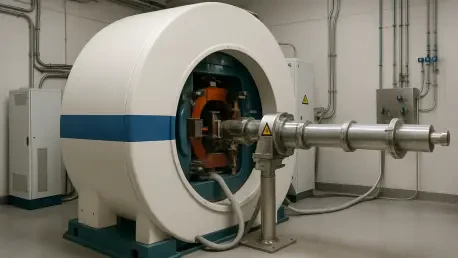
Modern cyclotron engineering has moved away from the massive, cumbersome designs of previous decades toward streamlined, automated systems that prioritize energy efficiency and ease of operation. Contemporary units now feature enhanced beam stability and sophisticated digital monitoring interfaces, which allow technicians to manage radioisotope production with unprecedented precision and safety. These technological advancements have effectively lowered the barriers to entry for many healthcare institutions that previously found the operational complexity and high maintenance costs of older models prohibitive. By integrating advanced shielding materials and self-contained cooling systems, manufacturers have managed to reduce the physical footprint of these machines, making them suitable for urban medical facilities where square footage is at a premium. This shift toward miniaturization does not come at the expense of power; rather, it reflects a refinement of particle acceleration physics tailored for clinical use.
One of the most critical advantages of these modern, onsite cyclotron systems is their ability to mitigate the logistical nightmares associated with the short half-lives of medical isotopes. For example, Fluorine-18, a staple in Positron Emission Tomography imaging, has a half-life of only 110 minutes, meaning that its diagnostic utility diminishes rapidly from the moment of synthesis. Relying on distant production hubs often results in significant isotope decay during transit, leading to higher costs and potential delays in patient care. By producing radiopharmaceuticals directly at the clinical site, healthcare providers can ensure a consistent, on-demand supply that aligns perfectly with scheduled patient workflows. This reliability is particularly vital for emergency oncology screenings and complex neurological evaluations where timing is paramount. Furthermore, the move toward automation in these systems reduces the risk of human error and radiation exposure, creating a safer environment for specialized staff.
Expanding Clinical Horizons: Oncology and Theranostics
Within the current medical landscape, oncology remains the primary driver for cyclotron demand, accounting for nearly half of the total market revenue due to the critical role of specialized scans in cancer staging. However, the emerging field of theranostics—a dual-purpose approach that utilizes the same molecular pathways for both diagnosis and targeted therapy—is rapidly expanding the functional requirements of these machines. This paradigm shift requires a broader spectrum of high-purity radioisotopes beyond the standard tracers, prompting a surge in demand for versatile, multi-particle cyclotrons. These advanced systems are capable of accelerating different types of ions, allowing researchers and clinicians to experiment with novel isotopes that can deliver lethal radiation doses specifically to malignant cells while sparing healthy tissue. The integration of such technology allows for a highly personalized treatment journey, where the effectiveness of a therapeutic agent can be monitored in real-time through high-resolution imaging.
Beyond cancer care, the application of cyclotron-produced isotopes is finding significant traction in the management of cardiovascular and neurological disorders. In cardiology, molecular imaging is increasingly used to assess myocardial viability and blood flow with a level of detail that traditional stress tests cannot match. Meanwhile, in neurology, the ability to visualize amyloid plaques and tau proteins in the brain is revolutionizing the early diagnosis and research of neurodegenerative conditions like Alzheimer’s disease. As the global population ages, the demand for these sophisticated diagnostic tools is expected to rise exponentially, further cementing the role of the cyclotron as a cornerstone of geriatric medicine. The diversification of isotope applications ensures that the market remains resilient against shifts in any single medical subfield. This broad clinical utility encourages private equity and public health departments to invest in long-term infrastructure projects that will support molecular imaging for decades.
Strategic Investment: Regional Growth and Global Supply Chains
While North America continues to maintain a dominant position in the market thanks to its mature nuclear medicine infrastructure and favorable reimbursement policies, the Asia Pacific region is rapidly closing the gap. In 2026, significant investments from both government bodies and private healthcare groups in countries like China, India, and South Korea are fueling an unprecedented expansion of domestic isotope production capabilities. This push is largely motivated by a strategic desire to reduce dependence on international supply chains, which have historically been vulnerable to geopolitical instability and transportation bottlenecks. By establishing a robust network of localized cyclotrons, these nations are not only improving patient access to advanced diagnostics but are also positioning themselves as leaders in the global radiopharmaceutical research sector. The rapid modernization of healthcare facilities in these regions creates a fertile ground for the adoption of the latest cyclotron models.
The evolution of the medical cyclotron market also reflects a broader global trend toward the decentralization of specialized healthcare services. In the past, high-end diagnostic imaging was largely confined to university hospitals and major metropolitan centers, but the advent of cost-effective, smaller-scale cyclotrons is allowing regional clinics to offer the same level of care. This democratization of technology is essential for addressing the healthcare disparities that often exist between urban and rural populations. Furthermore, as the regulatory environment for radiopharmaceuticals becomes more standardized across different jurisdictions, the path for bringing new tracers to market is becoming clearer and more efficient. Manufacturers are responding to this by offering comprehensive service contracts and modular upgrades, ensuring that their equipment remains relevant as clinical needs evolve. The synergy between technological innovation and strategic regional expansion is creating a robust framework for growth.
Future Considerations: Operational Excellence in Nuclear Medicine
Strategic leaders within the healthcare sector focused on long-term capital investments and facility upgrades should have prioritized the integration of automated radiopharmaceutical production to ensure clinical resilience. The transition from a centralized procurement model to a localized production strategy proved to be a decisive factor for institutions seeking to maintain high-volume patient throughput without the risks of isotope depletion. Stakeholders who invested in versatile cyclotron platforms capable of supporting both diagnostic and therapeutic isotopes found themselves better positioned to adopt theranostic protocols as they moved into the mainstream. This proactive approach allowed medical centers to offer a more comprehensive suite of services, ultimately improving patient outcomes and streamlining operational costs. Looking forward, the emphasis on energy-efficient designs and digital remote monitoring will likely become the standard requirement for any new nuclear medicine installation.
Beyond the immediate technical specifications, the successful deployment of cyclotron technology required a coordinated effort between clinicians, physicists, and administrative planners to optimize the radiopharmaceutical supply chain. Institutions that fostered interdisciplinary collaboration were able to maximize the utility of their equipment, expanding into niche areas like pediatric imaging and targeted alpha therapy. As the industry moves toward 2033, the focus will likely shift toward the development of even smaller, “plug-and-play” cyclotron systems that require minimal shielding and can be operated with limited specialized personnel. This evolution will further lower the barrier to entry, making precision medicine a reality for a wider array of healthcare systems globally. Decision-makers should have remained vigilant regarding evolving safety regulations and waste management protocols to ensure that their facilities remained compliant while pushing the boundaries of what is possible in modern nuclear diagnostics.