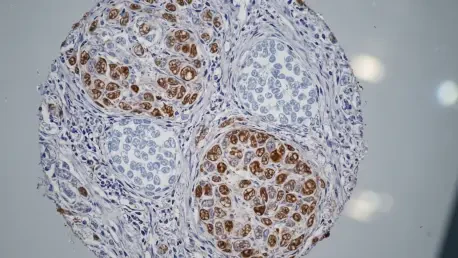

The release of the BAP1 assay follows other recent launches like VENTANA MTAP and Claudin-4 to create a robust suite of diagnostic tools for lung health. Pathologists have long navigated the significant difficulty of differentiating between malignant mesothelioma and benign reactive processes in pleural effusions. Benign inflammation often mimics the cellular features of aggressive cancer, leading to diagnostic delays or potential misinterpretation of biopsy results. The introduction of the automated VENTANA BAP1 (SP527) assay changed this paradigm by providing a reliable biological indicator of malignancy through the loss of nuclear expression. This specific marker became essential for identifying cancerous transformations with high precision. By utilizing this tool, clinical laboratories moved away from subjective assessments toward a model that relied on genetic loss as a proxy for disease. This shift ensured the diagnostic journey was faster and significantly more accurate for all patients.
Genetic Loss Indicators: The Power of Protein Analysis
The biological significance of the BAP1 protein, located on chromosome 3p21, stems from its role as a tumor suppressor that regulates the cell cycle and DNA repair. When the BAP1 gene undergoes a mutation or deletion, the resulting loss of protein expression in the nucleus serves as a clear indicator of oncogenic activity. Research across clinical settings showed that this loss is nearly 100% specific for malignant mesothelioma, a finding that revolutionized how pathologists approached difficult cases. Unlike older markers that might show variable staining in both healthy and malignant cells, the absence of BAP1 provided an objective result that removed much of the guesswork from the diagnostic process. This clarity allowed medical teams to confidently diagnose even the most subtle cases of pleural and peritoneal malignancies. The automated nature of the assay further minimized human error, providing consistent results across many different laboratory settings and global systems.
Beyond confirming cancer, the BAP1 assay proved indispensable in differential diagnosis, where mesothelioma must be distinguished from metastatic lung cancer. In the past, non-small cell lung cancer often presented with similar histological features, leading to inappropriate treatment paths. By integrating BAP1 testing with established markers such as calretinin and WT1, clinicians established a multi-layered diagnostic protocol that isolated the origin of the tumor. This comprehensive approach was vital in 2026, as targeted therapies became the standard of care, requiring absolute certainty regarding the tumor type. The ability to rule out mimics with high specificity meant that patients received the most effective drugs for their condition from the beginning. This refinement in testing not only improved survival rates but also reduced the physiological toll of ineffective treatments. This methodical screening ensured that every patient started therapy with confidence and hope.
Clinical Efficiency: Strategic Tissue Stewardship
One of the most significant hurdles in oncology was the limited availability of patient tissue samples, often referred to as the challenge of tissue stewardship. Small needle biopsies provided only a few milligrams of material, which had to be shared across diagnostic tests and molecular profiling. The VENTANA BAP1 assay addressed this by being part of a streamlined, automated workflow that maximized the utility of every micron of tissue. By providing a single-slide solution that delivered high diagnostic yield, the assay preserved enough biological material for essential downstream applications like next-generation sequencing. This conservation was critical because it allowed patients to access personalized medicine without the need for repetitive, invasive re-biopsies. The move toward intelligent immunohistochemistry ensured that the initial sample was sufficient to map out a complete treatment plan, encompassing both the initial diagnosis and the identification of genetic targets.
Looking back at the rollout of these diagnostic systems, the global healthcare community successfully implemented standardized testing protocols that bridged the gap between academic centers and community hospitals. This transition relied on the BAP1 assay’s registration as a Class I IVD with the U.S. FDA and its IVDR approval as a Class C device, ensuring that quality-controlled diagnostics reached every market. Hospitals adopted these tools as the foundation for a more integrated approach to thoracic oncology, where diagnostic speed was prioritized alongside accuracy. The integration of automated IHC into routine pathology workflows allowed labs to handle increasing caseloads without compromising analysis. Furthermore, the focus on preserving tissue samples paved the way for more comprehensive genomic studies, discovering new therapeutic vulnerabilities in mesothelioma. These advancements established a clear roadmap for future innovations, emphasizing that the preservation of data was as vital as the diagnosis.