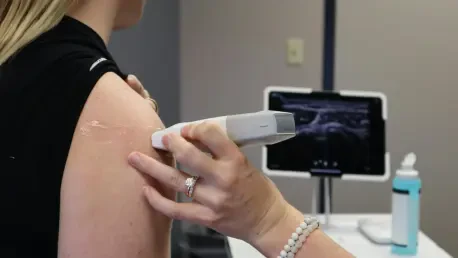

Imagine a world where medical imaging is so precise that even the tiniest vascular anomaly can be detected in real-time, empowering clinicians to make faster, more accurate diagnoses. Samsung has turned this vision into reality with the launch of its groundbreaking R20 ultrasound system, a super-premium device designed to transform general imaging in healthcare. This innovative tool doesn’t just enhance diagnostic capabilities; it reimagines them with cutting-edge artificial intelligence, superior image quality, and a design that prioritizes clinician comfort. As healthcare demands grow increasingly complex, the R20 steps in as a game-changer, promising to elevate the standard of patient care across diverse medical fields like obstetrics, vascular imaging, and beyond. Its arrival signals a bold leap forward, blending technology with practicality to address real-world challenges faced by medical professionals every day.
Pushing Boundaries with Advanced Imaging Technology
The R20 ultrasound system stands out primarily due to its remarkable imaging prowess, built on Samsung’s proprietary Crystal Architecture™. This technology delivers unparalleled uniformity, resolution, and penetration, ensuring that scans across applications—whether for abdominal, thyroid, or musculoskeletal imaging—are consistently clear and detailed. Clinicians benefit from an ultra-high-definition OLED monitor paired with a powerful GPU-driven imaging engine, which together create visualizations that inspire diagnostic confidence. Moreover, enhanced Doppler sensitivity and color flow visualization allow for the detection of subtle vascular structures and pathologies with striking precision. This isn’t just an upgrade; it’s a complete overhaul of what ultrasound imaging can achieve, setting a new benchmark for accuracy in varied clinical settings and catering to a wide range of patient needs with ease.
Beyond the impressive hardware, the R20’s impact lies in how it transforms the diagnostic process into something seamless and reliable. The system ensures that whether a clinician is examining intricate breast tissues or assessing gynecological conditions, the images produced are not only detailed but also actionable. This clarity can make all the difference in early detection and treatment planning, potentially improving patient outcomes significantly. Additionally, the broad spectrum of applications means that specialists across multiple fields can rely on a single device for diverse needs, reducing equipment clutter and operational costs in busy medical facilities. The R20’s imaging capabilities aren’t just a technical feat; they’re a practical solution to the everyday challenges of delivering high-quality healthcare in high-pressure environments, proving that innovation can directly translate into better care.
Revolutionizing Workflows with AI Innovation
One of the most transformative aspects of the R20 is its suite of AI-powered tools, designed to streamline complex procedures and elevate clinical efficiency. Features like Live LiverAssist and Live BreastAssist enable real-time detection of suspicious lesions with detailed classifications, such as BIRADS for breast imaging, while auto-measurement tools ensure consistent and accurate assessments of internal structures. Additionally, technologies like Deep USFF offer fat fraction quantification that correlates closely with MRI standards, providing a less invasive and more accessible diagnostic option. These advancements reduce the manual workload for clinicians, allowing them to focus more on patient interaction and less on repetitive tasks, fundamentally changing how ultrasound procedures fit into the broader workflow of medical care.
Furthermore, the integration of AI in the R20 isn’t just about automation; it’s about enhancing precision in ways that were previously unimaginable. By minimizing human error through automated measurements and real-time assistance, the system empowers healthcare professionals to make confident decisions swiftly, even under tight schedules. This efficiency is particularly crucial in high-volume settings where time is often a limiting factor. The AI tools also adapt to various clinical scenarios, ensuring that whether a scan is for obstetrics or urology, the technology responds with tailored insights. As a result, the R20 doesn’t merely support clinicians—it redefines their capabilities, turning ultrasound imaging into a smarter, more intuitive process that aligns with the fast-paced demands of modern healthcare while maintaining a sharp focus on diagnostic accuracy.
Prioritizing Clinician Comfort and Efficiency
Equally noteworthy is the R20’s emphasis on ergonomic design, which addresses the physical and operational challenges clinicians face daily. Lightweight transducer cables, an intuitive touch interface, and customizable configurations ensure that the system adapts to individual user preferences and varied clinical demands. This thoughtful approach minimizes physical strain and fatigue, a common issue for professionals performing repetitive scans over long shifts. By creating a user-friendly experience, the R20 enables clinicians to maintain peak performance without the burden of cumbersome equipment, proving that technology can prioritize human needs just as much as diagnostic outcomes in the evolving landscape of medical imaging.
Moreover, the ergonomic focus of the R20 reflects a deeper understanding of how workflow efficiency ties directly to patient care quality. When clinicians are less bogged down by awkward tools or complex setups, they can dedicate more energy to interpreting results and engaging with patients. This design philosophy extends to practical features like streamlined interfaces that reduce learning curves for new users, ensuring that even in busy or understaffed environments, the technology remains accessible. The balance of cutting-edge innovation with user-centric design in the R20 showcases a holistic approach to healthcare solutions, reinforcing that advancements should enhance not just what clinicians see, but also how they work, ultimately benefiting everyone in the medical chain.
Setting a New Standard in Healthcare Innovation
Reflecting on the launch of the R20 ultrasound system, it’s clear that Samsung crafted a tool that went beyond incremental improvements, setting a transformative precedent in general imaging. Its blend of superior imaging architecture, AI-driven efficiencies, and ergonomic considerations addressed critical pain points in clinical practice with remarkable foresight. This device didn’t just meet existing needs; it anticipated future challenges, ensuring that healthcare professionals were equipped with a solution that was both powerful and practical for diverse medical applications.
Looking ahead, the legacy of the R20 invites exploration into how similar innovations can further bridge gaps in diagnostic technology. Healthcare facilities might consider integrating such advanced systems to stay competitive, while industry leaders could draw inspiration to push boundaries in user-focused design. The strides made with this system suggest a future where technology and human needs align even more closely, urging stakeholders to invest in solutions that prioritize both precision and ease of use. As the field evolves, the benchmark established by such advancements will likely guide the next wave of medical imaging tools.