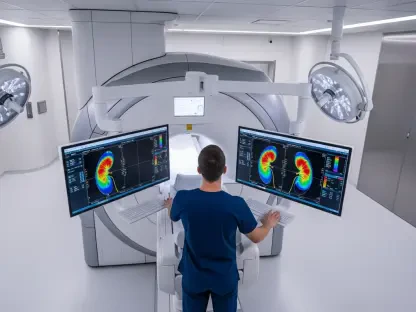

Riding a wave of robust demand for advanced diagnostic technologies, GE HealthCare has demonstrated significant financial strength, posting impressive fiscal year 2025 results that have bolstered investor confidence and set a positive tone for the year ahead. The company announced total revenues of $20.6 billion for the fiscal year, a notable 4.8% increase over the $19.7 billion recorded in the prior year, signaling vigorous growth in key areas of its business. This performance immediately resonated with the market, as the company’s shares saw a 1.1% lift to $79.71 upon the opening of Nasdaq trading on February 4th. The results not only highlight the successful execution of the company’s strategic initiatives but also reflect broader trends in the healthcare industry, where investment in sophisticated medical equipment and diagnostic tools continues to be a top priority for providers worldwide. This upward trajectory provides a solid foundation for the company as it navigates the evolving landscape of global healthcare.
A Closer Look at the Financial Performance
Segment-Specific Revenue Drivers
The cornerstone of GE HealthCare’s financial success in fiscal year 2025 was its Imaging segment, which continued to be the largest contributor to the company’s top line. Generating an impressive $9.25 billion in revenue, the division saw a solid 4.4% increase from the previous year’s $8.86 billion. This consistent growth can be attributed to a confluence of factors, including persistent global demand for advanced diagnostic tools like MRI, CT, and ultrasound systems. Healthcare providers are increasingly investing in this technology to improve diagnostic accuracy and patient outcomes. The segment’s strong performance was further underscored by its fourth-quarter results, where it posted a 6.6% growth to reach $2.55 billion. This sustained momentum reflects not only healthy capital investment trends within the healthcare sector but also GE HealthCare’s strong commercial execution and its ability to innovate and deliver cutting-edge imaging solutions that meet the complex needs of modern medicine, from small clinics to large hospital networks.
In stark contrast to the steady growth of the Imaging division, the Pharmaceutical Diagnostics (PDx) segment emerged as the company’s growth superstar, delivering an exceptional performance that significantly outpaced all other verticals. The PDx division, which specializes in contrast media and radiopharmaceuticals used to enhance the visibility of tissues and organs during medical imaging procedures, reported its revenue soared by an astounding 15.6% to reach $2.9 billion, up from $2.5 billion in fiscal year 2024. This remarkable growth was even more pronounced in the final quarter of the year, where the segment’s revenue skyrocketed by 22.3% to $790 million. This surge indicates a powerful and growing demand for diagnostic agents that are critical for a wide range of procedures, from routine scans to complex oncological and neurological assessments. The performance of the PDx segment highlights a critical industry trend: as imaging technology becomes more sophisticated, the need for equally advanced diagnostic agents to maximize its potential grows in tandem, positioning this division as a key engine for future growth.
A Tale of Two Divisions
While the Imaging and PDx segments celebrated significant gains, the Patient Care Solutions (PCS) division presented a more nuanced picture of the company’s overall performance. The PCS vertical, which encompasses a range of products from patient monitoring systems to anesthesia delivery equipment, was the only segment to experience a downturn in fiscal year 2025. Its revenues registered a modest decline of 1.2%, settling at approximately $3 billion. This slight contraction continued into the fourth quarter, with the segment reporting a fractional decline of 0.3%. The performance of the PCS division may reflect a variety of market dynamics, including longer hospital capital budget cycles for this type of equipment, increased competition, or a post-pandemic normalization of demand for certain patient monitoring technologies. Despite this dip, the segment remains a substantial part of GE HealthCare’s portfolio, and its performance will be closely watched as the company continues to refine its strategy and product offerings to align with the shifting priorities of healthcare providers in a dynamic and often challenging market environment.
Supporting the company’s overall positive results, the Advanced Visualisation Solutions (AVS) vertical demonstrated solid and reliable growth, further strengthening the company’s position in the healthcare technology market. This division, which provides sophisticated software for analyzing medical images and aiding in clinical decision-making, saw its revenues climb by a healthy 4.3% to reach $5.35 billion for the fiscal year. This growth is indicative of the increasing integration of software and data analytics into the clinical workflow. As medical imaging becomes more complex and data-rich, the need for powerful software tools to interpret these images accurately and efficiently has become paramount. The AVS segment is strategically positioned at the intersection of hardware and software, providing the critical intelligence layer that transforms raw imaging data into actionable clinical insights. Its steady growth underscores the broader industry shift toward integrated, software-driven healthcare solutions and highlights the success of GE HealthCare’s strategy to build a comprehensive ecosystem around its core imaging hardware.
Strategic Vision and Future Outlook
Forward-Looking Guidance and Executive Strategy
Buoyed by its strong fiscal year 2025 performance, GE HealthCare issued an optimistic forecast for the upcoming fiscal year, projecting earnings per share to fall within the range of $4.95 to $5.15. This forward-looking guidance is particularly noteworthy as it confidently surpasses the average analyst estimate of $4.92 per share, as compiled by the London Stock Exchange Group (LSEG). The ambitious projection signals a strong belief within the company’s leadership in its ability to maintain its growth momentum and continue delivering value to shareholders. CEO Peter Arduini attributed the successful year to the diligent execution of the company’s core strategy, which is built on the three pillars of advancing precision care, accelerating growth, and optimizing business operations. He emphasized that healthy capital investment trends across the healthcare industry, combined with robust commercial execution by his team, were instrumental in achieving these results and laid a firm groundwork for the year ahead.
In his commentary on the company’s direction, CEO Peter Arduini outlined a strategic vision that extends far beyond its legacy as a premier manufacturer of medical hardware. He highlighted a commitment to a disciplined yet proactive approach to mergers and acquisitions, aimed at strategically filling capability gaps and enhancing the company’s overall value proposition. This strategy was recently put into action with the landmark agreement to acquire Intelerad, a leading provider of medical imaging software, for $2.3 billion. This acquisition is a clear and decisive step in GE HealthCare’s evolution, marking a significant pivot toward becoming a more comprehensive healthcare solutions provider. By integrating Intelerad’s sophisticated software platforms, the company aims to create a more seamless and intelligent ecosystem that combines its world-class imaging equipment with powerful data management and analytics tools, ultimately transforming the way healthcare is delivered.
A Strategic Pivot in a Shifting Landscape
The acquisition of Intelerad represents more than just a tactical expansion; it is a fundamental component of a broader strategic shift designed to reshape GE HealthCare’s identity in the marketplace. For years, the company has been synonymous with high-quality imaging hardware, but the future of healthcare technology lies in the integration of devices, software, and data analytics. Leadership has recognized this paradigm shift and is actively working to move the company beyond the perception of being solely a hardware vendor. This strategic pivot is aimed at establishing GE HealthCare as an indispensable partner to healthcare systems, offering end-to-end solutions that address the entire patient care continuum. By building out its software and service capabilities, the company is positioning itself to capture a larger share of the healthcare technology market and create more resilient, recurring revenue streams that are less dependent on cyclical capital equipment sales.
This strategic evolution was driven by a keen understanding of the changing needs of healthcare providers. In an era of value-based care and increasing operational pressures, hospitals and clinics required more than just state-of-the-art equipment; they sought integrated solutions that improved efficiency, enhanced clinical decision-making, and lowered the total cost of care. GE HealthCare’s focus on precision care, enabled by the fusion of advanced imaging, diagnostics, and intelligent software, directly addressed these needs. The company’s strong financial performance and optimistic future forecast were direct results of this strategic alignment. By successfully navigating this transition, the company had not only secured its market leadership but had also established a clear and compelling vision for its role in shaping the future of healthcare delivery.