
The clinical demand for high-resolution diagnostic imaging has traditionally clashed with the biological necessity of limiting patient exposure to ionizing radiation, creating a persistent technical bottleneck for radiologists. As the global population continues to age through 2026 and beyond, the healthcare sector is grappling with a projected surge in complex chronic conditions, such as advanced cancers and cardiovascular diseases, that require frequent and precise monitoring. GE HealthCare has addressed this mounting pressure by securing FDA 510(k) clearance for True Definition DL, a sophisticated deep learning image reconstruction technology. This advancement arrives at a critical inflection point where radiology departments must balance an unprecedented volume of patients with the need for absolute diagnostic accuracy. By integrating deep neural networks directly into the imaging chain, the system moves beyond the limitations of iterative reconstruction to provide a more sustainable path for high-throughput clinical environments. This shift represents a broader movement toward AI-integrated diagnostics where computational power compensates for physical hardware limitations.
Overcoming the Technical Constraints of Matrix Resolution
The primary innovation of True Definition DL lies in its ability to effectively resolve the long-standing clinical dilemma known as the radiation trade-off, which has hampered imaging quality for decades. Historically, obtaining ultra-high-resolution images of high-contrast anatomical regions, such as the intricate structures of the inner ear or the dense patterns of the musculoskeletal system, required either a significant increase in radiation dose or a reduction in scan speed. This new deep learning solution utilizes a dedicated neural network to suppress visual noise and distracting artifacts while simultaneously sharpening spatial resolution across the board. This specific architectural approach allows for the generation of a massive 1024-matrix display without the traditional penalties associated with increased patient exposure or limited coverage areas. Consequently, clinicians can now access finer anatomical details that were previously obscured by electronic noise, ensuring that the smallest pathological changes do not go unnoticed during routine screenings.
Driving Operational Efficiency in Modern Radiology
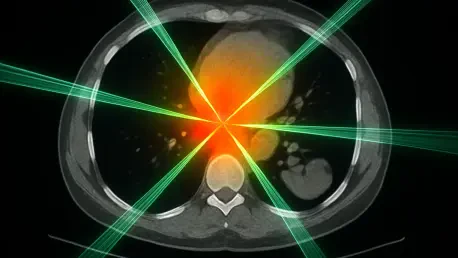
The remarkable efficiency of this deep learning system was evidenced by its ability to complete a high-resolution chest scan in less than one second, a feat that proved vital for acute care settings. This sub-second performance was essential when identifying tiny pulmonary nodules or evaluating complex interstitial lung diseases early in their progression, where motion artifacts often compromised data integrity. Experts noted that by aligning imaging performance with specific diagnostic tasks, the technology empowered radiologists to make more confident assessments at an accelerated pace. From 2026 to 2028, healthcare facilities prioritized the integration of such AI-driven reconstruction tools to alleviate staff burnout and optimize patient throughput. Facilities that adopted these advanced protocols successfully demonstrated a significant reduction in repeat scans and a measurable improvement in diagnostic reliability. These organizations recognized that refining neural networks ensured that high-quality, low-dose imaging became the universal standard for all computed tomography procedures regardless of clinical complexity.