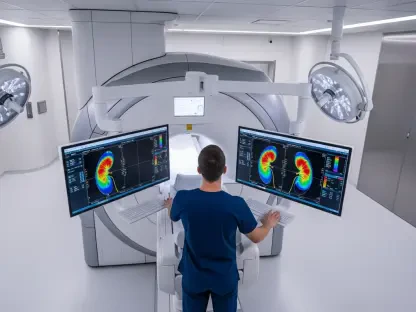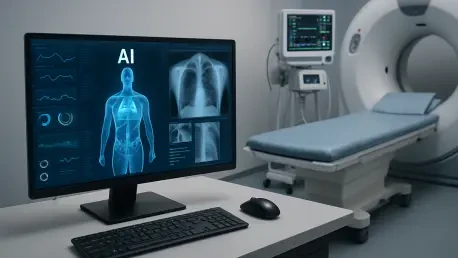

The modern hospital is facing an unprecedented data deluge, with over 20 million abdomen-pelvis CT scans performed each year in the United States alone, creating a significant and growing gap between the sheer volume of imaging exams and the finite capacity of skilled radiologists to interpret them. This mounting pressure on diagnostic departments has ignited a race to develop intelligent systems that can not only accelerate workflows but also enhance the accuracy of critical findings. In this high-stakes environment, a new generation of artificial intelligence is emerging, moving beyond narrow, single-task functions to embrace a more holistic and comprehensive approach to medical imaging analysis, promising a future where technology works more like a human expert. A Boston-based startup is at the forefront of this evolution, backed by significant new funding and groundbreaking regulatory clearance for a system designed to see the bigger picture.
A New Contender in a Crowded Field
A significant infusion of capital has positioned a2z Radiology AI, a startup founded in 2024, to challenge the established norms of medical imaging AI following the successful closure of a $4.5 million seed funding round. The investment, with participation from influential firms such as Khosla Ventures and SeaX Ventures, provides the company with the necessary resources to transition from development to deployment. The financing is strategically allocated to accelerate the commercial rollout of its flagship product, fuel continued research and development into more advanced diagnostic capabilities, and prepare for a full market launch anticipated in 2026. This financial endorsement serves as a powerful vote of confidence in the company’s vision and its potential to alleviate some of the most pressing challenges in modern radiology, signaling that the industry is ready for more sophisticated and integrated AI solutions that go beyond simple, isolated tasks and begin to address the complexity of a complete diagnostic workflow.
This funding milestone was closely preceded by a critical regulatory achievement that validates the company’s innovative direction and provides a clear path to market entry. The company secured formal FDA clearance for its a2z-Unified-Triage system, a landmark approval that sets it apart in a competitive landscape. The system is distinguished as the first of its kind in the United States with the ability to simultaneously screen for and triage seven different urgent medical conditions from a single abdomen-pelvis CT scan. This multi-condition capability represents a fundamental departure from the prevailing paradigm of single-purpose AI tools, which typically focus on identifying one specific abnormality at a time. By designing a system that can concurrently evaluate a range of potential issues, from appendicitis to aortic aneurysms, the technology offers a more comprehensive safety net for patients and a more efficient workflow for overburdened radiologists who need to assess entire studies, not just isolated findings.
Redefining the Role of AI in Diagnostics
The technological promise of the a2z-Unified-Triage system was substantiated with compelling clinical data presented at the recent RSNA 2025 conference, offering tangible proof of its real-world impact on radiologist performance. The results of a prospective study demonstrated that radiologists who incorporated the AI system into their preliminary report drafting process experienced significant gains across multiple key metrics. They reduced their average reporting time by a notable 17.8%, allowing for higher throughput without sacrificing quality. Furthermore, their diagnostic confidence saw an increase of 14.8%, while the measured mental demand required to complete their tasks dropped by an impressive 22.4%. Perhaps most importantly, these efficiency and workflow improvements were coupled with an enhanced ability to detect critical findings. This was accomplished without the common trade-off of an increased rate of false positives, addressing a major barrier to the widespread adoption of AI in clinical practice and proving that the system can augment, rather than simply accelerate, human expertise.
At the heart of a2z’s strategy is a deliberate move away from the fragmented, single-condition AI tools that have dominated the market thus far. The company’s core philosophy centers on building comprehensive systems that evaluate entire imaging studies holistically, a method designed to align closely with the intricate cognitive processes of a human radiologist. This approach directly confronts the limitations of narrow AI, which can miss incidental findings or fail to contextualize one abnormality in relation to others. Investor Vinod Khosla underscored this pivotal distinction, noting that while many competitors focus on solving single, isolated problems, a2z’s platform is engineered to evaluate a broad spectrum of conditions simultaneously, bringing artificial intelligence “closer to the comprehensive capabilities of a real-life radiologist.” This ambition to replicate the synoptic, all-encompassing view of a human expert represents a significant advancement in the field, aiming to transform AI from a simple flagging tool into a true diagnostic partner.
The Path Toward Broader Integration
The company’s recent successes with its abdomen-pelvis CT system marked not an endpoint, but a foundational step in a much broader and more ambitious long-term vision. The strategic roadmap involved expanding its comprehensive analysis technology from its initial application across other critical imaging modalities and anatomical regions. This forward-looking plan was built on the core principle that a holistic, multi-condition approach was not just beneficial for one area of the body but was a universally applicable model for improving diagnostic medicine. The ultimate goal was to create a suite of interconnected AI systems capable of delivering expert, radiologist-level interpretation on demand, making high-quality diagnostics more accessible, consistent, and efficient across the entire healthcare ecosystem. This strategic pivot from a single product to a scalable platform signified a commitment to fundamentally reshaping how medical images were interpreted in the future.