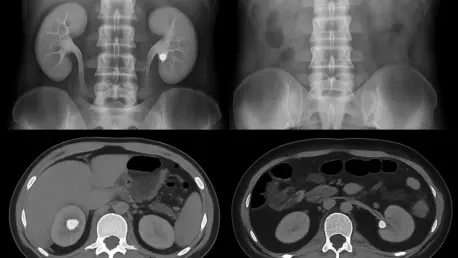

The intense, debilitating pain of a kidney stone often sends patients rushing to the emergency room, where the primary goal is a swift and accurate diagnosis to guide immediate treatment, but this urgent search for answers frequently involves a hidden, long-term risk. The go-to diagnostic tool, the computed tomography (CT) scan, delivers a dose of ionizing radiation that contributes to a patient’s cumulative lifetime exposure. While a single scan may seem inconsequential, medical imaging is now estimated to be a factor in tens of thousands of cancer cases annually in the United States, implicated in both blood malignancies and solid tumors. This issue is particularly pronounced for individuals suffering from kidney stones, a condition with an approximately 50% recurrence rate. This high likelihood of future episodes means many patients undergo repeated imaging over the years, systematically increasing their radiation burden. The dilemma for clinicians, especially in high-pressure emergency settings, is balancing the need for immediate diagnostic certainty against a potential health risk that may not become apparent for many years or even decades.
Evaluating a Safer Diagnostic Path
In response to these growing concerns, researchers at the Yale School of Medicine initiated a direct comparison between the established standard-dose CT scans and their low-dose counterparts to determine if patient safety could be improved without compromising diagnostic accuracy. A standard CT scan for suspected kidney stones typically exposes a patient to 10-12 millisieverts of radiation, a significant dose when accumulated over multiple procedures. The research revealed a pivotal finding: low-dose CT imaging demonstrated 100% sensitivity for detecting ureteral stones larger than five millimeters. This is a critical detail, as these larger stones are the ones most likely to cause severe obstruction and require surgical intervention. While the low-dose protocol did occasionally miss smaller stones, these are generally managed through observation and pain control rather than invasive procedures, making their immediate detection less critical. Furthermore, the study addressed concerns about overlooking other serious diagnoses, finding that the risk was minimal, at only 2-3%. In such rare cases, persistent or worsening symptoms would almost certainly prompt follow-up imaging, ensuring significant issues were not ultimately missed.
Redefining the Standard of Care
The compelling evidence from this research underscored that a fundamental shift in clinical practice was not only possible but essential for patient well-being. The investigation concluded that the primary obstacle to widespread adoption of safer imaging was not a limitation of technology but rather a need to enhance physician awareness and build comfort with low-dose protocols. In many clinical environments, particularly emergency departments, the default to standard-dose CT scans was driven by a desire for the most comprehensive images possible, prioritizing the immediate diagnostic question over the less tangible, long-term risk of radiation exposure. The research illuminated a clear path forward: making low-dose CT the default standard of care for suspected kidney stones could dramatically reduce unnecessary radiation exposure for a large patient population. This change represented a crucial evolution in medical imaging, one that successfully balanced the demand for high diagnostic accuracy with the paramount importance of long-term patient safety.