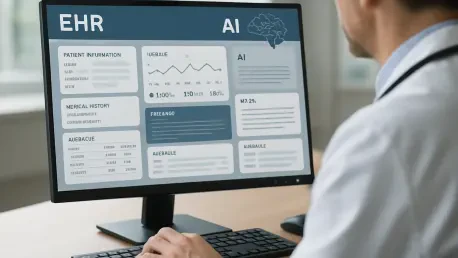

The modern clinical environment presents a significant paradox where physicians are surrounded by an unprecedented volume of data within the electronic health record, yet they often struggle to access the precise, evidence-based information needed at the moment of a critical decision. This deluge of information can lead to cognitive overload, administrative burnout, and potential delays in delivering optimal care. The challenge is not a lack of data but the inefficiency of retrieving and synthesizing it within the demanding workflows of patient encounters. Addressing this bottleneck has become a central focus for healthcare innovators, prompting a shift from simply digitizing records to creating intelligent systems that actively support clinical judgment. The integration of advanced artificial intelligence directly into the EHR is emerging as a promising solution, aiming to transform the digital chart from a passive repository into an active, intelligent partner for the clinician, capable of delivering curated, context-aware insights on demand.
A Strategic Shift Toward Intelligent Healthcare
Sutter Health is taking a significant step in this direction by embedding an artificial intelligence-powered clinical decision support platform from OpenEvidence directly into its Epic EHR infrastructure. This initiative is engineered to provide physicians with instantaneous access to the most current care guidelines, peer-reviewed clinical studies, and other vital evidence-based data at the point of care. By empowering clinicians to use natural language to query this vast repository of medical knowledge from within the patient’s chart, the system dramatically streamlines the search for critical information. This seamless integration is designed not only to save valuable time but also to enhance the quality and safety of patient care by ensuring that every clinical decision is informed by the latest and most relevant medical evidence. The goal is to move beyond static protocols and provide a dynamic resource that adapts to the unique complexities of each patient case, thereby supporting a higher standard of personalized medicine and improving overall health outcomes.
This integration represents a cornerstone of Sutter Health’s comprehensive digital innovation strategy, reflecting a deep commitment to building a more connected, proactive, and sustainable healthcare ecosystem. According to leadership, including Chief Digital Officer Laura Wilt and Chief AI Officer Dr. Ashley Beecy, the primary objective is to empower care teams with tools that make their work more efficient and effective. By embedding advanced AI into daily workflows, the organization aims to alleviate administrative burdens and allow clinicians to focus more on direct patient interaction and complex medical problem-solving. This initiative builds upon Sutter’s existing experience with generative AI, which it began using two years ago in a successful effort to mitigate clinician burnout. The move to integrate AI for clinical decision support is a logical and ambitious next step, aimed at transforming not just the provider experience but the very fabric of how the health system serves its communities, promising a future where technology and human expertise work in concert to deliver superior care.
The Synergy of Human and Machine Intelligence
The collaboration between health systems and AI vendors is indicative of a broader industry trend focused on leveraging advanced artificial intelligence to transcend the limitations of traditional clinical decision support (CDS) systems. A recent study conducted by researchers at Mass General Brigham sheds light on the nuances of this technological evolution. Their research compared the diagnostic accuracy of a long-standing, well-regarded CDS platform, DXplain, with that of large language models (LLMs) like GPT-4. While the established DXplain system ultimately demonstrated superior performance in diagnostic precision, the study’s most compelling finding was not about which system was better in isolation. Instead, the researchers highlighted the immense potential of a hybrid approach. This suggests that while LLMs possess remarkable capabilities in understanding and processing natural language, the structured, deterministic logic of traditional CDS platforms remains invaluable for clinical accuracy. The future, it seems, lies not in a wholesale replacement of one technology with another but in a thoughtful synthesis of their complementary strengths.
This concept of a hybrid model proposes a powerful synergy: combining the sophisticated linguistic capabilities of LLMs with the transparent and evidence-based reasoning of traditional CDS. LLMs excel at interpreting complex, unstructured clinical notes and patient queries, effectively acting as an intelligent interface that can understand context and nuance. Meanwhile, established CDS systems offer a deterministic foundation built on curated medical knowledge, providing reliable and explainable diagnostic suggestions. By integrating these two technologies, a new generation of decision support tools could emerge. These tools would allow a clinician to interact using natural language while receiving recommendations backed by the rigorous, verifiable logic of a traditional CDS. This fusion promises to create a system that is not only more intuitive and efficient to use but also more powerful and clinically effective, ultimately leading to a new standard in data-driven patient care that fully leverages the distinct advantages of different AI methodologies.
Charting a New Course for Clinical Practice
The integration of sophisticated AI directly into EHR workflows marked a pivotal moment in healthcare’s digital transformation. It represented a fundamental shift from viewing the EHR as a static digital filing cabinet to envisioning it as a dynamic and intelligent clinical co-pilot. The initiatives undertaken by forward-thinking organizations demonstrated that the true value of health information technology lay not just in data storage, but in its active synthesis and timely delivery at the point of care. The conversation moved beyond the simple replacement of legacy systems and focused on the synergistic potential of combining the linguistic fluency of large language models with the structured, evidence-based logic of traditional clinical decision support. This hybrid approach acknowledged the unique strengths of both human clinicians and artificial intelligence, establishing a framework where technology augmented, rather than replaced, clinical expertise, which ultimately set a new precedent for patient safety and care quality.