

Quest Diagnostics is currently working with law enforcement and forensic experts to determine the full extent of the stolen protected health information from the Quanum platform. This formal acknowledgment comes after security teams identified unauthorized activity within the cloud-based

Medical researchers at the University of Vienna are investigating whether dual-modality imaging can accurately identify which patients with elevated PSA levels truly require a biopsy. For decades, the standard protocol for suspected prostate cancer has relied heavily on the Prostate-Specific

A single vial of blood drawn during a standard physical examination may now possess the revolutionary capability to expose dozens of hidden malignancies before a patient ever experiences a single symptom. For decades, the medical community sought a universal diagnostic tool that could peer into the

The digital heartbeat of modern medicine now pulses through a complex network of interconnected devices that, while life-saving, remains increasingly susceptible to the sophisticated tools of global cybercriminals. As 2026 experiences a sharp rise in targeted incursions, the priority for healthcare

Privacy controls such as physical shutters and software-defined privacy zones are essential features for maintaining a respectful and non-intrusive monitoring setup. As the global population continues to age into 2026, the strategic implementation of elderly monitoring systems has transformed from

Athletes and biohackers often prefer the Whoop interface because it offers high-frequency heart rate sampling and deep dives into specific strain and recovery scores. This preference has defined a clear divide in the wearable market as of early 2026, where the demand for data-rich, screenless

Governor Patrick Morrisey signed House Bill 4965 into law to eliminate the administrative cycles that frequently delay critical medical care for state employees. This legislative intervention arrived as a necessary correction to a system that often prioritized bureaucratic checklists over the

Every yuan invested in TCM robotics research is intended to translate abstract medical experience into standardized and visualized information for clinical support. At the 2026 Krypton Global Sustainable Leaders Summit, the discussion on this transformation reached a new peak with the unveiling of

Security researchers have found that combining blockchain with encryption can extend model training latency to nearly eighteen seconds per round. This discovery arrives at a pivotal moment as the Internet of Medical Things (IoMT) solidifies its role as the backbone of modern clinical environments.
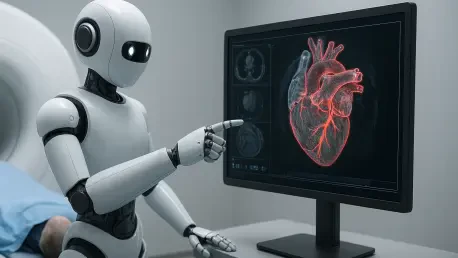
A study of 10,000 hospital records revealed that diagnostic accuracy often collapses when medical AI is exposed to the unique image characteristics of the ORIZURU robotic platform. This phenomenon, frequently described as domain shift, occurs when an algorithm trained in a specific, controlled
1 2 3 4 5 6 7 8 9 10 11 12 13 14 15 16 17 18 19 20 21 22 23 24 25 26 27 28 29 30 31 32 33 34 35 36 37 38 39 40 41 42 43 44 45 46 47 48 49 50 51 52 53 54 55 56 57 58 59 60 61 62 63 64 65 66 67 68 69 70 71


